logo mobile sidebar
support-image-mobile
Share your ideas with our local expert team - we’re here to listen and help you shape a meaningful journey through Indochina.
(+84) 868 663 993
Asia Leading Tour Operator 2025
tripadvisor travelers choice awards 2024
Travelers' Choice Awards 2025

Author: Content

Tham Ma Pass: Conquer Ha Giang’s Iconic Winding Pass

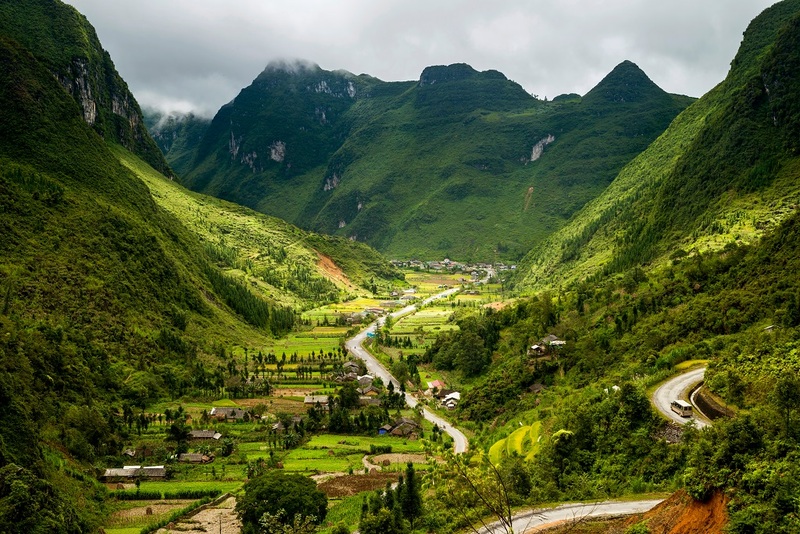
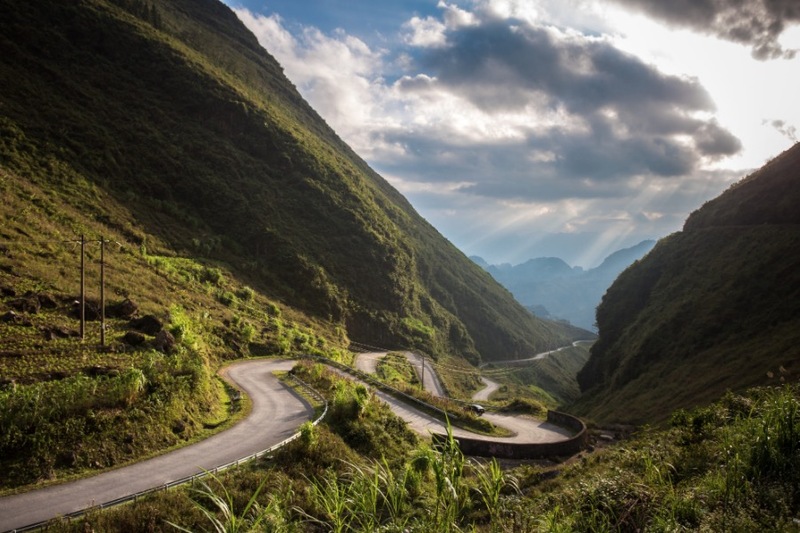
Tham Ma Pass is a well-known meandering mountain pass on the journey from Ha Giang to Dong Van and is characterized by limestone landscapes with severe curves. It is a common destination for adventurers seeking to explore Northern Vietnam.

Introduction To Tham Ma Pass

Tham Ma Pass is an iconic and breathtaking mountain pass in Ha Giang, Vietnam. It is situated on the bendy road that connects Yen Minh Town to Pho Cao Commune. The view along this picturesque stretch of road lies on the route to Dong Van. This mountain pass connects two of the most famous places on the Dong Van Karst Plateau.

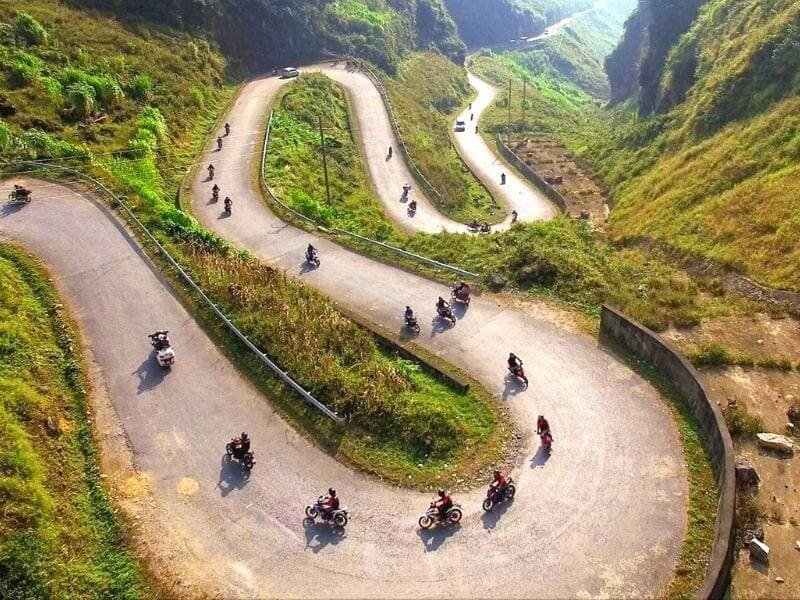
Tham Ma has many tight hairpin turns that hug steep cliffs. This route will surely provide you’re in for a thrill, a fun drive. You can appreciate the views of the rugged mountains and steep valleys below. This was one of the highlights of our trip along the legendary Happiness Road. With proper planning, we felt we not only tackled the mountain pass of Tham Ma but also enjoyed other highlights of Ha Giang.
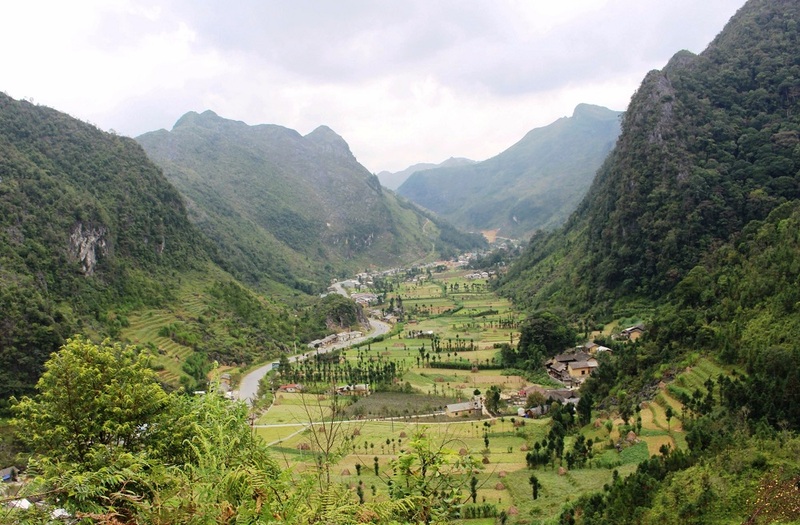
Tham Ma Slope 1

History Of Tham Ma Pass

Tham Ma Pass is known for its beautiful curves, but it has a legend behind its name. In the day, local inhabitants would take horses up this steep mountain pass to test their strength. The horses would have pack loads and be led up the pass, and only horses that made it to the top and continued (without dying of exhaustion) were considered strong horses. The weaker horses would either be returned or retired from service.

So, the pass went from being used to test the endurance of an animal to checking a person’s endurance. Locals say that couples who can ascend Tham Ma together will stay strong through other challenges of life, so it makes for a romantic and meaningful stop along the way in Ha Giang.

Unique Architecture Of Tham Ma Pass

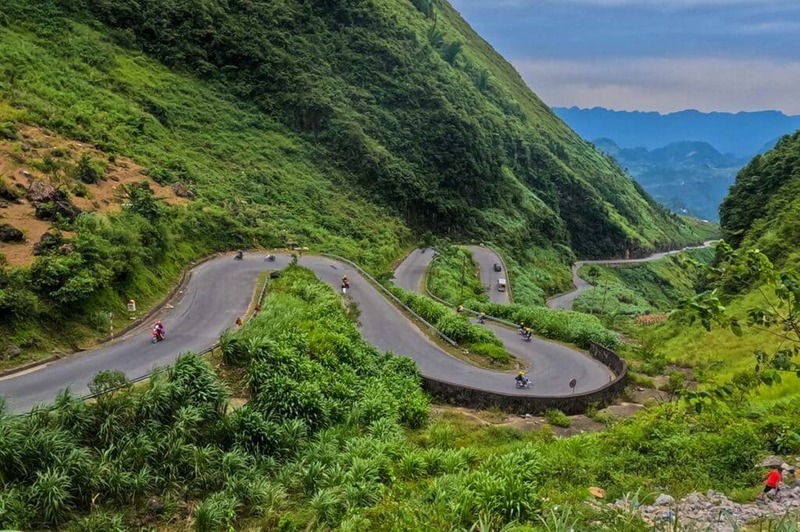
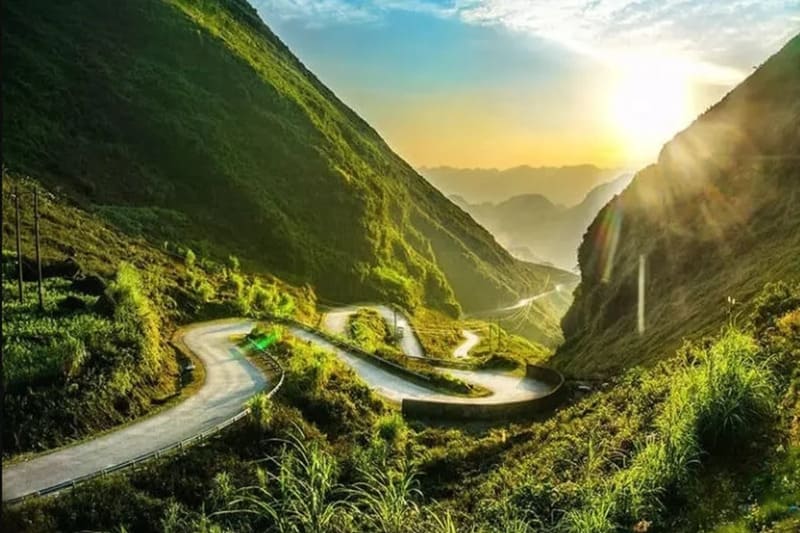
Tham Ma Pass is located on National Highway 4C in Ha Giang and is known for its S-shaped passes that look like a silk ribbon draped on the mountain. This unique and iconic winding mountain pass extends around 5 kilometers, with an elevation of about 1,500 meters above sea level. It connects Van Chai and Lung Thau communes in Dong Van District. It is characterized as unique because of its 9 sharp winding bends that test even the skill of seasoned riders.

Conquering Tham Ma may not be a simple task; it will challenge the experienced traveler on Vietnam’s hilly/mountainous roads and certainly will be an exhilarating experience for the first-time visitor. However, the rider conquering the serpentine Tham Ma will also be rewarded with magnificent and breathtaking views and further beautiful and impressive sites among the Dong Van Karst Plateau.

From Tham Ma, there are many immediate choices to continue one’s tour of the nearby area, including Pho Cao, the old town of Dong Van, the Hmong King’s Palace (Dinh Vua Meo), Sung La Valley, Lung Cu Flagpole, and the northernmost point in Vietnam.

4 Cultural Experiences You Shouldn’t Miss

Tham Ma Pass is more than just an exciting winding road with beautiful scenery, as it brings you to some culturally rich and stunningly beautiful areas in Ha Giang. Below, we share some of the greatest highlights to check out along your journey.

Experience The Untamed Beauty Of Quan Ba

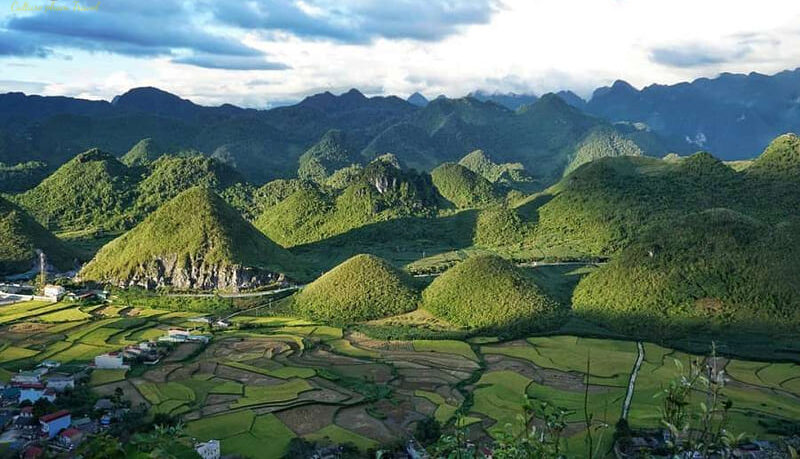
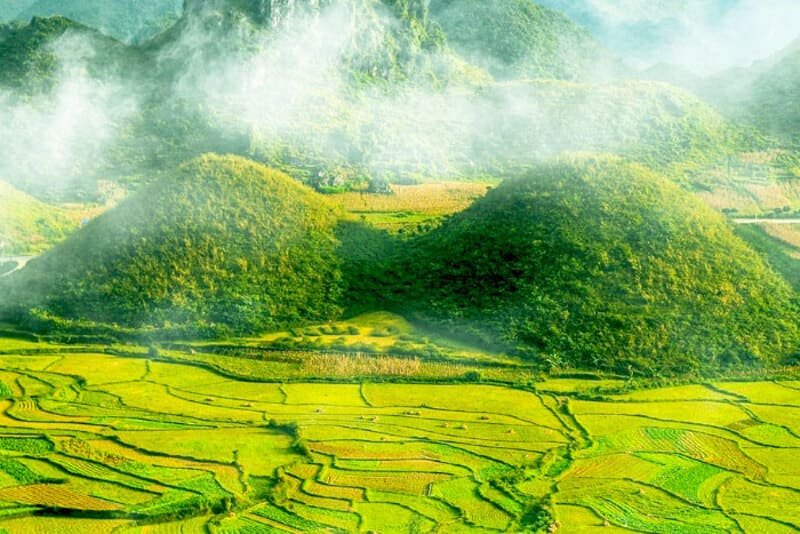
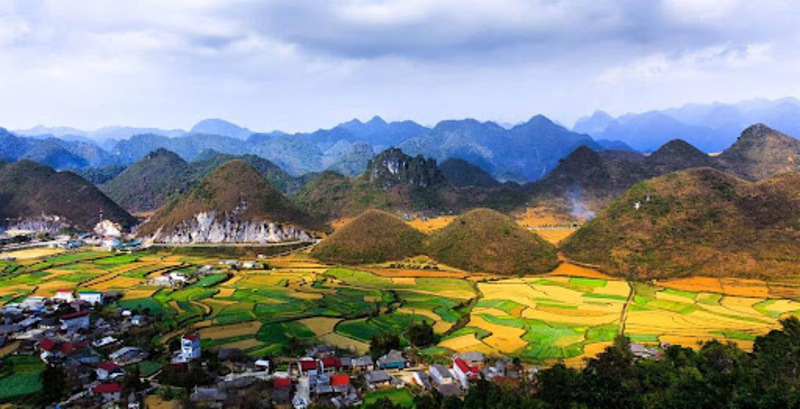
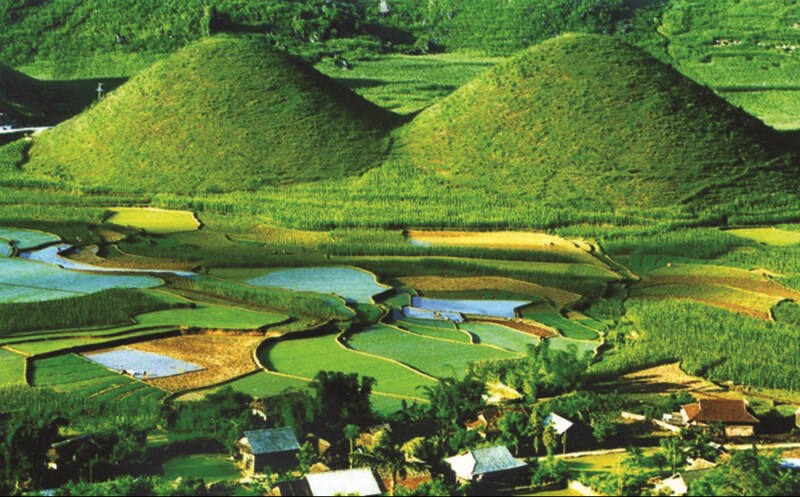
Just before you reach the Tham Ma Pass is Quan Ba, a must-see stop where beautiful nature and culture come together. See the iconic Quan Ba Heaven Gate at 1,500 meters above sea level, which provides marvellous views of the entire Tam Son Valley. Don’t forget to check out the mystical Fairy Twin Mountains, two round hills that are shrouded in local legend.

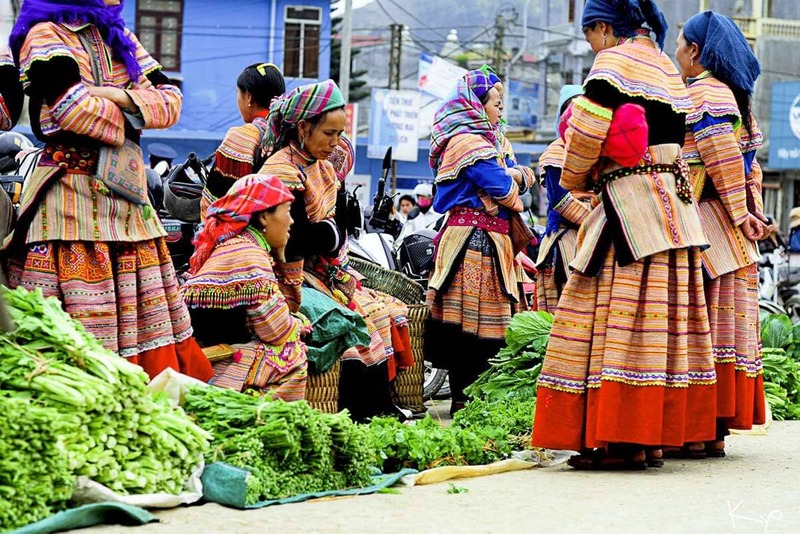
You can also visit the Quyet Tien Market to purchase handmade ethnic textiles, try some local food, or simply wander around and enjoy the peacefulness of the area, and the hospitality from the Dao and H’mong ethnic communities gives you an added appreciation of life in the highlands.
Tham Ma Slope 3

Uncover the Tranquility of Yen Minh

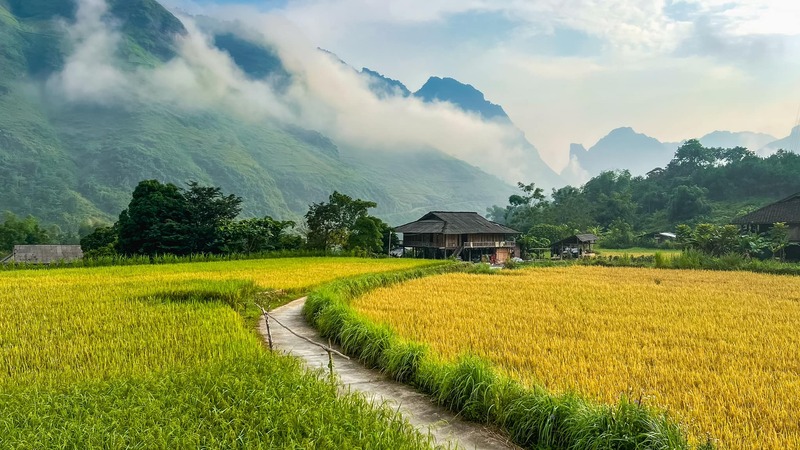
Yen Minh is often referred to as the “second Da Lat of the North” for its pleasant climate and pine forests. This highland town is located between Quan Ba and Dong Van and makes for a great stopover where one can relax. Stroll along the tranquil streets under the canopy of trees, or wander into a nearby rural village.

There are many choices, including the unique Du Gia Village, famous for its road less travelled, smiling inhabitants, and jaw-dropping terraced fields. Whether you sit sipping tea while gazing out at the hills, or hike to the hills themselves, Yen Minh gives the ultimate fix of tranquillity while moving through the highlands.
Tham Ma Slope 4

Discover The Beauty Of The Dong Van Karst Plateau

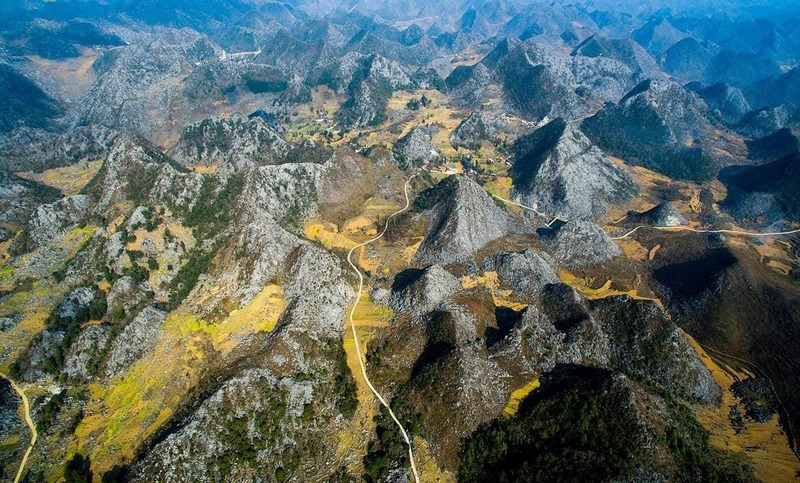
As soon as you pass the Tham Ma Pass, you will enter the Dong Van Karst Plateau Global Geopark, which is regarded by UNESCO (and many geological wonders and cultural heritages) as a great feature. Your adventure begins in Pho Cao Village, where interesting old H’mong villagers’ houses with stone fences and earthen boundaries can be found. Then, continue to the beautiful Sung La Valley filled with flowers.

Next travels on to the Ma Pi Leng Pass the legendary views to the Nho Que River. You may also want to check out the Hmong King Palace (Dinh Vua Meo), Pho Bang Old Town, and the Lung Cu Flagpole (Vietnam’s northernmost point). Each site mentioned has its own story, and the journey evokes a historical and culturally soulful experience.
Things to Do in Ha Giang 4

Experience The Local Tastes Of Ha Giang

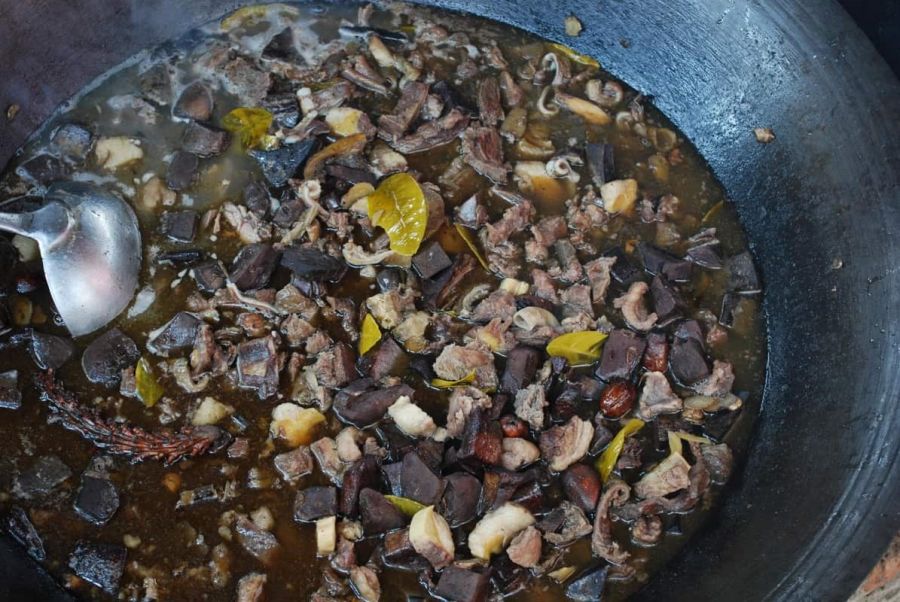
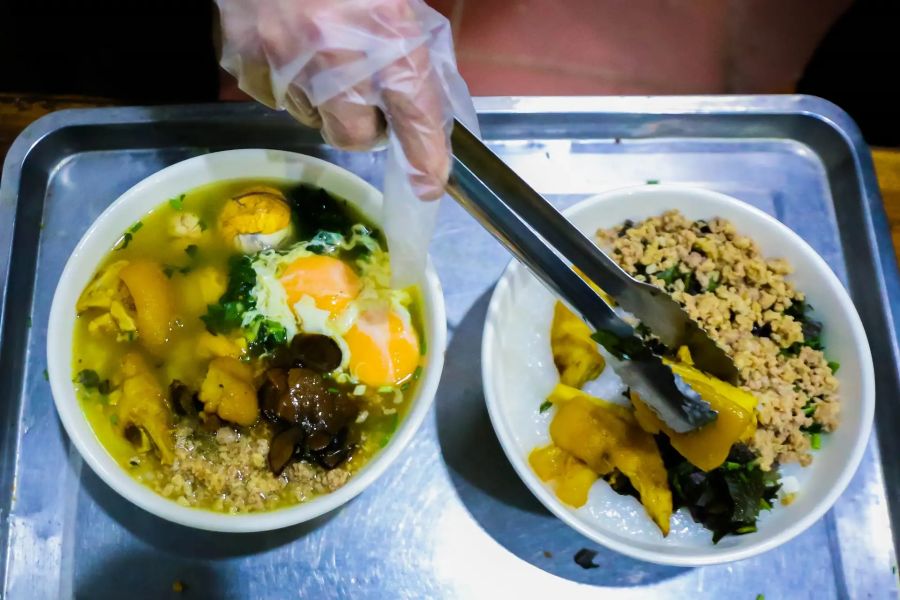
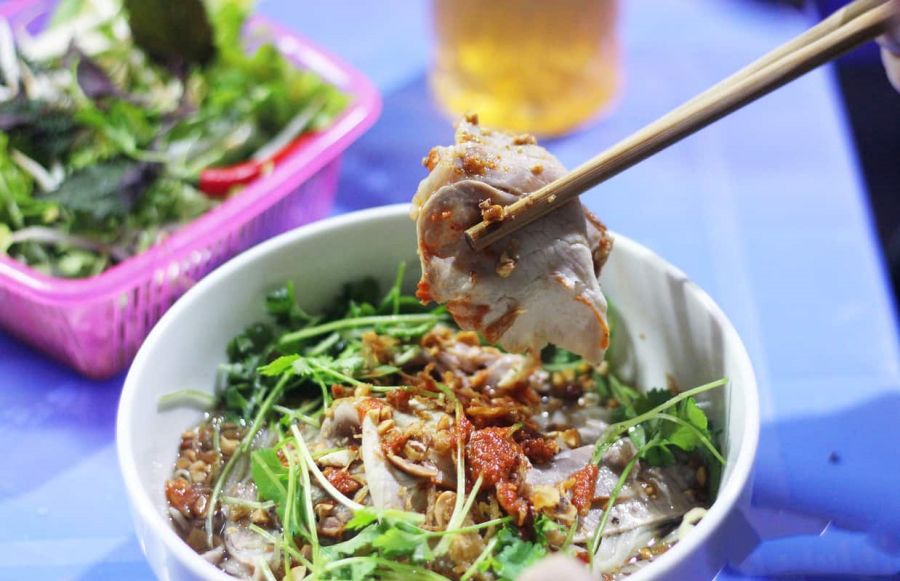
No expedition in Tham Ma would be complete without enjoying the local flavors. One must-have is pho Trang Kim, which is a chicken noodle soup served at Quyet Tien Market with a sweet, light broth and, for each serving, very beautiful noodles that will forever be in your heart.

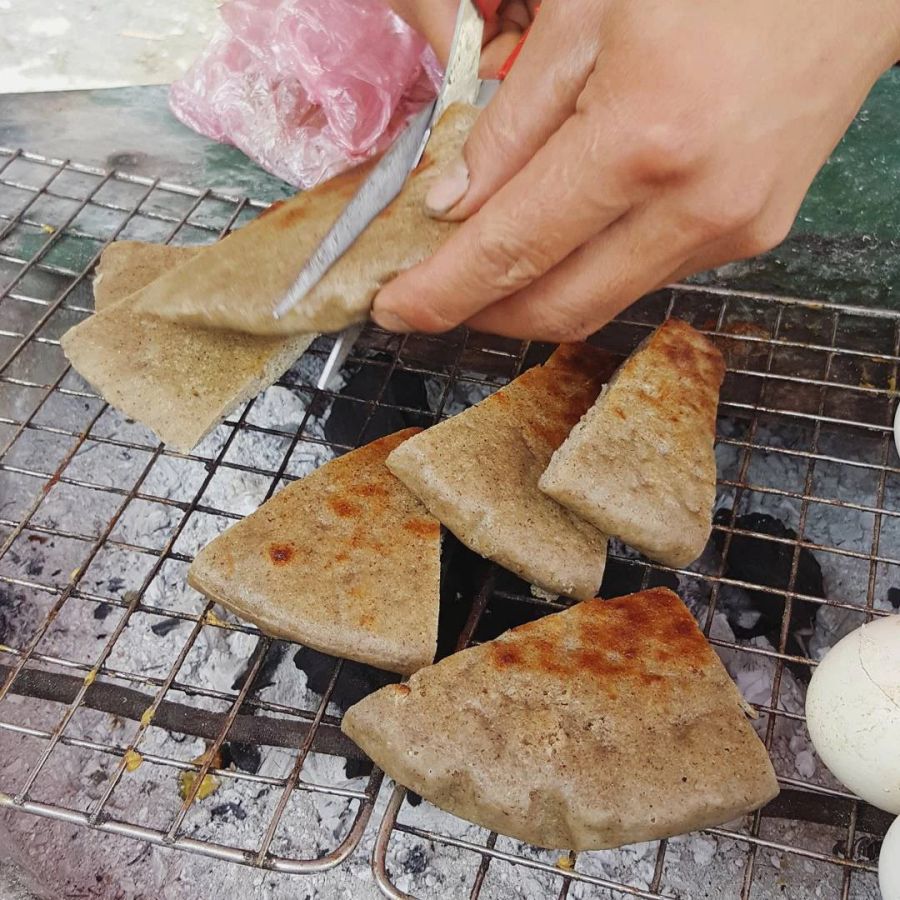
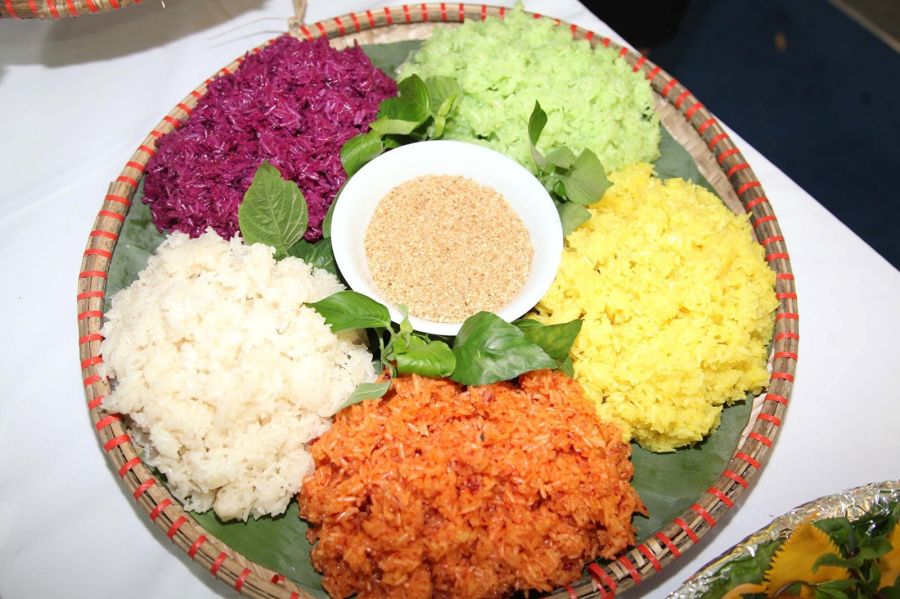
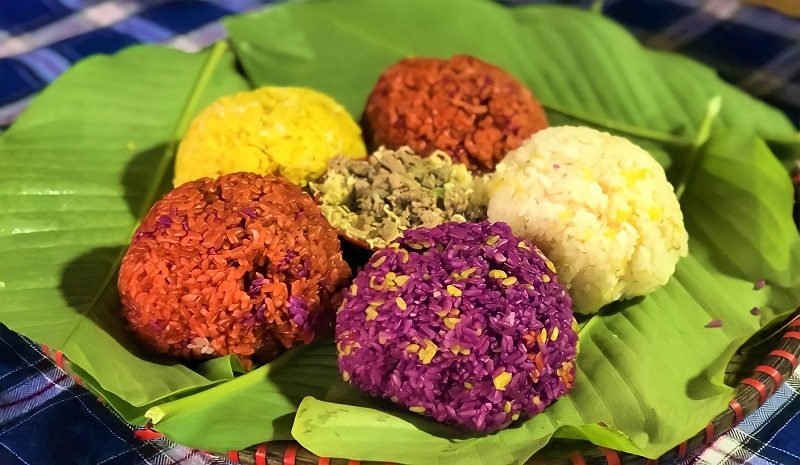
There are also signature dishes like Thang Co, a horse-meat stew, grilled pork flavored with mac khen spice, infused sticky rice colored by dyes from natural plants, cháo ấu tẩu, or canna plant medicinal porridge, and deep-fried buckwheat cake. These highland dishes, made up of local foods, will basically blow your taste buds. Each dish has all of the home-cooking warmth from ethnic home cooking, and it provided us with a yearning for more.
Tham Ma Slope 5

Entrance Fee

Currently, visiting Tham Ma Pass is entirely free. Tham Ma Pass is on the public route of National Highway 4C. It is a main route to connect towns in Ha Giang. You can stop for free, take pictures, and admire the beautiful curves of the iconic mountain pass, which is free to appreciate.

However, if you plan to go to other attractions in Ha Giang, then the other iconic attractions like the Lung Cu Flag Tower, Vuong Family’s Palace (King Meo’s Mansion), Dong Van Old Quarter, Lung Khuy Cave, etc., will require an entrance fee. Entrance fees generally range from 10,000 VND to 50,000 VND per person, depending on the attraction and time of day.

Best Time to Visit Tham Ma Pass

Every season, Tham Ma Pass becomes a stunning masterpiece of nature, showcasing different waves for travelers every season.

If you visit during September to early October, you can see the golden beauty of the harvesting rice fields of the terraced rice fields; it’s an incredible experience, and the vista is breathtaking as it blankets the beautiful mountains.

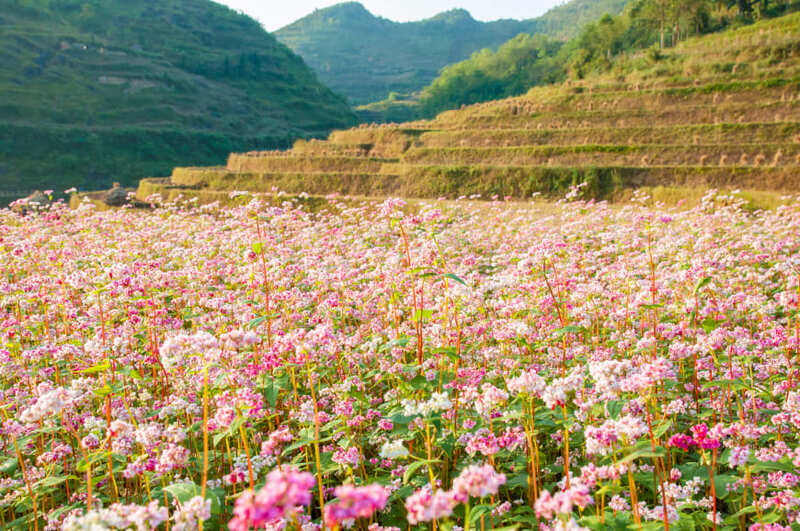
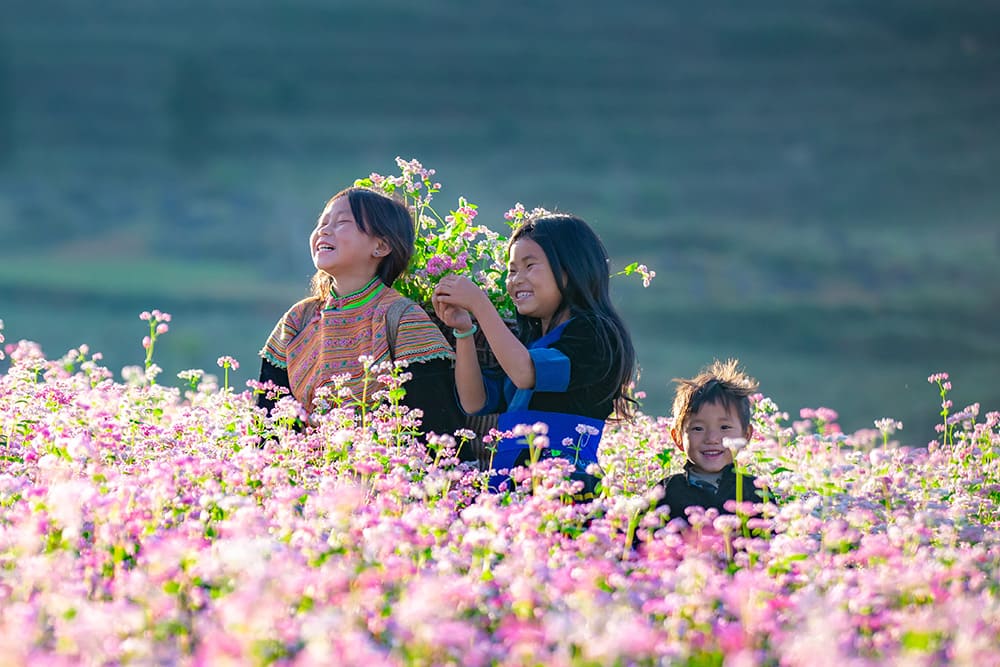
From late October to November, the hillsides are drenched with dreamy pink, white, and purple colors when the buckwheat flowers cover everything, creating a beautiful, romantic scene for the highlands. By November and December, beautiful, bright yellow mustard flowers pop and can warm you in the chilly mountainous areas.

By making the most out of the experience and enjoying your trip, you also want to ensure your safety. Make sure you check the weather forecast before your trip. Keeping an eye on the forecast to avoid falling rain will save you from slipping on leaves scattered everywhere, particularly if you’re on a motorbike.
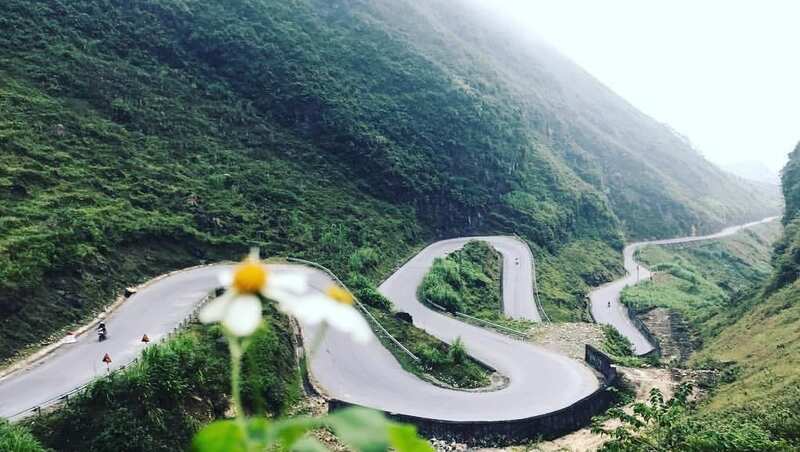
Tham Ma Slope 2

How to Get to Tham Ma Pass

To reach Tham Ma Pass, travelers first need to get to Ha Giang City. From there, the most recommended way to explore is by renting a motorbike, as it allows for flexibility and a more immersive travel experience. Follow National Highway 4C, which takes you through Quan Ba and Yen Minh on the way to Dong Van. Tham Ma Pass lies right on this iconic route, perfect for those aiming to conquer the Dong Van Karst Plateau.

Things to Know Before Traveling to Tham Ma Pass

Before you embark on the exciting turns of the Tham Ma Pass, you’ll want to be prepared for the road conditions, as well as the weather, so here are a few travel tips to make sure your adventure is fun, safe, and memorable:

  • Take a good look over your motorbike before setting off for your trip, and pay extra attention to the brakes, tires, and lights since this pass can be steep and has a lot of sharp bends.
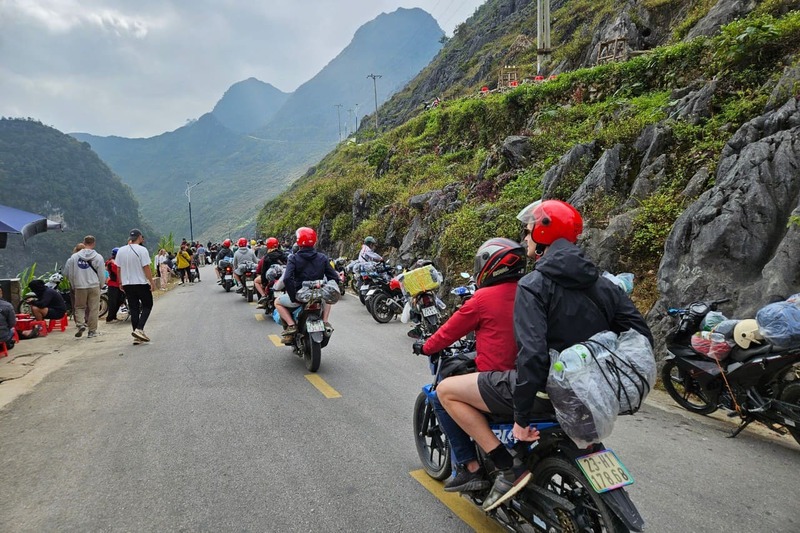
  • These passes are not meant for inexperienced riders with uncertain sit-on ability. These very slippery conditions will require excellent bike control, particularly when you are going downhill.
  • Try and avoid riding in the rainy season (June–August) or during rainy weather, as it can make the roads very slippery, not to mention being in the fog with no visibility.
  • You will also want to fill up with gas before you leave Ha Giang City, as there are very few gas stations on this route. Running out of gas up on a mountain pass is not something to plan on doing!
  • Bring essentials, including good quality helmets, gloves, sunglasses, sunscreen, water, a light jacket, and also bring a raincoat, as the weather can change quite rapidly in the mountains.
  • As always, reviewing maps and explaining your route before your trip is a good idea so you know where you’re headed, or if possible, download the maps for offline use since signal may not be available in some areas.

FAQs About Tham Ma Pass

Are you planning your first trip to Tham Ma Pass? To help you prepare for an exciting and, most importantly, safe journey, we have compiled the most frequently asked questions about Tham Ma Pass:

Why is it called Tham Ma Pass?

The story goes that Tham Ma was the location for the test of the horse’s strength as they made their journey carrying supplies up the steep pass.

Where is Tham Ma Pass?

Tham Ma Pass is located along National Highway 4C between Yen Minh and Pho Cao in Ha Giang Province.

Is it safe to drive through Tham Ma Pass?

Yes, the road is dangerous because it is steep and has many sharp bends, but as long as you have the driving skills to ride a motorbike, you should be safe navigating the road.

Is there an entrance fee to visit Tham Ma Pass?

There is no entrance fee because Tham Ma Pass is a public trail visible from the public road.

What should I take when I visit Tham Ma Pass?

Take your protective gear, water, your snacks, a full gas tank, and check the weather before you take off!

Final Thoughts: Is Tham Ma Pass Worth Visiting?

Definitely! Tham Ma Pass provides the best of adventure and breathtaking mountains, while allowing you to experience the rugged and beautiful landscape of Northern Vietnam. Ascending a motorbike, or on four wheels, the curving pass will deliver great memories and experiences. Are you ready to ride on the majestic roads of Ha Giang? Seni World will help you plan the trip of a lifetime!

Get Lost in Heaven: Visit Quan Ba Heaven Gate in Ha Giang

Located at 1500 meters above sea level in Ha Giang, Quan Ba Heaven Gate is the entrance to the Dong Van Karst Plateau. The views, mountains, and changing landscape are breathtaking and are a spectacular beginning to any adventure in northern Vietnam.

Introduction To Quan Ba Heaven Gate

Quan Ba Heaven Gate (Cong Troi Quan Ba) is a fantastic mountain pass located at a height of 1,500 meters in Quan Ba District, Ha Giang Province. Often known as the first “gate” to the Dong Van Karst Plateau Global Geopark, this iconic gateway symbolizes the start of the legendary Happiness Road.

The gate rests between two gigantic limestone mountains, and the gate opens to jaw-dropping views of lush valleys, winding roads, and the towering mountain ranges of northern Vietnam. Breathtaking scenery, coupled with cool mountain air, makes it a popular stop for nature lovers, photographers, and adventurous travelers alike looking to enjoy a unique experience in Ha Giang.

Quan Ba Gate 5

History Of Quan Ba Heaven Gate

As locals would tell you, the lands west of Quan Ba Heaven Gate were once part of a H’Mong kingdom which spanned west across what are today’s districts of Quan Ba, Meo Vac, Dong Van, and Yen Minh in the province of Ha Giang.

During French colonization in 1939, the French built a large wooden gate in that spot for the regulation of passage onto the Dong Van Karst Plateau, which established the symbolic and real boundary between lowlands and highlands, predominantly occupied by ethnic minorities. The gate is no longer there, but there is now bilingual signage in Vietnamese and English, showing travelers the way into more of the wilderness north of Ha Giang.

Unique Architecture Of Quan Ba Heaven Gate

Quan Ba Heaven Gate is more than just a viewing point; it is a mountain pass forming a natural gap between two high limestone mountains at an elevation of about 1,500 meters above sea level. It is a narrow mountain gap that then becomes the gateway to the area known as the Dong Van Karst Plateau and also signifies a change in both height and scenery.

Heaven Gate is located in Quan Ba District, about 43 kilometers north of Ha Giang City in northern Vietnam. An important stop along the Happiness Road, which is a feat of engineering created to traverse the mountainous area of northern Vietnam. Heaven Gate is considered a natural arch (cleft) that is wide enough to allow for a single roadway through. While it is both strategically and symbolically important, it provides visitors with a stunning perspective of the Tam Son Valley with its beautiful rice terraces, the symbol of Quan Ba’s Twin Mountains, and the ridges of limestone beyond.

Quan Ba Gate 2 e1755662196637

3 Cultural Experiences You Shouldn’t Miss

Quan Ba Heaven Gate is not only a picturesque stop, but also a destination where nature, myths, and local life are intertwined. Make sure to take your time to appreciate the amazing cultural highlights if you’re traveling through the stunning gateway to the Dong Van Karst Plateau.

Admire The Stunning View From The Heaven Gate

Quan Ba Heaven Gate is located at 1,500 meters above sea level, where you can take in stunning views. The surreal experience includes standing at the peak while cool mountain breezes continue to blow the clouds below your feet. As you gaze across the enormous Tam Son valley, you will find distinct golden rice fields, beautiful winding roads, and quaint villages hidden among the mountains. One of the best experiences here is the sunrise or sunset at this height; the valley glows in a soft shade of gold. It is one of those shots where the air is fresh, the silence is profound, and every glance is a postcard shot!

Quan Ba Gate 3

Marvel At The Legendary Twin Mountains (Fairy Mountains)

Just underneath the Heaven Gate lies a site that is among Ha Giang’s most beloved natural sights, Nui Doi Co Tien (Twin Fairy Mountains). Twin hills that perfectly matched, standing next to each other like twin sisters, were round hills called “the breasts of the fairy who fell down to earth”. According to legend, the fairy fell in love with a human and had a baby. When she returned to the sky, she left behind the mountains for her baby to drink from.

Leaving aside the myth, the sight itself is dazzling, especially early in the morning when the clouds cling to the hills and the scenery takes on a surreal, dream-like quality; it is a magnificent area to take some pictures and take stock.

Quan Ba Gate 1

Visit Nearby Nature Spots

Quan Ba Heaven Gate is a great place to base your exploration of several nearby, lesser-known natural wonders. One of which is Thạch Sơn Thần, a fairly mysterious stone formation that is said it guard the mountains. This is located in Dong Van Karst Plateau Geopark – a UNESCO-designated site of ancient limestone cliffs, basins, and deep valleys.

Another very interesting site in the area is Lung Khuy Cave, touted as the most beautiful cave in Ha Giang. Lung Khuy Cave was only recently discovered in 2015, and offers stunningly beautiful stalactites and a mystical ambiance that will make you feel like you have entered a crystal palace.

Quan Ba Gate 4

For a peaceful, poetic view, you might want to consider visiting the Lonely Tree. This unique little highlight has only one tree standing proud and resilient on a rocky ridge. It might seem simple, but this compelling image has evoked lovely stories from the minds of numerous travelers.

Entrance Fee

Quan Ba Heaven Gate has no entrance fee; you don’t need a ticket to be able to enjoy this stunning mountain pass. You can just roam around and enjoy the mountain scenery for free! Some attractions near the Heaven Gate, like local caves or culture sites, sometimes charge a small fee, typically 10.000-15.000 VND, for an entrance to visit.
Best Time To Visit Quan Ba Heaven Gate

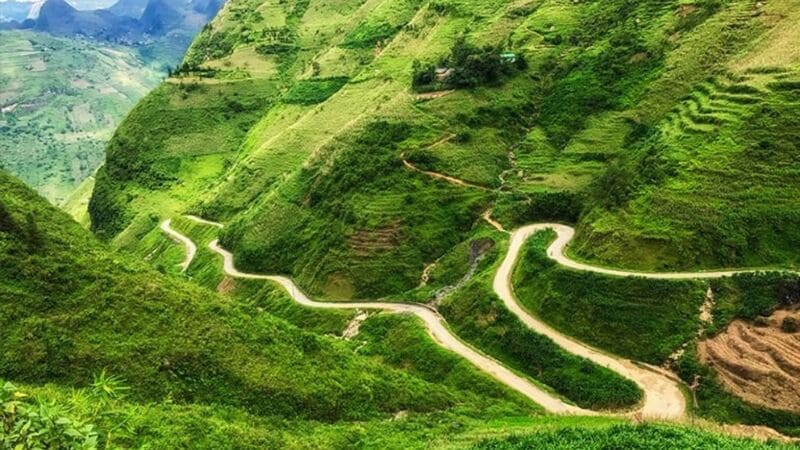
The winding and bumpy road to Quan Ba Heaven Gate is very steep, so it’s best to visit during periods of dry, clear weather. The best time to visit this scenic spot is between August and September, when the skies are clearer, golden sunlight reaches the mountains above, and the rice fields below begin to ripen. there’s so much warmth and color throughout the whole valley.
If you love the classic flowers of Ha Giang, October to December is the season to see the buckwheat flowers bloom. The hillsides and valleys of delicate flowers surround you in gentle colors from soft white to pink to fuller magenta.

May to June is the water season; that is when the terraced rice fields begin to furnish water. From Heaven Gate, you will see the rice paddies shimmering and reflecting the clouds of the sky. What a magical view!
Traveling should not happen from June to late July, because this is the rainy season in Ha Giang. Heavy rain and thick fog can create slippery roads and complicate travel with limited visibility.

How to Get to Quan Ba Heaven Gate

The Quan Ba Heaven Gate is located on National Highway 4C, approximately 3 km from Tam Son Town and around 43 km north of Ha Giang City. To get there, you must leave the main street of Ha Giang city center toward the 0 km milestone, then head out on National Highway 4C. Take the scenic route past Bac Sum Pass and through Quyet Tien Commune until you reach Quan Ba District. Quan Ba Heaven Gate is located at the beginning of the famous Happiness Road.

Because the road to the gate meanders through steep cliffs and deep valleys, a motorbike is the best mode of transport, as it is flexible and suitable for this type of transport and geographical location. You can rent a motorbike in Ha Giang for around 180,000 VND for the day.

For those less confident on two wheels, travel buses and private cars utilizing the similar route (but likely a little slower and less flexible on the narrow mountain route) can be alternative means of transport!

Means of transportation Price Duration
Motorbike Rental 180,000 VND/day 1.5 – 2 hours
Bus (Ha Giang–Tam Son) 80,000 – 120,000 VND 2.5 – 3 hours

Things to Know Before Traveling to Quan Ba Heaven Gate

When visiting Quan Ba Heaven Gate, it’s critical to think ahead, plan, and make sure you come prepared, especially since you are driving on mountain roads at a high elevation. Proper timing, clothing, and essentials will make the trip safer and enjoyable.

  • Check the weather report beforehand, especially in the rainy season, as poor visibility and slippery roads make it unsafe to drive on.
  • Try to visit on a clear sun-shining day during mid-morning to noon, as this is when fog starts to rise, and you will have the best views of the mountains.
  • Wear the proper footwear – hiking boots and sneakers should work, but avoid high heels on steep, uneven places.
  • Bring a warm jacket or thermals because it may be chilly at an elevation of 1,500 meters above sea level, even during the day.
  • Bring light snacks and drinking water with you while you’re exploring, as there will be limited options for food and beverages along the way.

FAQs About Quan Ba Heaven Gate

Are you planning your visit to Quan Ba Heaven Gate? Here are some frequently asked questions to help prepare for your journey:

What is the reason for the name Quan Ba Heaven Gate?

“Heaven’s Gate” refers to its location between two high, towering mountain tops at 1,500 meters above sea level. It resembles a gateway to the skies and is the initial stop on the road to the Dong Van Karst plateau.

Is it necessary to pay an entrance fee when visiting Quan Ba Heaven Gate?

No, there are no entrance fees to access Quan Ba Heaven Gate. However, some other tourist attractions nearby may charge a small fee of money, usually 10,000-50,000VND.

What is the best time to visit Quan Ba Heaven Gate?

August to October is the best time with clear skies and golden rice fields. You will want to avoid the rainy season (June–July), which may include slippery and foggy roads.

How do I get to Quan Ba Heaven Gate?

From Ha Giang City, take highway 4C north. You will make your way through Bac Sum Pass. The gate is around 43 km away and 3 km from Tam Son Town. The most convenient form of transport is a motorbike, as the roads have many winding bends through the mountains.

What should I pack for my trip to Quan Ba Heaven Gate?

You should bring warm clothing, particularly if you plan to go from late fall to early spring. Take hiking shoes or sturdy sneakers. Bring water, light snacks, and a camera to capture the beautiful scenery!

Final Thoughts: Is Quan Ba Heaven Gate Worth Visiting?

Anyone who travels to Ha Giang should not miss Quan Ba Heaven Gate. At 1,500 kilometers high, this beautiful place provides a breathtaking view of Tam Son Valley and the splendid Twin Mountains. Quan Ba Heaven Gate is the entrance to the Dong Van Karst Plateau. It is a great destination for people who love nature, gorgeous views, and taking pictures, as well as people who would like to learn about the diverse cultures of the different ethnic peoples through a Vietnam trip. Let Seni World show you the breathtaking views of northern Vietnam!

Hoang Su Phi Travel Guide for Nature Lovers

Hoang Su Phi is a mountainous district in western Hà Giang, known for its stunning terraced rice fields, a wide array of ethnic cultures, and calming landscapes. This secret treasure is a unique mix of natural beauty and traditional highland culture.

Introduction To Hoang Su Phi

Located in the western highlands of Ha Giang, Hoang Su Phi is an awesome place to visit with some fine terraced rice fields, interesting ethnic culture, and rugged mountain scenery. Hoang Su Phi is home to 12 ethnic minority groups, including the Hmong, Dao, La Chi, and Nung. So visitors will get ++++to experience some breathtaking views together with a great cultural experience. The rolling rivers, foggy hills, and serene villages paint beautiful surroundings for travelers looking for beauty, real culture, and a break from the throngs of tourists.

Hoang Su Phi 1

History Of Hoang Su Phi

Hoang Su Phi’s historical development is mainly associated with local ethnic minorities’ lives and traditions, especially its typical terraced rice fields, which are generally recognized by locals as dating to 200–300 years. Historically, Hoang Su Phi was initially and previously part of the Binh Nguyen District of Tuyen Quang Province. Hoang Su Phi was first formally identified as the Vi Xuyen District of Tuong Yen Prefecture in the context of the Later Le Dynasty.

In 1835, the Nguyen Dynasty restructured the geographic area, differentiating east of the Lo River as Vinh Tuy District (changed to Bac Quang District), leaving Vis Xuyen District with the rest of the land on the west side of the Lo River. Therefore, Hoang Su Phi was established as one subdivision. It took until 1991 before Hoang Su Phi was formally established as a district of Ha Giang Province, defining Hoang Su Phi as an administrative identity and as a cultural identity in northern Vietnam, or an identifiable identity.

Unique Architecture Of Hoang Su Phi

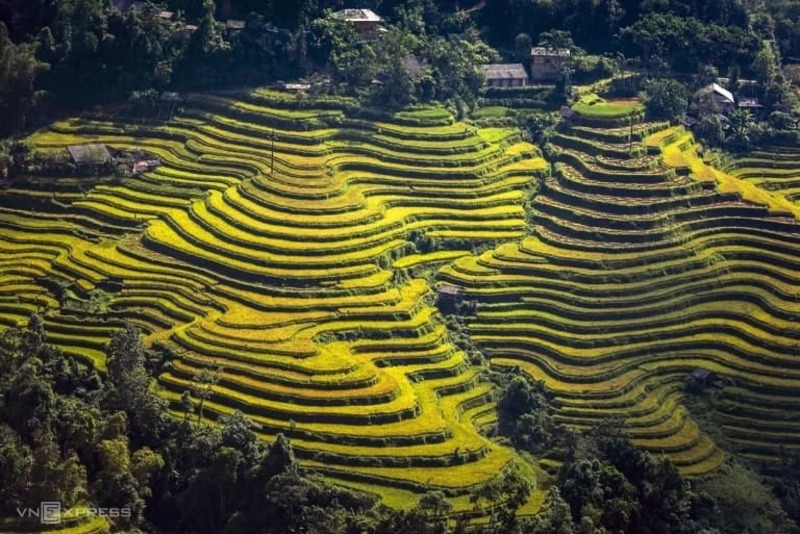
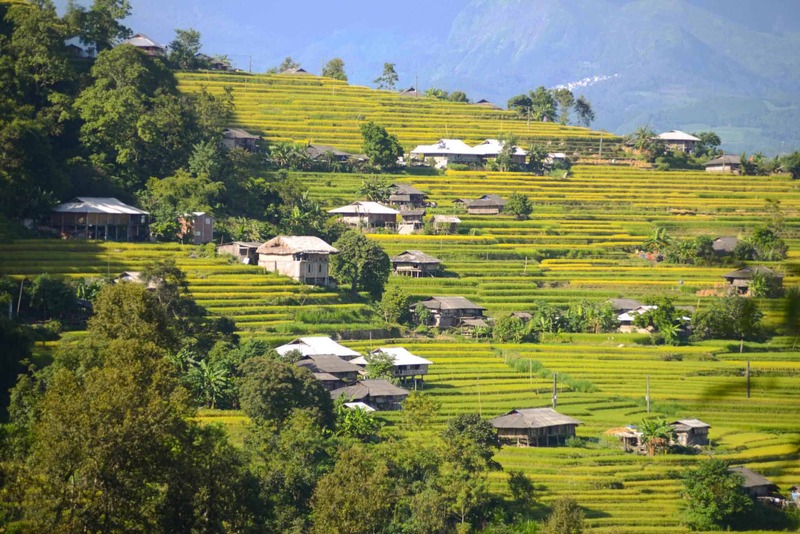
Hoang Su Phi is a district with steeply sloped mountainous terrain, variable elevation, and characterized by ascents and descents that interlace and carve the land through winding streams in western Ha Giang. Hoang Su Phi is made up of rice terraces, which rest on the land, tiering up like steps to the sky from years of practice, and the ethnic minority people who live here.

The hills they rest on are towering when separated by deep valleys, with the upper streams of the Chay River providing beauty as well as complexity to the landscape. This union of nature and man’s craft creates one of the most iconic highland landscapes in Vietnam.

8 Cultural Experiences You Shouldn’t Miss

Hoang Su Phi delivers more than just picturesque views – it is a place of cultural history. From ancient rituals to energetic markets, below are the six most memorable experiences you shouldn’t miss.

Admire The Ban Phung Terraced Fields

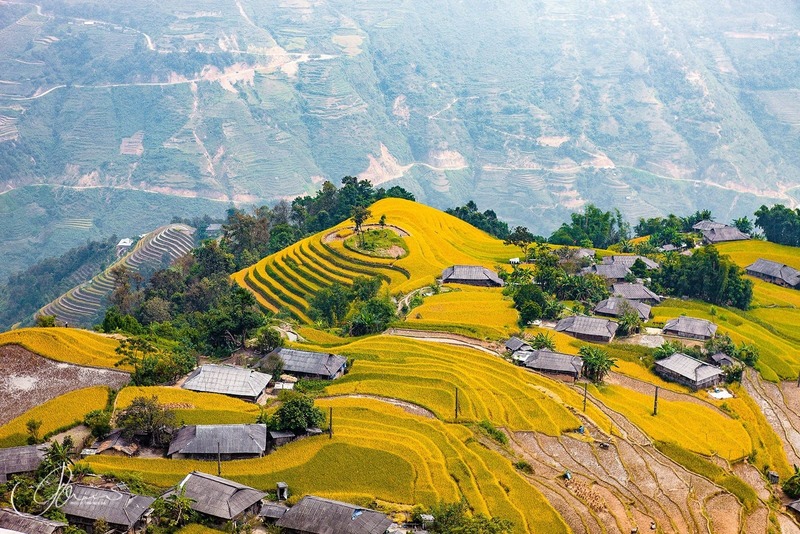
Located restfully near the border with China, Ban Phung has some of the tallest terraced rice fields in Vietnam. The terraced rice fields rise at an angle on each mountain slope, creating beautiful layers of both green and gold, especially during harvest time. Ban Phung requires a scenic 30 km mountain pass journey to arrive, which is even more rewarding.

Hoang Su Phi 2

Explore Fields Of Buckwheat Flowers

When Hoang Su Phi comes alive with blooming buckwheat flowers from late October to the beginning of November, the countryside blooms with soft pink and lavender flowers covering the hills, making it a picturesque and romantic experience. The fields of flowers attract photo buffs and nature lovers alike, and many local communities hold small festivals celebrating their annual flowering. In addition to the visual beauty of the flowers, buckwheat flowers are also included in local cuisine, making them even more culturally meaningful.

Hoang Su Phi 3

Trek Up Chieu Lau Thi Mountain

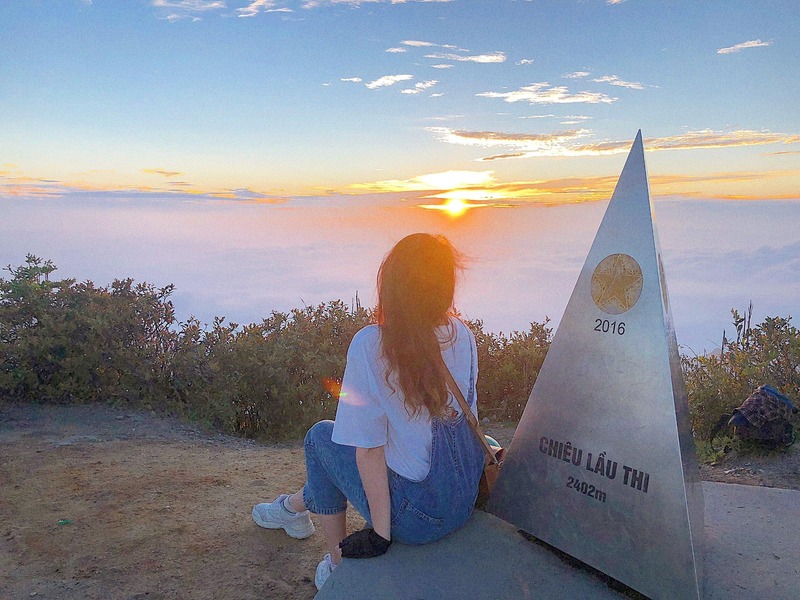
At over 2,400 meters in elevation, Chieu Lau Thi is one of the most famous mountains in northeastern Vietnam. Chieu Lau Thi means “Nine-Layered Mountain,” and as you trek upwards, you will go through layers of changing landscapes, mists, forests, rolling hills, and vantage points.

When the sky is clear, the views encompass a vast expanse of mountains and valleys below; on misty days, the landscape appears more mystical and ethereal. This is a moderately strenuous trek, but it is well suited for those who want to connect with nature and escape modern civilization.

Hoang Su Phi 4

Enjoy The Busy Hoang Su Phi Sunday Market

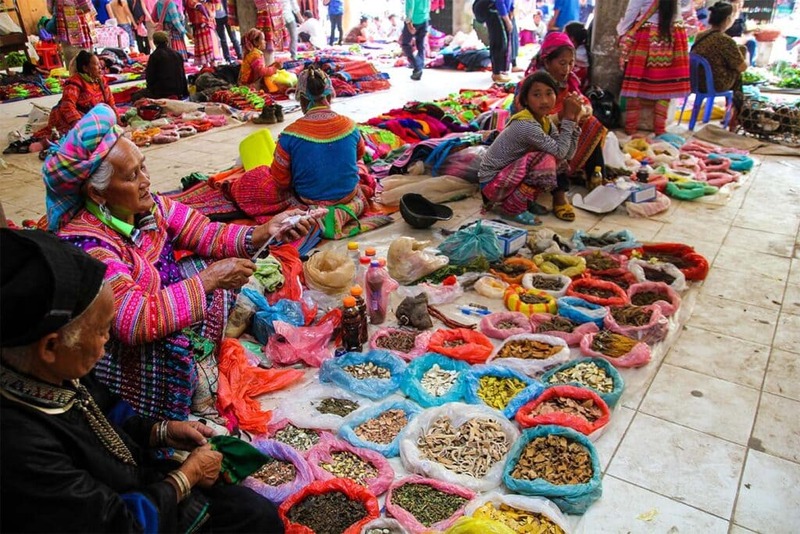
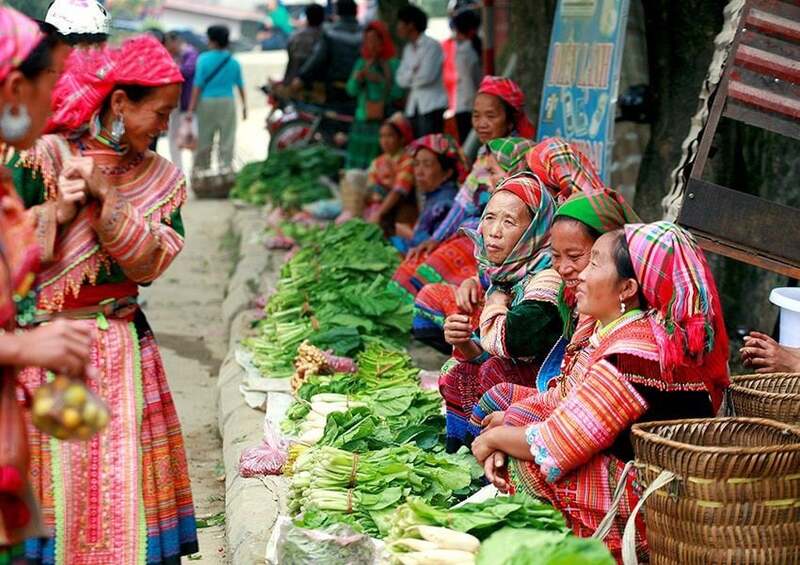
Every Sunday, the Hoang Su Phi town center attracts villagers from the surrounding area for its weekly market. And while “market” suggests the things that are bought and the things that are sold, markets are just as much about community. Donned in colorful ethnic wear, people freely offer and take fresh vegetables, medicines, fabrics, and more. The market is also an enjoyable spot to eat local dishes and experience folk songs woven into the fabric of the event. For many, the market is an occasion for stories and to catch up.

Hoang Su Phi 5

Visit Suoi Thau Temple

Situated on a hillside at the commune of Ban Luoc, Suoi Thau Temple is a sacred and peaceful space. With countless layers of terraced rice fields, there are sweeping views of the Hoàng Su Phì topography. Locals frequent the temple as it is believed the place is protected by ancient spirits, and they go to pray for health and prosperity. It’s a quiet space for traveling visitors to quietly ponder, appreciate the beauty of the region, and listen to age-old legends passed down by word of mouth for centuries.

Hoang Su Phi 6

Uncover The Tombs Of The La Chi

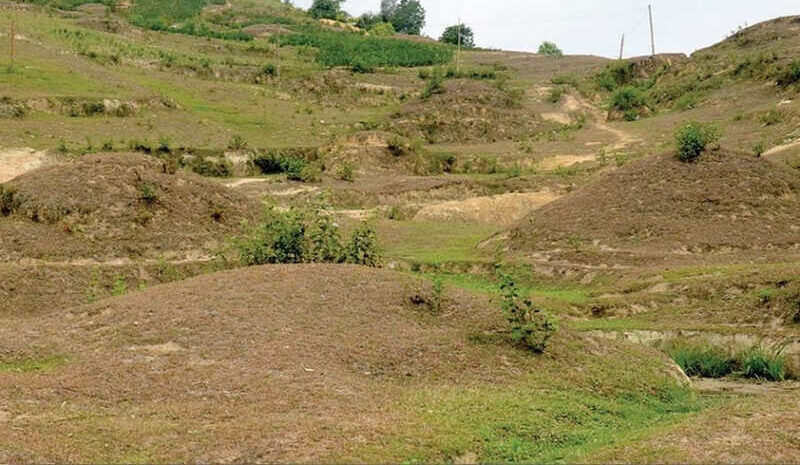
Scattered throughout Hoang Su Phi are hundreds of ancient tombs built by the La Chi ethnic group on the mountainsides. Some of these tombs rise over 1.5 meters tall and occupy areas of 25 square meters or more. The tombs are arranged in lines that curve with the landscape, which archaeologists say eminently symbolize cultural and spiritual identity. While many aspects of the tombs and their meanings remain unknown, visiting them will offer unique insight into the region’s ancestors and spiritual beliefs.

Hoang Su Phi 7 e1755595496476

Ascend The Majestic Tay Con Linh

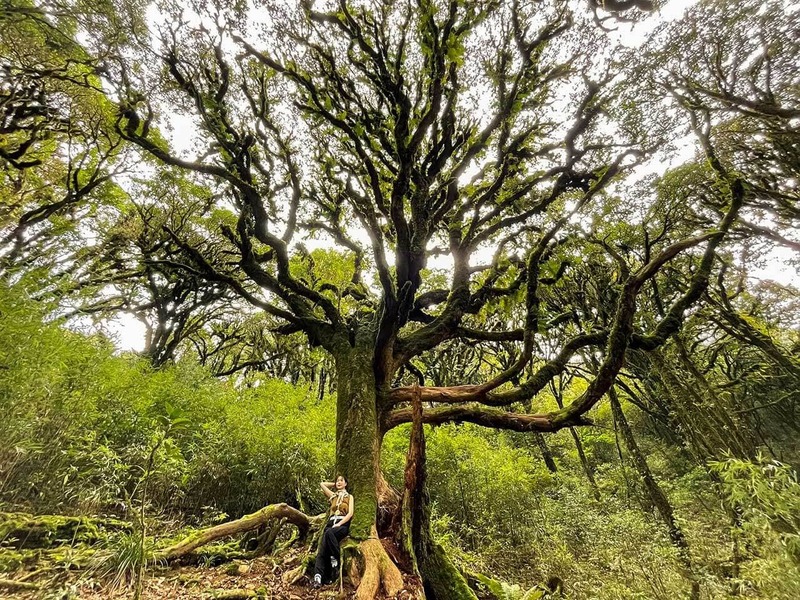
Tay Con Linh, meaning “roof of the Northeast,” stands at 2,419 m above sea level, making it the highest mountain in the Northeast. The La Chi people consider this mystical mountain sacred to them, a claim supported by the population who live at its base. The physical journey to its peak takes you through beautiful, dense sub-tropical vegetation and marvelous species of trees and wildlife, as well.

For those who enjoy trekking, Tay Con Linh is sure to test their abilities. The way to the peak takes adventurers through hard climbs to beautiful scenery that inspires feelings of freedom, fresh air, and commitment to the many people and stories of the area.

Hoang Su Phi 8

Admire The Historic Vinh Quang Temple

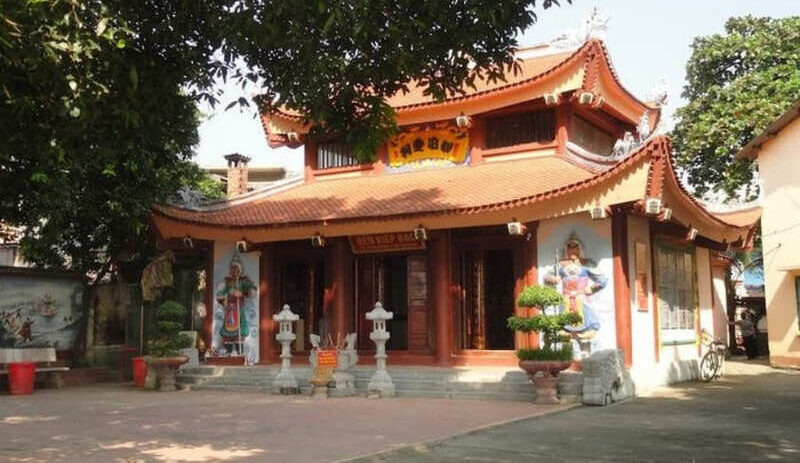
Found in the center of Vinh Quang town, Vinh Quang Temple was established in the late 1800s and is a cultural and religious center for the people in the area. The Temple is dedicated to several deities but primarily honors Hoang Van Dang, a beloved and respected chief of the region long ago. The temple’s structure with traditional wooden architecture exudes serenity and represents the spirit and calmness of the religious life in this area and the beliefs and customs of the people’s culture.

Hoang Su Phi 9 e1755595525411

Entrance Fee

Like other natural attractions in Ha Giang, like Ma Pi Leng Pass and Tham Ma Slope, entry fees in Hoang Su Phi are typically quite low or sometimes even free. Many cultural places, such as terraced fields, markets, and ethnic village entries, do not charge admission.

For major destinations or guided group tours (urban tourist areas), entry may be included as part of the packaged trip, and prices will vary based on the season and itinerary. You should always double-check with your tour operator and local guides ahead of time.

Best Time To Visit Hoang Su Phi

Every season in Hoang Su Phi has its own form of charm, and it’s a beautiful place to visit at any time of the year. To assist with deciding the best time to visit Hoang Su Phi, we have provided the most favorable times to visit, along with their respective highlights:

Water Pouring Season (April-June)

This is one of the most picturesque periods of the year, because the water flows from the mountains and fills the terraced rice fields, a colorful splendor reflected as a bright mirror below. Because this is the time for the locals to plant rice, it’s also perfect to witness the locals on the rice fields, carrying their farming traditions with them.

Golden Harvest Season (Mid-September)

September is the best time to experience the beauty of Hoang Su Phi. The rice terraces are fully ripe this month, and in the backdrop of the hills turned into a golden yellow wonder, creating unforgettable memories for the travelers and photographers alike. Every turn of the corner produces postcard postcard-perfect view!

Hoang Su Phi

Spring Festival Season (January-March)

Spring is often chilly and misty, yet the people of Hoang Su Phi come alive with an abundance of colorful ethnic festivals. Although visitors may have to opportunity to engross themselves in the festivities like the Forest God Worship Ceremony of the Nung people, or the “Quyá Hiéng” festival of the Red Dao. Either way, spring is an unforgettable experience, offering an opportunity to explore the rich and diverse spiritual and cultural practices in Hoàng Su Phì and beyond.

How To Get To Hoang Su Phi

Hoang Su Phi is situated approximately 100 km west of Ha Giang City and can be accessed by public transport or car. You may be comfortable or adventurous, and there are two primary ways to get there, along with travel times, costs, and useful information.

Means of transportation Bus Motorbike Private Car or Taxi
Price ~150,000 – 250,000 VND 150,000 – 200,000 VND/day ~1,000,000 – 1,500,000 VND (round trip)
Route Hanoi → Ha Giang Ha Giang → QL2 → Tan Quang → DT177 → Hoang Su Phi
Duration 3 – 4 hours 3 – 5 hours ~3 hours

Things to Know Before Traveling to Hoang Su Phi

Before starting your journey to Hoang Su Phi, it’s best to prepare well for its rugged mountains and unpredictable weather. Here are some essential tips to ensure a safe and fun experience:

  • Dress for cold, wet weather. Hoang Su Phi’s weather can be chilly and damp, especially in the spring and near the end of autumn. So you should incorporate warm clothes, thermal wear, gloves, and waterproof jackets.
  • Wear good shoes. You will hike and walk on treacherous ground, so a durable pair of trekking shoes or waterproof boots is needed.
  • Travel light. Pack what you need. Avoid bulky and unnecessary items because grappling with moving around will be tiresome and exhausting enough in the area.
  • Pack a few personal necessities. This means a flashlight, basic medicine (for nausea, stomach ache, fever), toiletries, and sun screening.
  • Learn about local customs. Respect the customs of the ethnic minorities in this area. Understanding some local customs will help avoid unintentional disrespect.
  • Bring some food and drink. Food stalls are rare in remote areas, so pack some light snacks and drinks for your journey.
  • Bring your ID, driver’s license, and ensure your vehicle is well maintained, with working lights and brakes; wear reflective gear if you are riding a motorbike or, if you decide to journey home by U-haul, check it is roadworthy.
  • Small gifts for local children. If you feel wistful and want to do something nice, bringing candies, books, or school supplies will help make the children in remote villages smile.

Final Thoughts: Is Hoang Su Phi Worth Visiting?

Yes, Hoang Su Phi is a secret treasure of Northern Vietnam. It was the beautiful rice terraces, quiet mountain landscapes, and numerous ethnic cultures of the Hoang Su Phi area that amazed us. It’s a place that we’ll never forget because it will never be lost to us. Seni World can assist you in planning a unique and memorable visit to Hoang Su Phi for your Vietnam adventure.

Dong Van Karst Plateau Travel Guide for First-Time Visitors

The Dong Van Karst Plateau is a UNESCO Global Geopark located in northern Vietnam. Visitors can see breathtaking limestone formations, steep valleys, and traditional ethnic minority villages. The ancient karst landscape offers stunning views and cultural riches you will never forget.

Introduction To Dong Van Karst Plateau

Situated in the northern highlands of Ha Giang, the Dong Van Karst Plateau Geopark covers more than 2,356 km², at elevations of between 1000-1600 m. As a UNESCO Global Geopark, it features striking limestone summits, deep valleys, and cultural richness in its diversity across four districts.

Travelers are fascinated by the beautiful landscape and its ancient geology, over 400 million years old, and unique ethnic communities. There is stunning scenery, unique stone formations, and a genuine village experience, making for a top bucket-list location in northern Vietnam.

Dong Van Karst Plateau 1

History Of Dong Van Karst Plateau

Dong Van Karst Plateau is one of the oldest geological areas in Vietnam, derived from the ancient block of South China. The region had once been a part of the supercontinent Gondwana that formed hundreds of millions of years ago.

The sedimentary rock layers exposed at Dong Van Karst Plateau were formed as recently as the Cambrian Period over 550 million years ago, and have experienced as many as seven geological ages. The area has plentiful fossils, signs of karst formation, and evidence of tectonic history that tells of planet Earth’s long-lasting and varied history.

The limestone mountains, deep dark caves, and deep sink holes have already been shaped by natural forces every day over millions of years. The spectacular karst landscape and geological layers of ancient rock will help visitors appreciate the length of geological time.

Given the distinctiveness of both geological and cultural values, Dong Van was approved as the first Global Geopark in Vietnam on October 3, 2010. Dong Van was designated the second Global Geopark in Southeast Asia.

Dong Van Karst Plateau 2

Unique Architecture Of Dong Van Karst Plateau

The Dong Van Karst Plateau consists primarily of enormous limestone mountains, which results in a rugged yet beautiful landscape that combines summit and foothill plateaus, hills, low mountains, and valley landforms. Located in the northern part of Ha Giang, the Dong Van Karst Plateau includes regions within four districts: Quan Ba, Yen Minh, Dong Van, and Meo Vac.

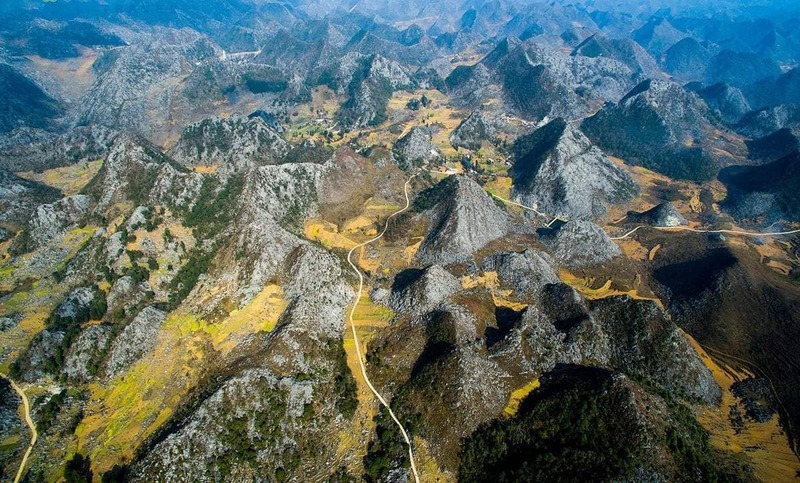
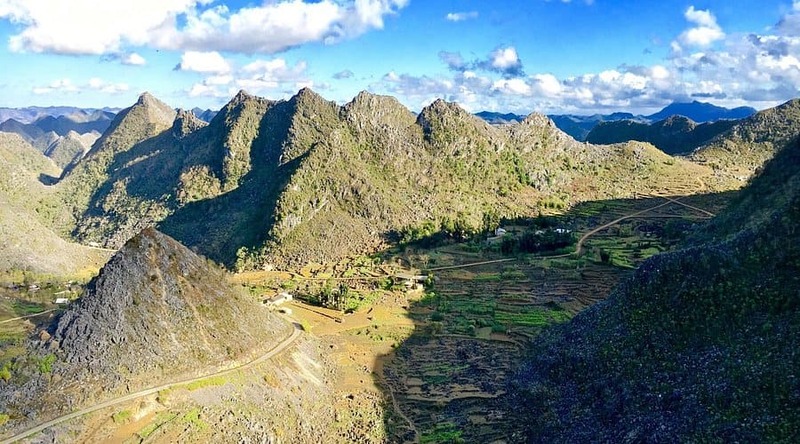
The Dong Van Karst Plateau is a spectacular landscape of limestone peaks, valleys, rivers, and hills with karst features that reach up to 2,000 meters in elevation, deep faults, and 500 million years of multiple geological strata that are beautiful yet also scientifically fascinating.

8 Cultural Experiences You Shouldn’t Miss

Dong Van Karst Plateau is not only characterized by amazing cliffs and rock formations, but it is also a place with rich traditions, great history, and honest rural life. Here are essential experiences that will help you to do this great area justice.

Visit The Old Quarter Of Dong Van

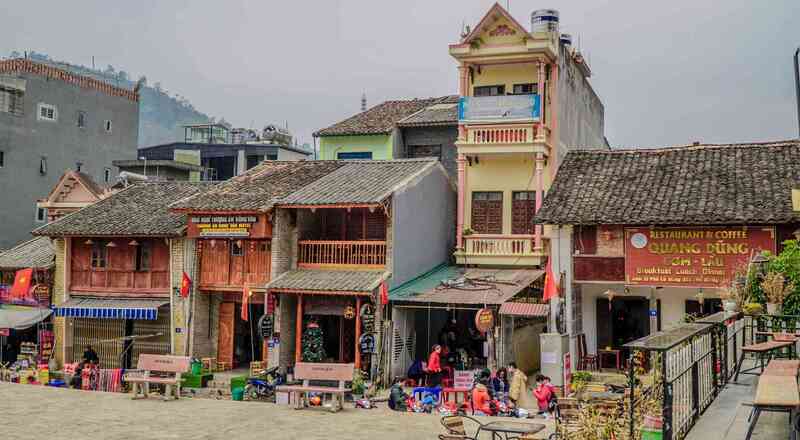
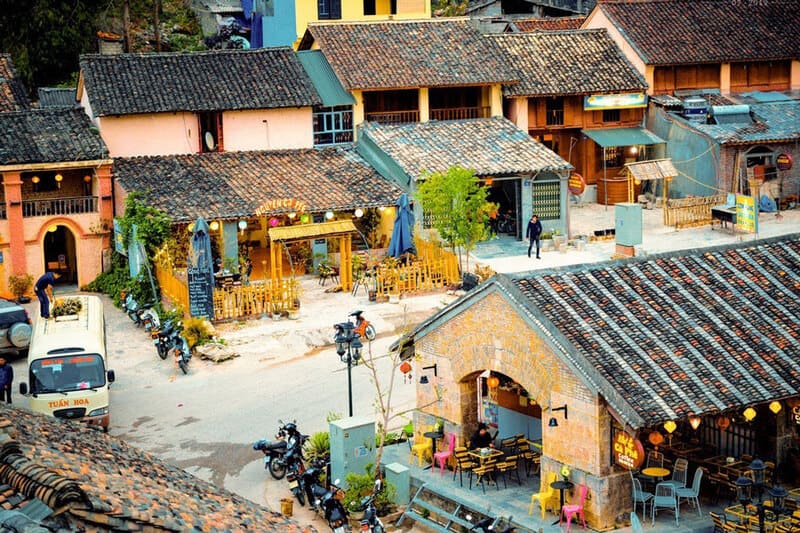
Located in the centre of Dong Van town, the Old Quarter of Dong Van has existed for over a century, and the charm of its houses is created in a U-shape and built with yin-yang tiled roofs and thick earthen walls according to the architecture of ethnic minorities.

Early in the morning or in the late afternoon, the entire street is bathed in the same romantic, golden light; a great time to take pictures and enjoy the course of the daily life of the locals. Don’t forget to enjoy a hot coffee at Café Pho Co (translation: Old Quarter Café), this coffee shop is located in a quaint 100-year-old house.

Lung Cu Flag Tower 3

Cross Tham Ma Pass

Tham Ma Pass is not just one of the most exciting roads in Northern Vietnam; it also stands as a symbol of hardship and perseverance. It is around 5 km, with nine sharp, turning curves, and connects Yen Minh and Dong Van districts. The name Tham Ma comes from a historical tale about testing the strength of horses on the steep pass. Today, it is a frequently visited spot for travelers seeking to push their limits and take stunning panoramic views of the highlands.

Dong Van Karst Plateau 3

Visit The Palace Of The Hmong King

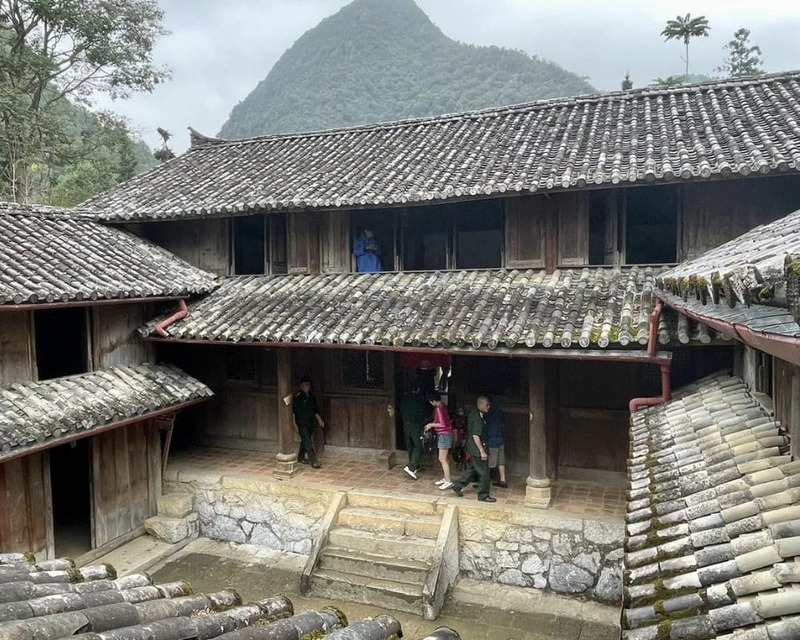
Otherwise known as the Vuong Family Mansion, this majestic building is the former home of a very powerful Hmong royal family. Construction started in the early 1900s and took over 8 years to finish. To this day, the property combines traditional Chinese architecture while making use of local materials like stone. rare wood and clay tiles.

The property also includes stone fortifications and towering sa moc (cypress) trees, and was originally built to prevent invasions. The property shows the wealth and clout of the Hmong people during this period. The property is now a protected national heritage site, giving visitors a taste of the past in the region.

Things to Do in Ha Giang 7

Nho Que River Boat Trip

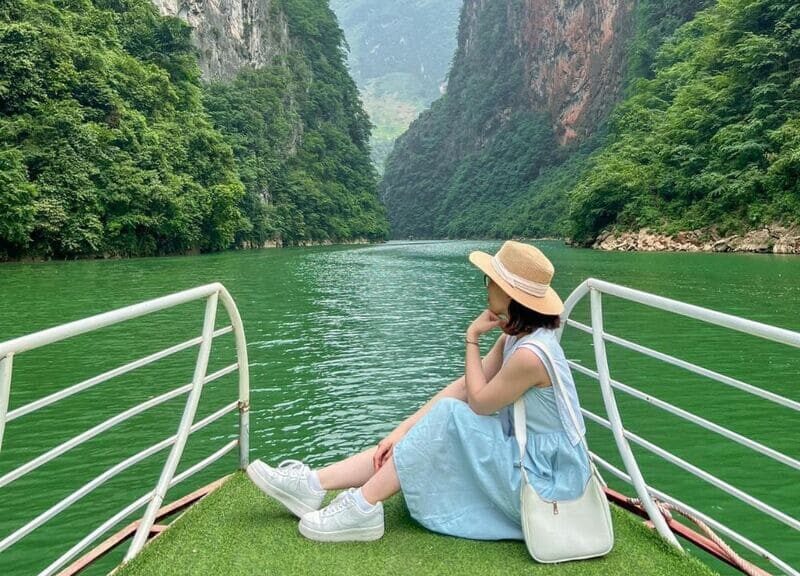
Drifting down the jade-green waters of the Nho Que River is an experience like no other in Ha Giang, blissfully tranquil, and provides another opportunity to look at the spectacular Dong Van Karst Plateau. Instead of looking down on the plateau from a mountain viewpoint, you will look up at the limestone mountain walls of Tu San, making it much different from your mountain exploration. Whether you row yourself in a kayak or hire a motorboat to carry you. Take your time, relax, and float.

Nho Que River 2 e1755592166652

Visit Lung Cu Flag Tower

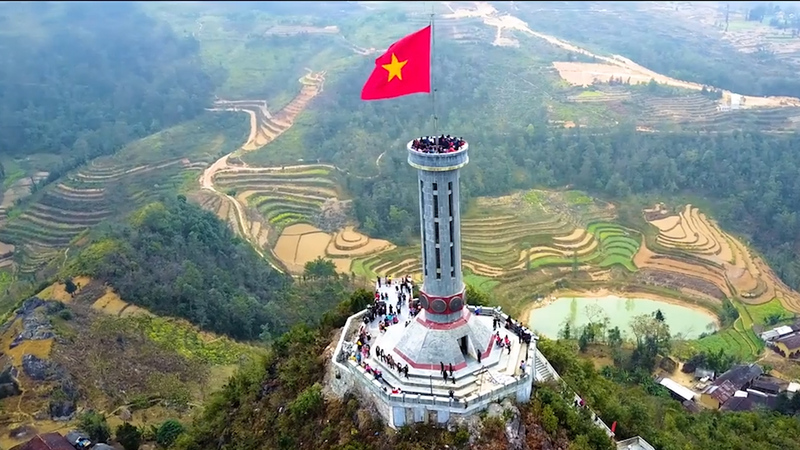
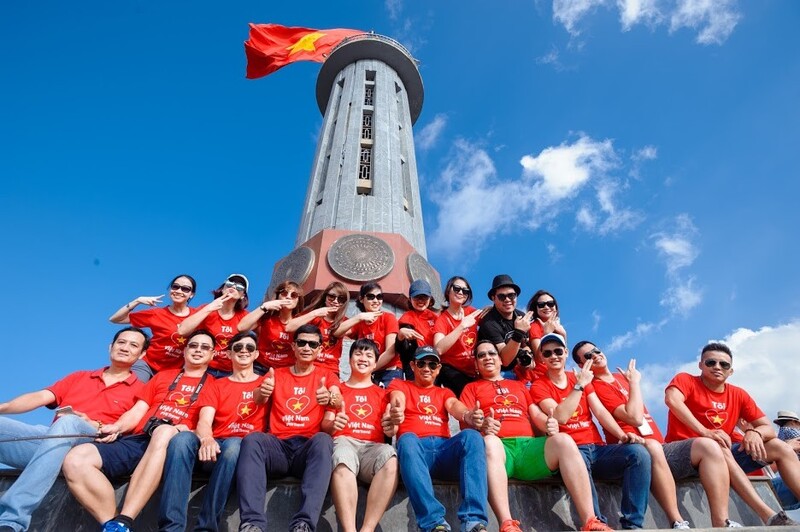
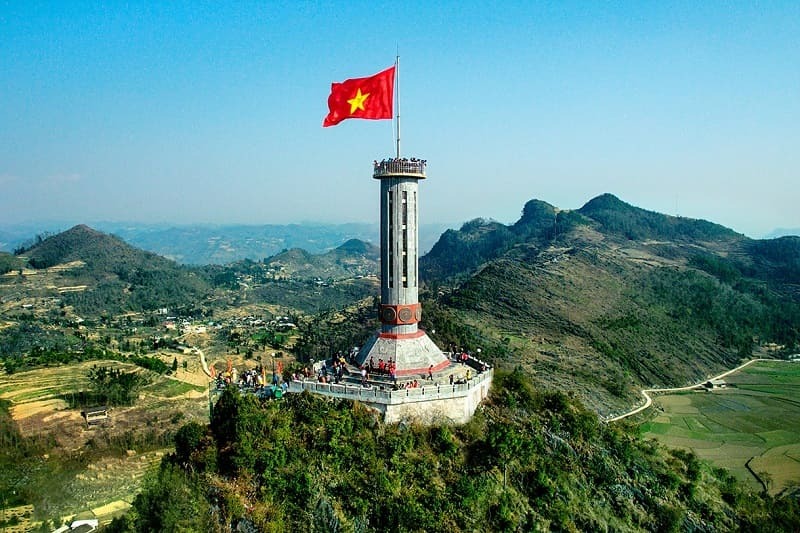
Lung Cu Flag Tower, located on Dragon Mountain at an elevation of 1470m above sea level, is a proud representation of Vietnam’s sovereignty and is modeled after the Flag Tower in Hanoi. It is also the northernmost point of Vietnam. The steep steps up may not be for everyone, but if you make it to the top, you have quite the reward: a panoramic view of terraced fields, villages, and borderlands as far as the eye can see. This is an emotional and patriotic place for many Vietnamese visitors.

Lung Cu Flag Tower 1

Marvel At Buckwheat Flower Fields In Sung La

In October and November, the hills in Sung La are gently blanketed in soft pastel pink and purple as buckwheat flowers bloom. These flowers are delicate, and their romantic symbolism, representing Ha Giang, attracts thousands of photographers and lovers of nature each year. When walking through the peaceful villages of Sung La on a winding stone path, you will feel as if you are walking in a fairy tale. The local ethnic families plant buckwheat for food, but buckwheat has recently become a cultural symbol and a highlight for tourism.

best time to visit Ha Giang

Visit To The House of Pao

Nestled in the village of Lung Cam in Sung La, you will discover the House of Pao. This magical place is famous for the award-winning Vietnamese film The Story of Pao, which was filmed on this site. The House of Pao is a traditional Hmong house built in 1947 and features a stone courtyard and the use of wooden beams throughout its interior.

The house is designed to be harmonious with nature. In and around the house are various fruit trees and flowering shrubs and blossoms that add to the poetic beauty of the place, particularly during the spring. Visiting the House of Pao will provide a nostalgic glimpse of cinematic and cultural history.

Dong Van Karst Plateau 4

Discover Pho Bang Ancient Town

Pho Bang is a truly unexpected surprise. Situated close to the Vietnam-China border, it is a sleepy little town populated primarily by the ethnic Hoa and the Hmong. The streets are lined with traditional houses with mud walls and solid wooden doors, adorned with faded red lanterns. The quietness and beautiful streets give it a peaceful charm that brings nostalgia of childhood.

There are very few travelers who come to this area, meaning that travelers to this area are those looking for a quiet place to experience a local culture and showcase the everyday lives and traditions of communities.

Dong Van Karst Plateau 5

Entrance Fee

Visitors to Dong Van Karst Plateau can find one entrance fee when paying through their accommodation provider. Local tourist attractions within the geopark may have extra entry fees.

Attraction Price
Daily Geopark Fee 30,000 VND (General)
Dong Van Old Quarter Adults: 50,000 VND
Children (above 1.2m): 50,000 VND
Lung Khuy Cave Adults: 50,000 VND
Children (above 1.2m): 20,000 VND

The Best Time To Visit Dong Van Karst Plateau

The Dong Van Karst Plateau is beautiful at any time of the year, but each season provides a different idea of beauty. Here are the best times to visit based on what you want to see:

  • Spring (January – March): When you see the peach and plum blossom in full bloom all over the plateau. There is a lively mix of ethnic spring markets that are great for experiencing local culture and traditions.
  • Summer (June – August): With a cool, comfortable climate for treks into the rugged rock highlands.
  • Rice harvest season (September): Rice terraces turned golden provide the most beautiful views with fresh mountain air and great panoramic photographs taken on a climb.
  • Buckwheat flower season (October – November): The entire area becomes a magical sea of pink and purple buckwheat flowers, an iconic sight from Ha Giang that draws nature lovers and all forms of photography.

How to Get to Dong Van Karst Plateau

Dong Van Karst Plateau is approximately 150 km north of Ha Giang City. The standard route is to travel on National Highway 4C, which is very scenic but also a winding mountain road. Depending on comfort or adventure, travelers can choose from a range of options for transportation.

Transportation Route Travel time Estimated cost
Bus Hanoi → Ha Giang (then transfer to Dong Van) 6–7 hours to Ha Giang, and 4–5 hours to Dong Van 250,000 – 400,000 VND (Hanoi–Ha Giang); then shared minivan to Dong Van: ~150,000 VND
Motorbike Hanoi → Ha Giang → Dong Van 10–12 hours total (or split into 2 days) Fuel + rental (~150,000 – 200,000 VND/day)
Private car Hanoi → Dong Van 7–9 hours ~2,000,000 – 3,000,000 VND/trip (for group)

Things to Know Before Traveling To Dong Van Karst Plateau

Before traveling to Dong Van Karst Plateau, it would be good to make your preparations to cope with the different terrains and weather conditions. Below are some travel tips to help your venture:

  • Watch the weather before you travel. Mountain weather can change quickly. Bring warm clothes even in summer, particularly for evenings.
  • Wear shoes that comply with the journey. You are on rocky and uneven terrain; thus, decent and firm walking or trekking shoes are required.
  • Be ready to spend a long time going to Dong Van. Be ready for a long driving time with winding mountain roads; you will have snacks, water, and motion sickness remedies as necessary.
  • Plan accommodation in advance because homestays and hotels can be in high demand during flower seasons and during festivals.
  • Please observe customs, Dong Van is full of ethnic groups. Dress modestly and ask for consent if needing to take photos of people.
  • Take cash. You will not find ATMs in most remote areas, as the amount of cash needed for meals, entry tickets, and for souvenirs.
  • Be prepared to stay connected. Mobile signals may be weak in some areas. Thus, you can remain in touch by downloading maps and info that you may need pre-trip.

Final Thoughts: Is Dong Van Karst Plateau Worth Visiting?

Dong Van Karst Plateau is not just a place to visit; it is a living museum of geology, history, and ethnic culture. Many people are attracted to the unique limestone formations, colorful markets, and calm mountain villages of the region. This UNESCO Global Geopark is an exceptional travel destination, and Seni World would be happy to help you plan your adventure in this unique part of Vietnam!

Nho Que River: The Top Natural Wonder of Ha Giang Plateau

The Nho Que River is a stunning natural treasure in Ha Giang, flowing between tall limestone mountains and the great Tu San Canyon. The river’s emerald-green waters and scenery are sure to impress anyone who appreciates nature and adventure.

Introduction To The Nho Que River

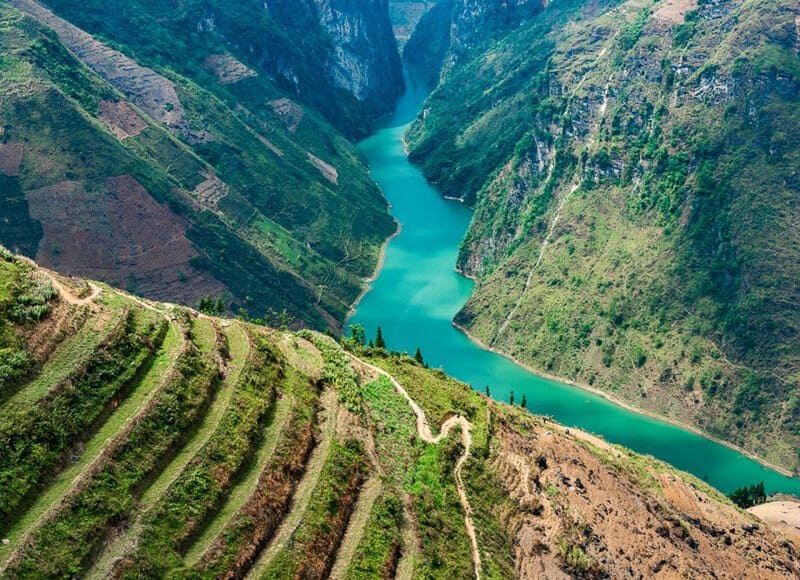
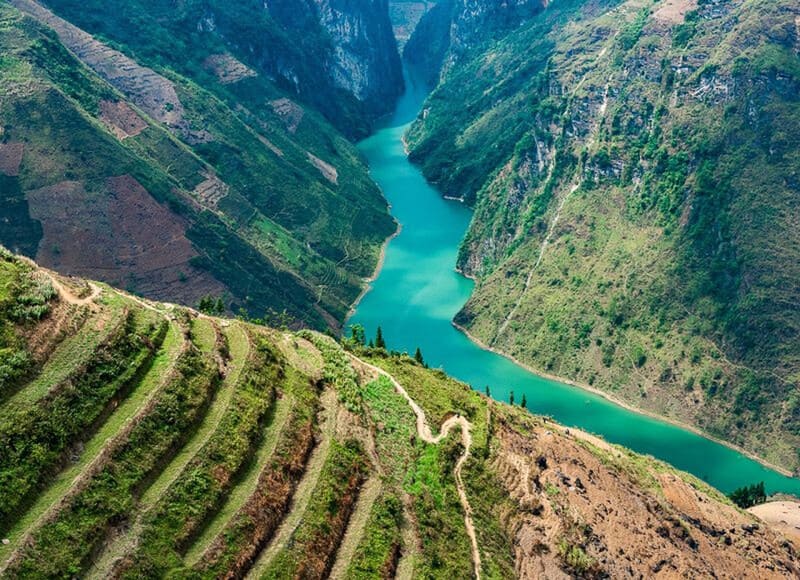
The Nho Que River runs for approximately 192 km through the province of Ha Giang and Cao Bang into Vietnam from China, meandering past some of the most beautiful limestone cliffs and emerald waters you may have ever witnessed before. Referred to as the “jade ribbon” of the Dong Van Plateau, this is a must-see destination for nature lovers, photographers, and adventure enthusiasts alike.

What amazes locals and tourists alike is the incredible scenery, including the unique canyon walls known as Tu San, where walls drop nearly 1,000 m straight down, and the surrounding water, called the Awakened Nho Que, glimmers against the light like liquid silk. A boat cruise or kayak trip is the best option for those looking to unwind and truly appreciate the wild beauty and tranquillity of the area, and create an unforgettable travel experience.

Nho Que River 1

History Of The Nho Que River

The Nho Que River starts in China and is known as the Nanli River (南利河) or the Pumei River (普梅河) before flowing into Vietnam’s remote northern region of Ha Giang. For a brief moment, it forms a natural border of Vietnam and China, before the river snakes deeply into the Dong Van Plateau.

The Nho Que is a tributary of the Gam River and has shaped some of the most spectacular landforms in Vietnam, such as the famous Tu San Canyon. In 2009, it was introduced as a National Scenic Site and hailed as one of Vietnam’s most unusual tectonic valleys, a natural marvel that has been born over millions of years.

Unique Architecture Of Nho Que River

Famous for its tapering water and twisting and turning shape, the Nho Que River flows through cliffs and valleys of great heights and depths. The river begins its journey from Nghiễm Sơn in Yunnan, China, and flows a total of around 192 kilometers (roughly 28.5 miles) through Vietnam’s Hà Giang province, passing through the towns of Dong Van and Mèo Vạc, and joins the Gâm River.

The most beautiful portion of the river flows into the Tu San Canyon, where the walls of cliffs rise sharply and directly from the emerald waters. These cliffs rise between 700 and 1000 meters on either side of the river. This section of the river is known as the deepest canyon in Southeast Asia, providing a much more dramatic and poetic landscape that is very unique and unlike anywhere else in Vietnam.

Nho Que River 2

3 Cultural Experiences You Shouldn’t Miss

You won’t just be sightseeing on a trip to the Nho Que River: you’ll also have the opportunity to become fully immersed in the nature, culture, and adventure of Ha Giang. Here’s a great list of things to try:

Cruise On The River And Take In Tu San Canyon

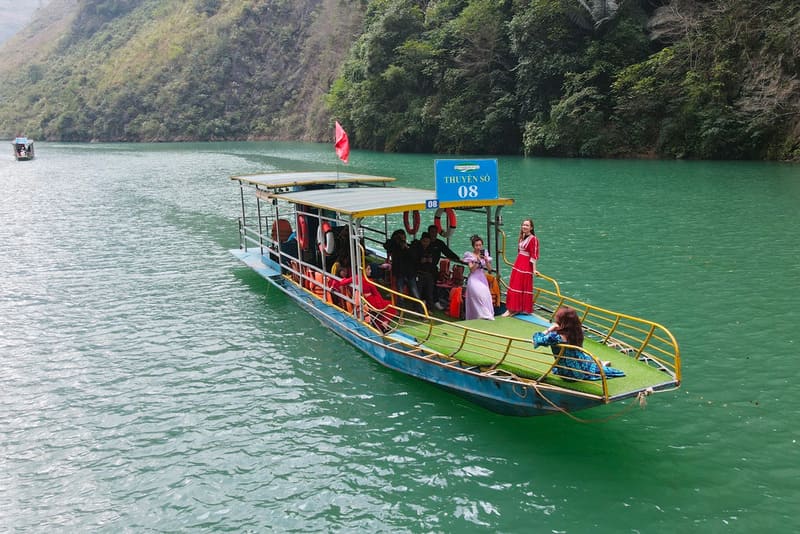
Drift along the emerald waters of the Nho Que River while viewing the stunning Tu San Canyon – the deepest canyon in Southeast Asia. Amazing cliffs reach 1,000 meters, making it feel like you are drifting between sky and stone. The air is pristine, the water is described as “mother’s milk”, and the scenery is to die for.

You will have the choice of a motor boat or a self-paddled wooden or metal boat. Prices range from 100,000 to 150,000 VND per person. Although the ride is fairly straightforward, it is recommended to hire a local guide to experience the ride as a newcomer to the Nho Que.

Nho Que River 3

See The River From Ma Pi Leng Pass

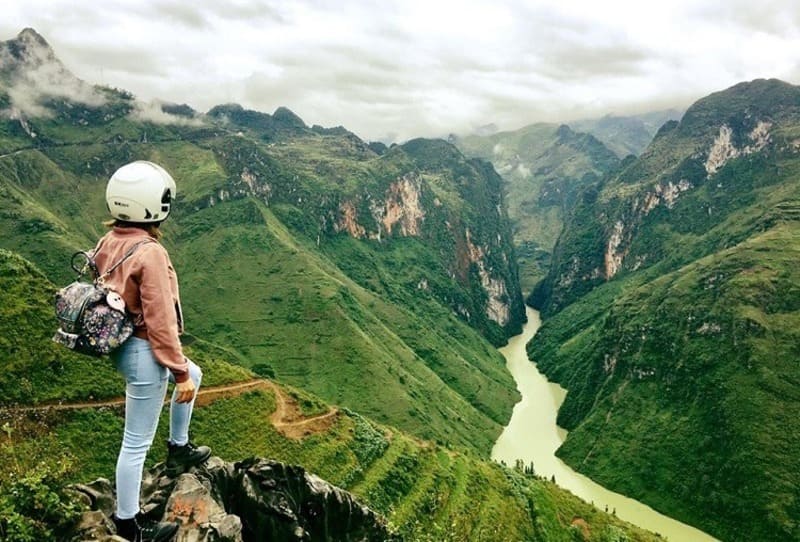
Once upon a time, the view of the Nho Que River couldn’t get any better than viewing it from the famous Ma Pi Leng Pass! Situated too high to see the panoramic view of the Nho Que River, Ma PI Leng Pass is a bird-eye view of everything underneath it!

You will feel as if you are looking at a painting altogether, everything melds, including the blue of the rivers with the foliage surrounding it, and the sky running away in the distance. Bring your camera, all potential shots will be postcard material.

Ma Pi Leng Pass 3

Try Kayaking Through The Crystal Blue Waters

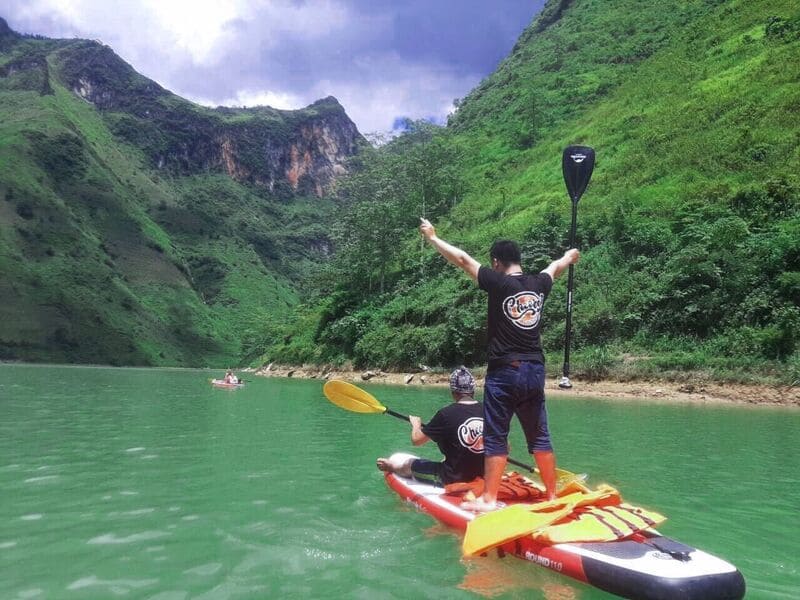
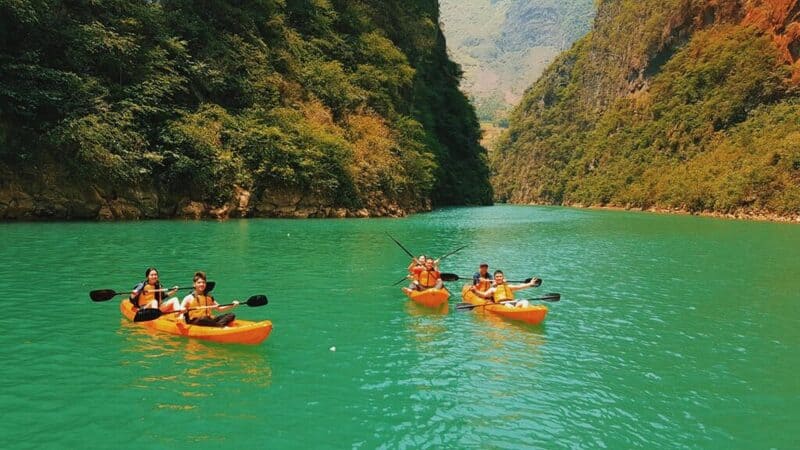
Kayaking is an immersive but quiet way to explore the river up close. Paddle along the gentle currents, weave your way between high cliffs, and indulge in the untouched beauty that surrounds you.

The best months to kayak are October to November and February to March, when it’s always sunny, especially with seasonal flowers blossoming from the mountains. Book your kayak tour and day at least a day in advance. Rentals cost 100,000-150,000 VND for 30-60 minutes of admiration and marveling!

Nho Que River 4

Renting Boat Fee

Boating is a great way to experience the beauty of the Tu San Canyon if you’re coming to the Nho Que River for the first time. You can access the river from either the Ta Lang Wharf or Xin Cai Wharf on scenic but steep roads. Be careful driving, or find a local driver for about 150,000 VND/vehicle.

Here are the common boating options along the river and estimated prices:

Boat Type Price (per person) Notes
Motorboat 100,000 – 150,000 VND Best for group travelers. Option to share or rent the whole boat
Self-paddled boat 100,000 – 150,000 VND Choose between a wooden or a metal boat. You can hire a rower if needed
Kayak From 50,000 VND Great for sporty visitors who want to explore the river more closely

Note: The road to the boat docks can be narrow and curvy. If you are driving a car, you should park near the Trang Huong Bridge and walk for about 2 km. For the best experience, contact the rental supplier at least one day ahead of time.

Nho Que River 5

The Best Time To Visit The Nho Que River

You can come to visit the Nho Que River all year round, but the most enchanting time is between the months of October and November. The weather starts to cool, and the mist adds an enchanting layer of mystery to the dramatic landscapes.

It is also the blooming season of the buck wheat flowers that blanket the mountain slopes in soft colors of pink and purple, all contrasted against the jade green river. The beautiful, surreal scenery will almost put you in a dream-like state, making it the perfect time to simply ride a boat peacefully and enjoy the poetic beauty of Ha Giang.

How To Get To The Nho Que River

Traveling to the Nho Que River is an adventure in itself, especially if you’re coming from outside of Ha Giang. Below are common transportation options to reach this beautiful location:

By Plane

There is no airport in Ha Giang, so your first trip will be to fly into Hanoi. From there, you can take a sleeper bus or arrange a private car to travel to Ha Giang. For the lowest price flight and travel arrangements, contact Seni World for assistance and special offers.

By Sleeper Bus

Buses from Hanoi to Ha Giang are easy on the budget and have many departures throughout the day. Bus tickets from Hanoi typically range from 250,000 to 600,000 VND, depending on the bus. The following bus companies are reputable, such as Bang Phan Bus, Manh Quan Bus, and Quang Nghi Limousine.

By Motorbike

If you are adventurous, consider riding a motorbike from Hanoi to Ha Giang. It is about 300 km, and there are great views on the way to Ha Giang. The only thing to consider is that the route includes winding mountain passes and steep slopes; therefore, it is not recommended for inexperienced riders.

Things To Know Before Traveling To The Nho Que River

Before heading out on your journey to the Nho Que River, it’s a good idea to be well-prepared. Here are some important tips to help you enjoy an easy and memorable trip:

  • Spring and autumn (especially from September to December) are the best times to visit for cool, bright, and calm river conditions.
  • Watch the road! The road to the river is narrow and steep. If you are riding a motorbike, make sure you have good skills and check your bike ahead of time.
  • Boats can fill up quickly in peak season. It’s a good idea to reach out to a boat provider one day ahead so you do not have to wait.
  • Bring warm clothes, especially in winter, as the air on the river can be cooler than the mountain passes.
  • Don’t forget personal items, including hats, sunglasses, sunscreen, and, most importantly, life jackets. If you’re unsure of the way, ask the locals or use Google Maps to help reach the dock for the boat.

FAQs About Nho Que River

If you are planning a trip to the Nho Que River, you probably have a few questions in advance. Here are some of the frequently asked questions to help you with your planning:

Why is it called the Nho Que River?

The name “Nho Que” derives from the local language, and it refers to the river enduring in the life and culture of ethnic communities in the Hà Giang region.

Is it safe to ride a boat on the Nho Que River?

Yes, riding a boat on the river is safe. Visitors will receive life jackets, and the boats are controlled by local guides with many years of experience.

How long does a boat ride last?

A boat tour on the Nho Que River lasts between 30 minutes to 1 hour, typically, depending on the type of boat and tour.

Can you swim in the Nho Que River?

Swimming is not recommended due to the river’s depth and flow. Enjoy the view of the river and its landscape from the boat.

Final Thoughts: Is The Nho Que River Worth Visiting?

The Nho Que River captivates travelers with its magnificent views, emerald-green water, and serene experience offered by boat rides on the waterway in northern Vietnam. The range of scenic experiences offered by the waterway is special for nature and adventure lovers alike. Let Seni World help you plan your visit to this beautiful river treasure.

Explore Ma Pi Leng Pass – One of Vietnam’s Top Four Peaks

The Ma Pi Leng Pass is one of the most incredible mountain passes in Vietnam, located in the highlands of Ha Giang Province. Swirling through clifftops and eyes the beautiful emerald Nho Que River below, the Ma Pi Leng Pass is unforgettable on your travels.

Introduction To Ma Pi Leng Pass

The Ma Pi Leng Pass is one of the most beautiful mountain roads in Vietnam, winding around steep cliffs and impressive karst scenery in Ha Giang. Known as “The King of Passes,” this 20-kilometer stretch between Dong Van and Meo Vac sits at around 1500m above sea level, and enables spectacular views of the colored Nho Que River far below.

Travelers come here to experience the accident and amazement from stunning switchback driving to grand panoramic scenery. The pass is part of the well-known Ha Giang Loop, and draws travelers from all over, including motorbike riders, photographers, and nature lovers. Each bend in the road opens up another view and opportunity to capture the wild Northern beauty of Vietnam!

Ma Pi Leng Pass

History Of Ma Pi Leng Pass

In addition to its stunning scenery, Ma Pi Leng Pass is also rich in history. The pass was created in the 60s and was part of the Happiness Road project that connected Dong Van and Meo Vac in Ha Giang Province.

Under the direction of the regional government, there were more than 1,300 young volunteers and 1,000 workers from local villages who worked almost without stopping for 2 ½ years and paved 175 kilometers of road across treacherous and rugged mountain terrain. The most difficult – and dangerous – part of the road is the Ma Pi Leng Pass. There were 17 extremely brave men who spent 11 months hanging off cliffs with pickaxes, making the road by hand.

This incredible pass is a symbol of bravery, sacrifice, and determination. There is so much blood, sweat, and tears reflected in every curve and contour of the road to the point where future generations could safely cross the mountains.

Ma Pi Leng Pass 1

Unique Architecture Of Ma Pi Leng Pass

Ma Pi Leng Pass is known for its steep, windy road. Ma Pi Leng contains 9 bends that double back into themselves and along the edge of enormous limestone cliffs. One side offers vertical-rock walls that cluster together like a gnarled fist; the other side starts steep and drops into an abyss that follows down towards the Nho Que River below.

Throughout the pass, you will be able to see the tremendous scenery of the Tu San Canyon, the elixir-green feeling of the Nho Que River, and the Dong Van Karst Plateau, a UNESCO Global Geopark that has existed for over 400 million years. The accuracy of the passageway carved out of the rock face that sticks to the cliffs by mere nudges makes the pass a wonder in nature and the labor of humanity.

6 Cultural Experiences You Shouldn’t Miss

Ma Pi Leng is more than just mountain passes and bends in the road. It’s an extraordinary journey where culture, nature, and traditions meld into one remarkable experience. Realizing that you’re not going to be short of some incredible experiences when visiting this well-renowned region, here are some things to consider while venturing to or through Ma Pi Leng:

Admire the Natural Views From The Pass

At around 1,200 meters above sea level, Ma Pi Leng Pass provides views that are to die for. The road winds and bends around impressive cliffs, not too far above deep drop-offs into valleys. Along the way, you will see the Nho Que river, Tu San canyon, and the Dong Van Karst Plateau as time has shaped these natural wonders.

Every corner is an incredible experience because nature seems to stop as you revel in the moment. Standing above clouds while gazing into sheer rock walls is something you cannot put into words. It’s not just a drive, but it’s an experience that engages all the senses.

Ma Pi Leng Pass 3

Take A Boat Trip Across The Nho Que River

Jump on a boat and cruise along the emerald waters of the Nho Que River, one of Vietnam’s prettiest rivers. The boat will take you up the river through Tu San Canyon, the deepest canyon in Southeast Asia, all hidden away under the cliffs of Ma Pi Leng Pass.

This one-of-a-kind experience provides a whole new angle of the hills above. The water is glowing green, fresh air, and the scenery feels untamed and pristine. It’s tranquil, dreamlike, and undoubtedly one of the best experiences to check off on any trip to Ha Giang.

Ma Pi Leng Pass 4

Savor Northeastern Highland Cuisine

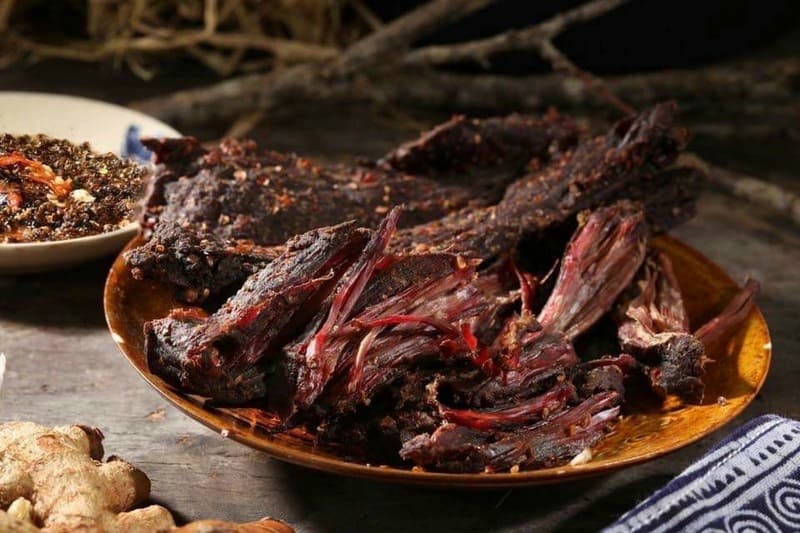
Don’t skip Ma Pi Leng before sampling the beautiful and bold flavors of the food of the highlands. Taste some traditional dishes, including Thang Co (stewed meat), salted dried buffalo, and handmade sausages, each dish full of smoky flavor and tradition.

For something truly unique, you must also try grilled moss or a sip of corn wine to keep you warm in the mountain air. The food is more than just a get-together. It’s a cultural coming together that is felt in every bite.

Ma Pi Leng Pass 5

Travel Back In Time At Dong Van Old Quarter

Tucked away among the ethereal peaks is Dong Van Old Quarter. A tranquil, idyllic town of timeworn stone homes. The region dates back over a century, and has thick earthen walls and tile roofs that echo an irretrievable past.

Wander the narrow lanes of the Dong Van Old Quarter, visit the local markets, or visit the town on a full moon night and enjoy the ambiance of the lanterns along the streets. Here is where tradition can be felt, and where a sense of time truly feels suspended.

Lung Cu Flag Tower 3

Visit The Enigmatic Hmong King’s Palace (Dinh Vua Meo)

You cannot visit Dong Van without visiting the Hmong King’s Palace. Imagine a historic mansion wrapped in legends. Built in the late eighteenth century, the building displays French, Chinese, and Hmong architectural merging slate stone walls, wooden pillars, and curved roofs.

As you walk through the cold, damp halls, you will feel as though you have stepped into a ghostly world. The Hmong King’s Palace is a strangely evocative place of power and antiquity, providing rare insight into the wealthy Vuong family and the communities of Dong Van.

Things to Do in Ha Giang 7

Admire The Lung Cu Flag Tower

Just a hop, skip, and jump from Ma Pi Leng, Lung Cu Flag Tower is the northernmost point in Vietnam. It sits atop Dragon Mountain, 1,470 meters in the air, and flies a red flag representing all 54 ethnic groups of Vietnam. Reaching the top gives sweeping views of the borderland below. It is not just a lookout, it is a symbol of national pride and unity.

Lung Cu Flag Tower 1

Entrance Fee

There is no entrance fee to Ma Pi Leng Pass. It’s a natural wonder, so you can see it totally free and enjoy the beautiful views and thrill of the mountain roads without regard for tickets or price. Just pack your bags, swing your backpack, and go!

Best Time To Visit Ma Pi Leng Pass

Ma Pi Leng Pass is beautiful all year round, with each season showcasing a different flavor of beauty. Whether you’re craving the blooming flowers, the golden rice fields, or the misty mountain vibes, there is always something special waiting for you in Ha Giang.

  • From January to March: The hills are decorated with the blooming plum and peach flowers that line the valleys, consisting of soft pinks and whites; A photographer’s / flower lover’s dream.
  • April: The infamous Khau Vai Love Market occurs, which is only once a year; A chance to release your inner local in a culturally-influenced way.
  • September: The fields of rice terraces turned a golden color – postcard-worthy scenes await. With it being harvest time, the views you’ll experience are unforgettable.
  • From October to November: The Buckwheat flower season occurs! Soft pink and purple blooming flowers decorate the hills even more, making Ma Pi Leng even more romantic and photo-friendly.
  • December: Mustard flowers will begin to bloom! Depending on your luck, you might even be able to see the beautiful snow covering the mountain peaks in those moments of distraction, which is something magical for sure in Vietnam.

How to Get to Ma Pi Leng Pass

There are two primary options to get to Ma Pi Leng Pass. You can arrive by bus or motorbike. Most tourists have started from either Hanoi and gone to Ha Giang City, and from there made their way to the pass either by rental bike or local transport.

Option 1: Hanoi → Ha Giang (by Sleeper Bus)

Buses run every day from My Dinh Bus Station in Hanoi. So you can book in advance and experience the smooth commuting time to Ma Pi Leng Pass, Ha Giang Province.

Duration Price (VND) Notes
6 – 7 hours 250,000 – 400,000 Sleeper bus, departs 05:00 AM – 09:00 PM

Option 2: Hanoi → Ma Pi Leng (by Motorbike Road Trip)

If you’re a more seasoned rider, you can ride your motorbike directly from Hanoi to the Ha Giang and Ma Pi Leng area by taking either of the following common routes:

  • Route 1: Hanoi → Thang Long Bridge → Viet Tri (Phu Tho) → Tuyen Quang → Ha Giang
  • Route 2: Hanoi → Son Tay → Co Tiet → Phu Tho → Doan Hung → Tuyen Quang → Ha Giang

The motorbike ride is long (about 300-350 km) and typically takes between 8-10 hours. You should take sufficient rest breaks and avoid riding at night. Don’t forget to wear a helmet and carry all necessary documents and licenses with you.

Also, after arriving in Ha Giang City, you should get a motorbike to explore with more freedom and security. The roads are winding and steep, so be careful and check that your bike is in good working order.

Ma Pi Leng Pass 6 1 1

Things to Know Before Traveling to Ma Pi Leng Pass

Before heading out to travel the amazing Ma Pi Leng Pass, it’s important to plan ahead. Here are some recommendations to make your trip easier and safer:

  • Only ride if you are comfortable with mountain roads. The curves can be steep and dangerous. If you are unsure of yourself, hire an easyrider who will drive and guide.
  • Dress comfortably. In summer, take a light jacket, but in winter, it might be cold, so dress accordingly with warm layers, gloves, and a scarf.
  • Ma Pi Leng only has one homestay, and many conveyances of other travelers simply stay the night in Meo Vac so they have more options.
  • A 3 day, 4 night trip to see the pass and surrounding areas is a good amount of time, as I think you would want to spend no more than 2 nights in Meo Vac, and if you go during a holiday, you want to have time if you have to share a room with anybody.
  • If you intend to ride, carry your license, vehicle papers, an extra gas canister (1.5L), a tire repair kit, and a mini pump, as there are few mechanics if you experience problems on mountain roads.
  • If you are camping, don’t forget your mosquito clothes, cooking pan, firewood, and stove, as the nights can get chilly, and there are many bugs.

 Final Thoughts: Is Ma Pi Leng Pass Worth Visiting?

Ma Pi Leng Pass is definitely worth the trip. The incredible views, the extensive history, and the exciting mountain roads all make it a memorable place for any traveler. Whether you’re into nature, culture, or adventure in any Vietnam trip, this iconic pass has something unforgettable for you. Let Seni World help you create the perfect itinerary in Ha Giang and experience Ma Pi Leng at its best!

Climb to the Top of Vietnam with Lung Cu Flag Tower

Lung Cu Flag Tower is a symbol of Vietnam’s sovereignty at the northernmost point of the country in Ha Giang. Atop Dragon Mountain, the tower offers stunning views, cultural significance, and deep national pride.

Introduction To Lung Cu Flag Tower

Lung Cu Flag Tower sits majestically atop Dragon Mountain in Ha Giang Province, marking Vietnam’s northernmost point at nearly 1,700 m elevation. This iconic structure, a 33 m octagonal palace, proudly hoists a 54 m² public flag representing Vietnam’s 54 ethnic groups.

A rise of over 800 gravestone ways rewards callers with broad vistas of plunging karst denes, terraced fields, winding Nho Que River, Chinese borders, and traditional ethnic villages below. At its base, an honorary hall exhibits the customs, tools, and dress of original H’Mong, Lô Lô, Tay, and Pu Péo communities.

Visiting Lung Cu Flag Tower offers much further than a print at the “ north pole. ” It’s a chance to feel public pride, substantiate different mountain societies, explore vibrant weekend requests and bordering villages like Lo Lo Chai and Pà, and witness the untamed beauty at the edge of Vietnam.

Lung Cu Flag Tower 1

History Of Lung Cu Flag Tower

The original Lung Cu Flag Tower dates back to the Ly Dynasty and was simply a sa moc (Cunninghamia) tree marking the northernmost point of the country.

In 1887, the French reconstructed the palace, making it a more defined corner. Several emendations followed in 1992 and 2000, each time expanding its size and significance. In 2002, a major upgrade gave the palace a 20-cadence height with a hexagonal base. Six citation reliefs depicting Dong Son drum patterns were placed around its pedestal.

A 9-cadence flagpole was installed at the top, flying a 54 m² Vietnamese flag representing the 54 ethnical groups of Vietnam. With the blessing from the Prime Minister, Ha Giang Province restored the palace into an octagonal shape over 30 meters. It was officially inaugurated on September 25, 2010.

Unique Architecture Of Lung Cu Flag Tower

Located on the top of the Dragon Mountain, Lung Cu Flag Tower has an octagonal shape and a striking presence at 33.15 meters. The bold red Vietnamese flag, 54 m² in size, proudly canvases at its peak, making it visible from a long distance.

To get to the top of the mountain, you will hike up 839 marked graves divided into three sections that have overlook resting maps to view the rough mountainous topography below.

You will see eight elaborate bas reliefs depicting the most significant historic periods of Vietnam encircled around the base. The body of the palace is adorned with patterns of the lesser-known Dong Son drums, giving a decorative dimension to the structure. Visitors can look out from the top across the northern border of Vietnam, where misty mountains touch the sky. It is a combination of public pride, natural beauty, and adrenaline of the subjugation within a single moment of an experience.

Lung Cu Flag Tower 2

5 Cultural Experiences You Shouldn’t Miss

There’s further to see around Lung Cu than just the flag palace. After visiting the peak, take time to explore near villages and upland municipalities; you’ll discover unique societies, beautiful decor, and warm-hearted locals to explore the best things to do in Ha Giang.

Wander Through Dong Van Ancient Town

Dong Van Ancient Town is about 50 minutes away from Lung Cu Flag Tower, and this is one of the best places to visit in Ha Giang. This little town is very charming with its old homes, cemeteries, and mountain vibe. Most of the homes were built over 100 years ago and maintain their beauty. The architecture is unique with thick earthen walls and tile roofs.

At night, the entire street is illuminated by many various lanternslichen nighttime lightswhich create a nice, relaxing, and magical atmosphere. The ancient town becomes even more remarkable if you come on the full moon day. It usually takes about 1 month for the lunar calendar to have a full moon day, because on these nights, locals decorate the site with bright lights and flowers. It is like taking a walk through a postcard from history.

Lung Cu Flag Tower 3

Explore The Dong Van Karst Plateau

The Dong Van Karst Plateau is a remarkable natural wonder and a UNESCO Global Geopark. It consists of four sections and consists of jagged limestone peaks, deep green valleys. The terrain certainly looks rugged and extends all the way to the horizon, and looks untamed and beautiful. It takes your breath away.

When you visit, you are scooting on snaking hidden roads, exploring quaint ethnical house-lots as the slate gravestone mountains clash with the blue horizon and terraced fields kiss the hills in soft sculpted curves. It is a place that any nature lover should see, or anyone looking for peace and tranquility in travel.

Lung Cu Flag Tower 4

Admire The Beauty Of Sung La Valley

In this valley lies a small place called Sung La, or the place where jewels grow, for flowers, in a rocky valley, grow. The vale from October and late April has pink buckwheat and the heroic mustard flowers, which are bright, for it becomes soft and beautiful in the rocky vale. It is a place for prints.

Sung La also has Pao’s House, where a traditional house from a famous Vietnamese movie sits. The house shows how some of the original people lived with rough walls and compressed floors. After a long day, you will see quiet towns with children playing and working in the fields. That is it! Simple, quiet, and charming.

Lung Cu Flag Tower 5

Visit Lo Lo Chai Village

Lo Lo Chai is a small village located right underneath the Lung Cu Flag Tower. It is inhabited by the Lo Lo ethnic minority group, who still live in traditional grave and complexion houses. The village is quiet and sleepy, with narrow roads lined with flowers and lively locals. Life here seems to move more slowly, just as it did many thousands of years ago.

While you will be here, you will see people weaving clothes, cultivating sludge, and cooking food over open fires. The Lo Lo people wear gorgeous handwoven traditional costumes in bright colours (this is not quite as important as some of the clothes that the people in Shanghai wore).

Lung Cu Flag Tower 6

Join the Local Markets In Dong Van

Every Sunday, Dong Van Market is the most diverse place in the entire city. People from nearby villages have come together to trade fruits and vegetables, clothing, and even tools. You will see women dressed in lovely dresses, while men stare at every stall while they sip tea, and laughter from children will ring out. It is a colorful view of life that brings all the communities of Ha Giang together.

For a small fee, you can sample local dishes such as Thang Co, or mud wine, or you can buy some handcrafted items or souvenirs to take home with you. I can say, even if you perceived nothing, you would still enjoy wandering about just to enjoy being there. The sights, sounds, smells, and colors from this event will certainly stay with you long after your trip.

Lung Cu Flag Tower 7

Entrance Fee

Before going to the Lung Cu tower, please check how much it costs and bring some money. It is a small fee, but it serves the purpose of keeping this important site up.

Age Price
Aldut 25.000 VND/pax
Children above 1m2 25.000 VND/pax
Children under 1m2 Free

Opening Hours

Lung Cu Flag Tower is open to visitors every day from 8:00 AM to 5:00 PM, including weekends and public holidays. You can go there any time of the year, but certain times bring very unique experiences.

  • During January and March, spring arrives in the region with peach, plum, and mustard flowers blooming. Festivals also come during this season, which is wonderful for observing local customs amidst a festive spirit.
  • In May, the locals fill the rice terraces with water to begin planting. The glossy paddies reflect the sky and mountains, creating peaceful and picturesque scenery.
  • From June to August, it is cool and dry. It is ideal for tourism, trekking, and photography. The blue sky and green hills provide the landscape with a fresh and vibrant appearance. October to December is the buckwheat flower season.

How to Get to Lung Cu Flag Tower

Lung Cu Flag Tower is 150 km away from Ha Giang City. The most convenient way to get there is by bus from Hanoi to Ha Giang, which takes 6 to 7 hours. Then, you can rent a motorbike or a car in Ha Giang City to visit the area. The suggested route is: Ha Giang City – National Road 4C – Quan Ba – Dong Van – Lung Cu.

When you reach the base of Dragon Mountain, you must climb 839 stone steps to get to the flag tower. The climb is broken into three parts, and each part has a small resting area where you can sit and view the scenery.

Service Price (VND) Notes
Electric car to the base 15,000 / person Free for children under 5
Motorbike parking ~10,000 / bike Pay at the designated parking area
Bus Hanoi → Ha Giang 250,000 – 350,000 Sleeper or limousine bus (6 – 7 hours)
Motorbike rental (per day) 150,000 – 250,000 Available in Ha Giang City

Things to Know Before Traveling to Lung Cu Flag Tower

Traveling to Lung Cu Flag Tower is a great experience, but with some planning, you can make your visit more rewarding and enjoyable. Here are some things you should know before you go:

  • Bring warm clothes and layers: Since Lung Cu is located at a high elevation, the temperatures fall below 14 °C, even during summer.
  • Wear sturdy, comfortable footwear: There are 839 stone stairs to ascend, so good footwear is important.
  • Bring a power bank, snacks, and water: Facilities are minimal, so bring necessities to keep you going and keep you connected.
  • You can rent a motorbike or a private vehicle for rent. Public transportation ends in Ha Giang city, so private transport provides greater flexibility.
  • Bring insect repellent and a first aid kit: The countryside can have insects and unpredictable weather, so maybe be prepared.

FAQs About Lung Cu Flag Tower

Is this your first time visiting the Lung Cu Flag Tower? Below are some of the most commonly asked questions to help you plan and have a great trip.

How tall is the tower, and how big is the flag?

The flag tower itself is an eight-sided tower that is 33 meters tall, with a flag pole that is an additional 9 meters. The flag of Vietnam is about 54 square meters, which represents the 54 ethnic groups of Vietnam.

How many steps do you have to climb to get to the top?

It is made of 839 stone steps divided into three sections, and there are rest areas in between each section. You can also take the electric car up to the middle and only climb the last 283 steps.

How much is the admission fee?

It is about 25,000 VND for adults, and children who are less than 1.3 m get in free. There is also a 15,000 VND fee for adults if you take the electric car to the base of the tower.

Is it open year-round?

Yes, you can visit the Lung Cu Flag Tower all year long. Keep in mind that it may be very cold at this altitude in the winter (December to February), so bring warm clothes!

Are there facilities at the tower or base?

There are thought to be basic facilities which include toilets, a small counter to buy tickets, and somewhere to rest. There are very few food stalls and beverage vendors, so it is advisable to bring your own refreshments and snacks.

Final Thoughts: Is Lung Cu Flag Tower Worth Visiting?

Lung Cu Flag Tower is not just emblematic of the north, but also has stunning landscapes and a rich cultural identity that is steeped in national pride. Every trek up Dragon Mountain and every village visit is like a moment in time. If you want an experience of a unique Vietnam trip filled with beauty but also local living experiences, this would be the place to visit. Let Seni World organize an unforgettable trip for you to Ha Giang now!

Where To Stay In Ha Giang: Top Picks for Every Travel Style

Where to stay in Ha Giang? From hotels to home stays, both traditional and rustic at Dong Van and Meo Vac, follow this guide on the best recommendations to discover your dream place to stay.

Popular Areas To Stay In Ha Giang

Depending on where you stay, your experience will differ. With the hustle and bustle of some of the city’s core, to the peaceful mountain towns, both provide their grace, amenities, and beautiful, picturesque surroundings. Here, we’ve scouted the trendiest spots and the top hotels, hostels, and homestays within those areas.

Accommodation in Ha Giang City Center

The heart of Ha Giang Province, Ha Giang City Centre, is the province’s gateway and the best place to start exploring these glorious mountains of the north. As the beginning of the popular Ha Giang Loop, it gives you access to taxis, bikes for rent, supermarkets, ATMs, as well as local food shops.

Some travellers spend a night here before or after driving the loop. And it’s the best position to meet guides or link up with local drivers if you’re not going to drive solo. Ha Giang City accommodation varies from cheap guest houses and comfortable hotels to the more “homely” homestays led by a local family.

Phoenix Hotel

As a 4-star hotel, Phoenix Hotel offers comfort and convenience. There is an indoor pool, a fully-equipped fitness center, and a daily buffet breakfast for guests to enjoy. The views from many of the rooms are of the stunning mountains and rivers, which add a relaxing ambiance to the end of long rides. The staff is professional and accommodating; it’s a top choice for solo travelers and families.

Where To Stay In Ha Giang 1

Silk River Hotel

The Silk River Hotel is one of the 3-star hotels in Ha Giang. With more than 30 guest rooms in semi-classical style and a warm and luxurious interior tone, this hotel is equipped with all modern facilities. At the top lines are processed by professional human resources, Silk River Hotel began to build the strongest services as well as the most recommended name of the hotel in Ha Giang City.

Where To Stay In Ha Giang 2

Four Points by Sheraton Ha Giang

The best option for travelers looking to bask in the highlands is the newly Five-Star Four Points by Sheraton. This hotel provides luxury amenities and on-site facilities, such as an indoor pool, a full-service spa, and fine dining. With a new property to match its quality and a level of service that is simply the best, the property is home to a five-star experience, right at the heart of Ha Giang. It’s a good pick for a couple or a celebratory meal while in town.

Where To Stay In Ha Giang 3

Ha Giang Hostel

The best hostel option for budget travel is Ha Giang Hostel. It is a very basic, no-nonsense place to sleep, with rates tending to hover around 260,000 – 280,000 VND per night. As with the other hostels in Ha Giang, the vibe here is affable, and the staff are regularly called upon to assist travelers with motorbike hire. They also help you with maps and off-the-beaten-path local secrets. There’s also a tiny pool with pretty views, ideal for a cooling-off dip after a day of sightseeing.

Where To Stay In Ha Giang 4

Accommodation in Dong Van

Dong Van, which is a UNESCO Global Geopark, has an interesting accommodation experience amidst the beautiful karst landscape and unique cultural beauty. This is a charming old town, and it gives you a glimpse of what local life is like, so it is a fantastic overnight stop-off on your loop ride.

The region is renowned for many homestays, where visitors can stay with locals in traditional H’mong and Tay ethnic villages. Such lodging is usually of traditional design, the food is home-made, and visitors are often given the chance to take part in local activities such as agricultural work and the production of handicrafts.

Little Yen’s Homestay

Little Yen’s Homestay is a family-owned homestay that emulates the warm and friendly nature of the people of Ha Giang. Rooms here are simple but cozy, featuring traditional touches like wooden beams, thick handmade blankets, and mosquito nets for a good night’s sleep.

The facilities are simple but clean and workable with hot showers, shared and private bathrooms, and comfortable mattresses. And most rooms come with a view of limestone peaks and/or terraced fields, so you can wake up to awesome natural beauty, Ha Giang.

Where To Stay In Ha Giang 5

Maison De Hill Homestay

If you’re seeking a truly cultural experience, check out the Maison De Hill Homestay. Nestled in a charming village just outside Dong Van, this family-run spot feels like a warm embrace. The cozy wooden interiors are adorned with handwoven blankets and inviting communal spaces that encourage connection.

Guests often rave about the genuine hospitality here, along with the delicious home-cooked meals made from fresh, local ingredients. The hosts are incredibly friendly and likely to share fascinating stories about local traditions, giving you deeper insights into the culture.

Where To Stay In Ha Giang 6

Dong Van Golden Hotel

Dong Van Golden Hotel is a budget hotel with a cheap rate, lovely mountain views, and helpful staff! Motorcycle rentals can be arranged at the property, and the hotel has everything from dorms to family suites with prices from 150,000 VND per night, depending on the season and type of room. It’s a favorite for backpackers and budget-oriented couples looking for a place to crash with easy access to the local attractions.

Where To Stay In Ha Giang 7

Epic Dong Van Hotel

A tranquil atmosphere and excellent service are only two of the many things Epic Dong Van Hotel has to offer. The hotel receives consistently high reviews for its peaceful location, attentive staff, and well-kept rooms.

Though a bit away from the center of town, this adds to its tranquil feel, and it’s a nice place to bed down on an overnighter for loop riders that want to chill out. Rooms are minimal but comfortable, with updated bathrooms and good water pressure. This is a small but appreciated luxury in these remote parts of Vietnam.

Where To Stay In Ha Giang 8

Hoa Cuong Hotel

Hoa Cuong Hotel is noteworthy for its nine-story contemporary architecture and significant room count (82 in total). The location is central for you to walk around the night market and local foods, the main attractions. Rooms are comfortable with private bathrooms, air conditioning, and Wi-Fi, and are a good option for travelers who appreciate the convenience of a typical hotel stay.

Where To Stay In Ha Giang 9

Accommodation in Meo Vac

It is the stunning northern gateway to the renowned Ma Pi Leng Pass showcasing which boasts spectacular mountain views that make you feel like you’re on top of the world. The accommodation options on offer here, from quaint homestays to charming hotels, are as varied as the lush karst scenery that envelops them.

Ong Vang Meo Vac Hotel

If you are searching for a nice accommodation for your next journey in Meo Vac, the Meo Vac hotel is ideal. Guests appreciate that the hostel is clean, has good facilities and friendly services, and has very convenient staffing that is always there to help. A spacious terrace is one of the highlights of the hotel, from where you can just breathe in those unforgettable mountain views. They also provide a substantial breakfast to start the day, and it’s well-positioned for exploring the town and the area.

Where To Stay In Ha Giang 10

Auberge de Meo Vac Mountain Lodge

The central market is a 10-minute walk from the Auberge de Meo Vac. Beautiful lodge that reflects the traditional roots, combined with comfortable guest rooms that seem like a snuggly home away from home.

Visitors are charmed by this one-of-a-kind retreat and the serene mountain setting. Nestled among the gorgeous limestone karsts of the region, your stay here will feel like a happy marriage of nature and culture, and almost every moment is designed to be special.

Where To Stay In Ha Giang 11

A Sen Homestay

If you want spacious family homestays in Ha Giang, A Sen Homestay gets it done for you. The hosts are terrific and serve fantastic home-cooked meals. Situated about 6 km away from the main city, this place is a wonderful escape from market madness.

The rooms are just so warm, with beautiful views of the green rice terraces and big mountains all around. It’s the sort of place where other Ha Giang Loop riders come together in the evening, taking in the area culture and eating great food, before they head out on the road again.

Where To Stay In Ha Giang 12

Meo Vac Valley Hotel

Meo Vac Valley is a clean, easy-to-navigate, and a good place to stay. It provides clean, simple rooms with all the basic comforts to satisfy you for a brief stay as you pass through. The staff are friendly and the atmosphere is quite close to the town center, about a 12-minute drive, where the Sunday market is, and you can eat in a local restaurant. It doesn’t have all the perks of bigger hotels, but for many thrifty travelers, it’s just cheap enough to be considered practical.

Where To Stay In Ha Giang 13

Mr Hung Guesthouse

Popular with Ha Giang Loop motorbike riders, this little guesthouse is reputed to be friendly, great value, and central. The rooms are clean and have basic furniture, which is ideal for backpackers. What elevates this guesthouse, however, is the host, Mr. Hung. He is a perpetual source of smiles, local recommendations, and assistance with logistics. Guests often mention how relaxed he makes it to get in and out of the area.

Where To Stay In Ha Giang 14

Accommodation in Yen Minh

Yen Minh is a peaceful place in the mountain range, aside from superb century-old terraced fields. Great options for people who are looking for something relaxing and natural beauty without the crowds prevalent in many other tourist locations.

Na Ma Guesthouse

Na Ma Guesthouse is in the town and close to area attractions, including Yen Minh Pine Forest (about 17 km). The inside is quite modern, and it has a cozy, yet posh atmosphere. The staff is friendly and is always willing to help guests. The hotel offers massage services, sauna, bar to relax and unwind after a busy day. Great for those looking for a little rest, with a break for easy access.

Where To Stay In Ha Giang 15

Homestay Friendly Yen Minh

Located in Coc Pang village, Homestay Friendly is a charming traditional wooden stilt-house made from local materials such as wood, bamboo, and reeds, with respect to the environment.

Here, you will wake up in the poetic scene with the sound of birds and the stunning sight of misty rice terraces. Pick up the pace of seasonal farm life at the Streams Lodge Homestay with activities including rice harvesting. It’s all about rustic charm and a deep respect for nature, the epitome of what hospitality really is.

Where To Stay In Ha Giang 16

Stream Lodge Homestay

Located by the peaceful Du Gia stream, the homestay offers a perfect getaway for those longing for fresh air and true nature.
Some of the accommodation options available include bright double rooms with wonderful views of the lake, a large room big enough for three guests, and eight-bedroom dormitories; all have ensuite facilities. But the biggest attraction here is++++ the infinity hot pool. While you bathe in warm water, you can stare out at the stunning mountains that surround you.

Where to stay in Ha Giang

How Long To Stay In Ha Giang

How long you stay in Ha Giang depends on how you want to travel and what you hope to experience. If you’re like most visitors, three to four days should be a perfect amount of time to take in the art and history of the region and explore its varied and beautiful natural landscape.

Most itineraries can cover Ha Giang city, Dong Van, Meo Vac in 3 days among travellers. With this itinerary, you will be able to complete the full Ha Giang Loop with a good balance of places, activities, and a couple of restful days.

Final thoughts

Where to stay in Ha Giang can influence your experience. Every attraction has its own special beauty: Dong Van with its cultural history, Meo Vac with its grandeur, Ha Giang City with its ease of access. And if you just want to keep your adventure hassle-free, contact SeniWorld. They help you with everything from Ha Giang Loop tours to motorbike rentals and homely accommodations.

Ha Giang Food: Explore The 10 Best Mountainous Cuisine

Ha Giang food reflects the ethnic culture of the region and its inherent rustic ingredients and only methods of preparation. For backpackers and foodie travelers alike, eating Ha Giang food is an experience you won’t soon forget.

Thang Co (Traditional Horse Meat Soup)

Thang Co

Thang Co is one of the earliest and most recognizable ones among the cuisine of ethnic Hmong in Ha Giang. Normally, Thang Co is made with horses and cooked with organs like the heart, liver, and intestines. It is flavoured with local herbs like cardamom, lemongrass, ginger, and “mac khen” (mountain pepper, which is only found in this region).

It smells strongly of offal, and the flavor is not only unusual but can be very off-putting to those not well-acquainted with organ meats. But to the inhabitants, it’s a comfort food, best enjoyed with fresh vegetables and a glass of warm corn wine. Eating Thang Co isn’t about trying out a new food; it’s about knowing the culture, the rites, and the relationship among the people of the ethnicity. It smells strong and gamy of offal, and the flavor is not only unusual but can be very off-putting to those not well-acquainted with organ meats.

For a real taste of this Ha Giang food, check out one of the Sunday markets in Dong Van or Meo Vac. Thang Co is typically served hot, communally, with people sitting around, chatting. The price for a portion for 2–3 people typically is around 100,000 – 150,000 VND.

Chao Au Tau (Au Tau Porridge)

Chao Au Tau

If you are interested in Ha Giang traditional medicinal cuisine, try Chao Au Tau (Au Tau porridge). This nourishing porridge is made from a bitter root plant called au tau, which only grows in the cold, mountainous areas like Ha Giang.

According to the locals, this dish aids sleep, reduces joint pain, and increases energy, making it especially popular on cold nights. Chao Au Tau usually combines sticky rice, simmered pork, shallots, and is topped with green onions. It has a bitter taste but is delicious when you juxtapose it with the soft meat and flavors of the rice. Chao Au Tau is often sold by elderly ladies in small street stalls or late-night diners in the city.

Banh Tam Giac Mach (Buckwheat Cake)

Banh Tam Giac Mach

The seeds are ground into flour, mixed with water, and steamed or griddled into dense, slightly chewy cakes. They have a mild taste and are nutty. Some people grill the cakes over hot coals; this imparts a smoky fragrance and provides the cake with crisp edges. Others like to eat them while they are warm and softer, tinged with a touch of honey or sesame salt. Either way, it’s a snack symbolic of the highland life.

These buckwheat cakes can be found primarily in village markets like Dong Van Market or during the Buckwheat Flower Festival in late autumn. They’re not street food at all. They’re also a testament to the resilience of people living in rocky, hard-to-farm terrain who manage to turn even the lowliest of crops into something nourishing and memorable.

Xoi Ngu Sac (Five-Color Sticky Rice)

Xoi Ngu Sac

One of the most spectacular and important Ha Giang foods from a visual and cultural standpoint is Xoi Ngu Sac (five-color sticky rice). This is a traditional dish that can be seen at ethnic festivals, weddings, or Tet (Vietnamese Lunar New Year). Every color is made from real ingredients: magenta leaves for purple, turmeric for yellow, and pandan leaves for green.

The sticky rice, which can be soft and fragrant, is often eaten with sesame salt, grilled meat, or boiled eggs. If you are doing a cultural festival in Ha Giang and you are looking for what to eat in Ha Giang, then Xoi Ngu Sac rice should be one of your savory menu items. It can typically be found at local markets and community events, especially in districts such as Quan Ba or Dong Van.

Thit Trau Gac Bep (Smoked Buffalo Meat)

Thit Trau Gac Bep

Buffalo meat smoked is one of the most famous delicacies of the Tay–Dao people in Ha Giang. Rather than using modern technology, villagers use ancient methods: smoking the meat over wood fires within their stilt houses for weeks, or even months.

To make the dish, fresh buffalo flesh, often from the thigh or shoulder, is sliced long, thin, and marinated with time-honored mountain spices. The seasoning often contains salt, chili, garlic, and “mac khen”, a wild pepper that grows exclusively in the forests of Vietnam’s north. The result is a chewy, smoky, high-protein dish that’s ideal as an appetizer or side dish. Locals will frequently tear it by hand and dunk it in spicy chili sauce, or pair it with corn wine.

You can buy this dish as a souvenir for the price of about 900,000 – 1,200,000 VND/kg.

Corn Wine

Ruou Ngo

No tour of Ha Giang food is complete without sampling corn wine, which is the drink of choice for almost any ethnic group in the region. Unlike the lowlands along the coast, where rice is the staple food, corn is more than just food in Ha Giang. It is also a part of life itself. Locals ferment and distill the corn after harvesting, using handmade clay or bamboo equipment. And all of this is purely natural and handed down through generations.

In Ha Giang, if you are invited into someone’s home at any time of the day, it would be impolite to refuse a sip of corn wine. Not a food, corn wine is, however, so deeply ingrained in local food dining culture that it deserves a place amongst the best food in Ha Giang you have to try!

Banh Cuon (Ha Giang Steamed Rice Rolls)

Banh Cuon

Banh Cuon can be found throughout Vietnam, but the one in Ha Giang has a special variation that distinguishes it from others. Here, the rice rolls are stuffed with egg or minced wood ear mushrooms, and instead of the standard fish sauce, they are served with a bowl of savory pork bone broth. This slight but significant twist makes the dish warm and hearty, a dish more suited to the cold mountain air.

Locals routinely eat them for breakfast or lunch. If you want to know what to eat in Ha Giang in the early morning, then this comforting dish will do the trick. You’ll come across it at street stalls and small local eateries, particularly in Ha Giang City. It costs about 25,000 – 40,000 VND per serving.

Banh Thang Den (Victory Cake)

Banh Thang Den

Banh Thang Den is a sweet treat that has been part of the culture of Ha Giang’s ethnic groups through many generations. The dough, made from glutinous rice flour, is balled by hand and filled with a granular filling of sesame seeds, crushed peanuts, and sugar. The rice balls are boiled until they rise to the surface of the water and become soft and chewy. Finally, into a bowl of hot, steamy ginger syrup they go, taking a sweet, spicy bite of heat to warm the insides, just the thing for a cool night in the mountains.

Victory Cake is not just a tasty snack; it’s a cultural keepsake. You will find this Ha Giang food in night markets or during local festivals, at least in towns like Dong Van or Meo Vac.

Men Men (Steamed Cornmeal of the H’Mong)

Men Men

One of the simplest but also most important dishes in Ha Giang is Men Men, a steamed cornmeal cake and one of this ethnic group’s staple foods. Men Men provides a stark reflection of the locals’ resourcefulness and profound connection to the land.

The dry corn is first soaked in water and then ground using stone mills into a fine powder before steaming twice in a traditional bamboo steamer. The result is slightly dry, grainy, and crumbly. But when swirled in a rich broth or ordered alongside pork shoulder or stir-fried leafy greens, it becomes a filling, warm embrace of a meal.

Men Men isn’t something you can order in tourist restaurants, it’s found in the kitchens of ethnic families and rural market stalls. The experience of trying it is instructive about how people in Ha Giang live with and off of what nature offers.

Sour Pho

Pho Chua

Pho may be the best-known of Vietnam’s noodles, but Ha Giang serves up its very own modification with Sour Pho, a dry version rich in flavor and texture. Instead of traditional piping-hot broth, this iteration opts for soft rice noodles with roasted pork, fresh herbs, pickled vegetables, peanuts, and fried shallots. The whole thing is then doused in a tangy-sweet vinegar-based sauce, which brings all the elements together.

This dish is also an example of the Ha Giang cook’s art of adjusting Vietnamese food to the local surroundings and palate. If you find a quick lunch stop in Ha Giang City, or when browsing your way through the small cafes around the mountain loop, this is some of the best Ha Giang food for visitors who want a little bit of something familiar and something more adventurous.

Final thoughts

Ha Giang food is a cultural journey influenced by the ingenuity and traditions of its people. From rich, smoky buffalo meat to vibrant sticky rice and porridge, every dish in this part of the world has a story you can eat. If you’re looking to see Ha Giang through its food and culture, why not travel with ease and local insight? SeniWorld offers customizable tours, transportation, and local guide services that ensure you don’t miss a single flavor in Ha Giang.

Ha Giang Itinerary: Unveil The Great Northernmost Of Vietnam

There are many attractions for you to visit in the Ha Giang itinerary, like Ha Giang City, Dong Van Town, Lung Cu, Sung La, and Meo Vac Town. Let’s read Seni World’s blog below to know more!

Why Choose The Ha Giang Itinerary?

The Ha Giang itinerary is a captivating journey through Vietnam’s Northernmost province, bringing travelers a mixture of impressive natural splendor and rich cultural experience. If you choose Ha Giang, you can have a chance to begin an adventure via attractive karst scenery, winding mountain passes such as Ma Pi Leng, and wonderful terraced rice fields.

Not only does it offer top-notch scenery, but Ha Giang also offers a real glimpse into the lives of numerous ethnic minority groups in Vietnam’s mountainous area. Therefore, travelers, especially global travelers, can hook up with local traditions, traditional markets, as well as the hospitality of local people. Ha Giang itinerary is a perfect selection for those looking for an off-the-beaten-path experience that mixes the thrill of the journey with deep cultural exploration.

What To Expect From The Ha Giang Itinerary

In the Ha Giang itinerary, you will go to many well-known attractions in Northern Vietnam. Let’s find out what to see and things to do in Ha Giang below.

Ha Giang City

In Ha Giang City and on the road along Ha Giang City, you can have a chance to explore iconic attractions like Quan Ba Pass, Cong Troi Quan Ha (Heaven’s Gate), Tam Son Valley, and Nui Doi Co Tien (Fairy Bosom Twin Mountains). They are world-famous places on Social Media platforms and attract many travelers, especially global travelers to Vietnam.

Dong Van Town

When arriving in Dong Van Town, you can not miss out on visiting Dong Van Karst Plateau Geopark, Dong Van Ancient Town, as well as enjoying the cool mountain air when walking on beautiful local roads to see many traditional houses here.

things to do in ha giang 12 1 1

Lung Cu

One of the most symbolic destinations in Northern Vietnam is the Lung Cu Flagpole in Lung Cu Commune. This is a perfect opportunity for you to have a photo of the giant national flag of Vietnam, and save wonderful memories in this destination.

Sung La

At the Sung La and on the road along Sung La, let’s uncover the Vuong Family Mansion (the King of H’Mong Palace), Nha Co Pao (or House of Pao), the H’Mong “rock gardens”, and the Sung La Valley with the lush, brilliant terraced fields.

Meo Vac Town

In the Meo Vac Town and on the road along Meo Vac, we will take you to see the Ma Pi Leng Pass, known as the “King of Passes”, the Nho Que River, and participate in the famous Cho Phien Meo Vac (Meo Vac Market) of ethnic minority groups.

Detailed Itinerary

Seni World will show you a detailed Ha Giang itinerary. This is a flexible adventure that will be customized to be suitable for you.

Day 1: Ha Noi – Dong Van

Early morning of the first day of the Ha Giang itinerary, we will take you from Noi Bai International Airport to the My Dinh bus station. Here, you can enjoy a sleeper bus trip to Ha Giang City, about 6 to 7 hours. When arriving at the Ha Giang City bus station, you will eat lunch with some iconic food like Thang Co (Horse Hotpot) or Pho Chua (Vietnamese Sour Noodle Soup).

Afterward, we will take you on a great adventure from Ha Giang to Dong Van. You will have a chance to see breathtaking, beautiful views when you climb the huge Quan Ba Pass, often called Cong Troi Quan Ha (Heaven’s Gate). Don’t forget to take some memorable photos here, as well as see the whole large perspective of the Tam Son Valley and the well-known Nui Doi Co Tien (Fairy Bosom Twin Mountains).

Arriving at the destination, you can enjoy the Dong Van Karst Plateau Geopark, with towering limestone formations and wonderful winding roads. After having dinner in a local restaurant with various symbolic foods, let’s stroll in the cool mountain air of Dong Van Ancient Town. You will see traditional houses, some of which are over a century old, constructed with clay bricks and tiled roofs. Overnight in Dong Van Town.

Ha Giang Itinerary

Day 2: Dong Van – Lung Cu – Sung La

On day 2, you will have breakfast in Dong Van Town, and then we will drive you from Dong Van to Lung Cu Flagpole. This is a great route with captivating karst landscapes and winding roads near far-flung villages. Climbing to the top of the Lung Cu Flagpole, you can respect the wonderful panoramic perspectives of the entire border vicinity, and you can see China in the distance. This is a perfect opportunity to have a photo of the giant national flag, symbolizing Vietnam’s Northernmost point.

Things to Do in Ha Giang 5
Turn back to Dong Van Town from Lung Cu, and we will visit the Vuong Family Mansion, known as the King of H’Mong Palace. Discovering this unique architectural complex, you can admire a mix of Chinese, French, and H’mong styles. After having lunch in a local restaurant, let’s move to the Sung La Valley to see the iconic H’Mong “rock gardens”. They are beautiful fields surrounded by stone fences.

Next, we will go to the Nha Co Pao (or House of Pao) in Sung La Valley. In the peaceful atmosphere, you will stroll around the village, see the daily life of the local people. In the Sung La Valley, you can also see its serene splendor, and if you arrive at the right season, you can witness the brilliant terraced fields. After an energetic day, we will drive you back to Dong Van Town. Have dinner and overnight in Dong Van Town.

things to do in ha giang 11 1

Day 3: Dong Van – Ma Pi Leng – Meo Vac – Ha Giang

On day 3, you will depart from Dong Van in the direction of Mèo Vạc, which is the best part of the Ha Giang Loop. Then you will arrive at the Ma Pi Leng Pass, known as the “King of Passes” in Vietnam. Let’s take a short break here, witness, and take some memorable photos of the Nho Que River. This river snakes through the pretty, deep emerald canyon underneath and is surrounded by surprisingly tremendous limestone karsts.

Things to Do in Ha Giang 2

When coming to Meo Vac Town, especially on Sunday, you can take part in the famous Cho Phien Meo Vac (Meo Vac Market). This is one of the largest and most dynamic highland markets, where ethnic minority groups collect to trade items, socialize, and unwind in local food. After that, we will take you from Meo Vac, through Yen Minh, and return to Ha Giang City. You will have dinner here, stroll on peaceful roads, and spend your last night in this mountainous city.

Things to Do in Ha Giang 10

Day 4: Ha Giang – Ha Noi

Last day of Ha Giang itinerary, let’s wake up early, enjoy the cool air in the mountainous area, and local food. Then, we will drive you to Hanoi. On the road to Hanoi, you will take a short break and have lunch in Tuyen Quang City. Coming to Hanoi, you will go to the Noi Bai International Airport, say goodbye to Vietnam, and depart to your country. See you again on another Vietnam itinerary.

FAQs About Ha Giang Itinerary

If you want your Ha Giang itinerary to be safer, more memorable, and interesting, let’s learn more about some FAQs below. Seni World has collected these insights from various Vietnamese and global travelers to Ha Giang throughout time.

When is the best time to visit Ha Giang?

The perfect times to uncover Ha Giang for you are Spring (from March to May) for witnessing brilliant blooming flowers and enjoying pleasant temperatures, and Autumn (from September to November) for seeing golden rice fields and unwinding in cool, clear weather. Besides, the period from October to November can also be a peak for domestic travelers.

best time to visit Ha Giang

How can I get to Ha Giang from Hanoi?

There are many types of transportation for you to move from Hanoi to Ha Giang. Among them, the most popular ways include:

  • By overnight sleeper bus (about 6 to 8 hours).
  • By limousine minivan (about 6 to 7 hours).
  • By motorbike (Just for experienced and skilled riders who can drive it directly from Hanoi to Ha Giang).

What should I pack when traveling to Ha Giang?

Some important things you should pack are layered clothing for different temperatures, sturdy footwear, a rain jacket, an umbrella, a basic first-aid kit, sunscreen, insect repellent, a portable charger, and cash (VND – Vietnam Dong).

How much money should I budget for the Ha Giang Loop?

Costs for this trip vary. With Vietnamese travelers, this will be about 2,500,000 to 5,000,000 VND, and with global travelers, this will be about 7,000,000 to 10,000,000 VND (including flight tickets).

If you choose Seni World’s tour, we will customize it in the most budget-friendly way for you. You just need to pay for extra local food, snacks, and souvenirs. Remember, in rural areas, cash is king.

What kind of lodging should I stay in Ha Giang?

If you want to experience a real culture of ethnic minority villages, let’s choose local homestays. They usually provide basic amenities like clean beds and blankets, hot and cool showers, and sometimes delicious home-cooked meals.

Things to Do in Ha Giang 12

Is mobile service available in Ha Giang?

Sometimes, the signal of mobile service can be spotty, particularly in remote and rural areas. If you want to have a smooth trip, let’s download offline maps instead of the online maps.

What are the emergency numbers I should remember when traveling in Ha Giang?

The general emergency numbers in both Vietnam and Ha Giang are 113 for police, 114 for fire, as well as 115 for ambulance. However, you should keep in contact with your tour operator, hotel, and homestay host for assistance in Vietnamese first.

Are there some local customs I should be carefully aware of?

You should dress simply and politely, in particular when you visit religious sites or interact with elders. Remember, do not touch people’s heads, and remove your footwear before entering someone’s home. Local people here, especially the Dao people, have the worship of their ancestors up to 9 generations, as well as worship Ban Vuong, their ancestor.

Should I book accommodation in advance, or will I easily find it on the go?

During peak season (from October to November, public holidays, and special occasions in Vietnam), you need to book lodging in advance, especially if you choose trending homestays. During the low season, you may find accommodation easier and more flexible, but booking it a day or two in advance is still a good idea for you.

Q10: How can I continue my adventure from Ha Giang?

Northern Vietnam has various wonderful destinations. Most travelers choose to return to Ha Giang City, and from this place, you can book a sleeper bus to other cities and provinces like Sapa, Cao Bang, or explore Hanoi. Besides, if you choose Seni World as the tour operator, and you still have energy after the Ha Giang itinerary, tell us, and we will schedule another perfect journey for you.

Final Thoughts: Is Ha Giang Worth Visiting?

If you want to take a Ha Giang itinerary, as well as consult Ha Giang’s accommodation and transportation costs, and receive support for the visa process, let’s contact Seni World, a reputable tour operator from Vietnam. We are here to help you from A to Z on your Ha Giang discovery journey.