logo mobile sidebar
support-image-mobile
Share your ideas with our local expert team - we’re here to listen and help you shape a meaningful journey through Indochina.
(+84) 868 663 993
Asia Leading Tour Operator 2025
tripadvisor travelers choice awards 2024
Travelers' Choice Awards 2025

Author: Linh Nguyen

Hue To Hoi An Travel Options, Distance, Route, And Ways To Go

Hue to Hoi An is among the most stunning travel routes in central Vietnam, where history, nature, and culture all come together. There are several ways to make this journey memorable, depending on your preferred mode of travel.

Overview Of Hue To Hoi An

The journey from Hue to Hoi An is a common part of many travel routes in central Vietnam. These two cities sit just a few hours apart, so it’s easy to visit both without rushing your schedule. Hue brings quiet, temples, and imperial history, while Hoi An is more relaxed, with lantern streets, tailor shops, and riverside cafés. Each place has its charm, and together they offer a balanced experience of culture, food, and local life.

train from hue to hoi an

Travelers often enjoy starting in Hue, then heading south toward Hoi An for a change of pace. The switch from royal tombs and citadels to colorful streets and beachside evenings feels natural. You don’t need to choose between tradition and atmosphere; you get a bit of both. That’s why this route works well for solo travelers, couples, and even families on short trips through Vietnam.

How Far Is It From Hue To Hoi An?

Hue and Hoi An are about 120 kilometers apart by road. Travel time usually ranges from 2.5 to 4 hours, depending on which route and transport you choose. The most direct way is via National Highway 1A, which includes the Hai Van Tunnel. This is the fastest and safest option in bad weather.

If you prefer a more scenic ride, you can go over the Hai Van Pass instead of the tunnel. It adds extra time but offers beautiful views of the coastline and mountains. The route is popular among motorbike riders and travelers looking for a slower, more memorable trip. Travel time also depends on traffic, stops along the way, and weather conditions, especially if you’re not traveling during the best time to visit Hue.

How to Travel From Hue To Hoi An?

There’s more than one way to travel from Hue to Hoi An, and each route offers its own experience. Below are the most common ways to go, along with what to expect from each.

By Motorbike

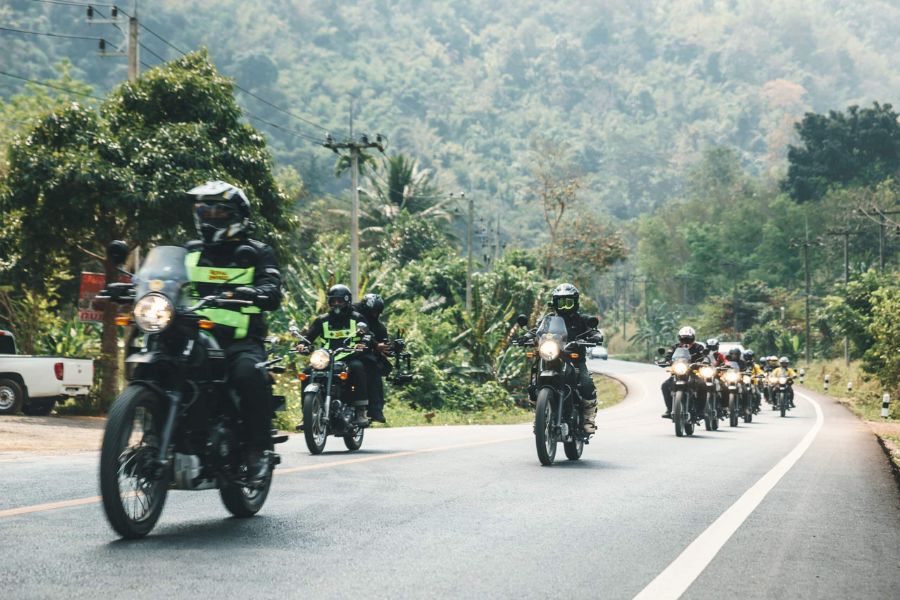
Many travelers choose to go from Hue to Hoi An by motorbike because it gives them full control over the journey. The most scenic route goes through Lang Co Bay, up and over the Hai Van Pass, then down into Da Nang before reaching Hoi An. The ride usually takes around 3 to 4 hours, but it can be longer if you take breaks along the way.

But this journey is not for everyone. The road can be dangerous during rain or fog, and parts of the pass have sharp turns with no guardrails. Riding a motorbike for hours in Vietnam’s traffic can be stressful, especially for those unfamiliar with local driving habits. It’s also important to wear proper gear, check the bike carefully, and plan your stops.

Travel From Hue To Hoi An by motorbike

Aspect Details
Route The most popular route for travelers:

  • Segment 1 (Hue to Lang Co Bay): Leave Hue City and head south on National Highway 1A, passing through Phu Loc and small rural areas until you reach Lang Co Bay.
  • Segment 2 (Lang Co to Da Nang via Hai Van Pass): Ride along the coastline, then ascend the Hai Van Pass, a winding mountain road with sweeping ocean views and photo opportunities.
  • Segment 3 (Da Nang to Hoi An): After descending into Da Nang, continue south along the beach road, pass the Marble Mountains, and arrive in Hoi An.
Distance The total Hue to Hoi An distance is approximately 120 kilometers (75 miles).
Travel Time The average travel time is between 3 to 4 hours, depending on the weather, traffic, and how many stops you make.
Suggested Stop
  • Lang Co Bay: This peaceful bay, home to the stunning Lang Co Beach, offers a beautiful stretch of sand and fresh seafood before heading up the Hai Van Pass.
  • Hai Van Pass summit: This is the most scenic viewpoint along the route and a great place for photos or a short break.
  • Da Nang city center: Many riders stop here for lunch or coffee before continuing to Hoi An.
  • Marble Mountains: These limestone hills offer caves, temples, and panoramic views, and can be a worthwhile cultural stop before reaching Hoi An.

By Bus Or Minivan

One of the most convenient modes of transportation between the two cities is by travelling on a Hue to Hoi An bus or a tourist minivan. The majority of tourists would take a tourist minivan or a shuttle bus, which would be around 5 hours or so door to door. These buses can normally collect you right outside your hotel in Hue and drop you right outside the old town in Hoi An.

There is a big difference in bus quality based on the company. Minivans are not especially slow compared to ordinary buses. However, space is relative, especially when you’re tall or are carried along with bulky bags. The less reliable options may be avoided by booking via your hotel or local agency.

Travel From Hue To Hoi An by minivan

Vehicle Type Price (VND) Travel Time Notes & Tips
Standard bus (open-seat or soft-seat coach) ~180,000 – 250,000 4.5 – 5.5 hours These are the most affordable and widely available options. They may make more stops along the way and can be slower due to passenger pickups. Check if the operator includes hotel pickup/drop-off in Hue and Hoi An.
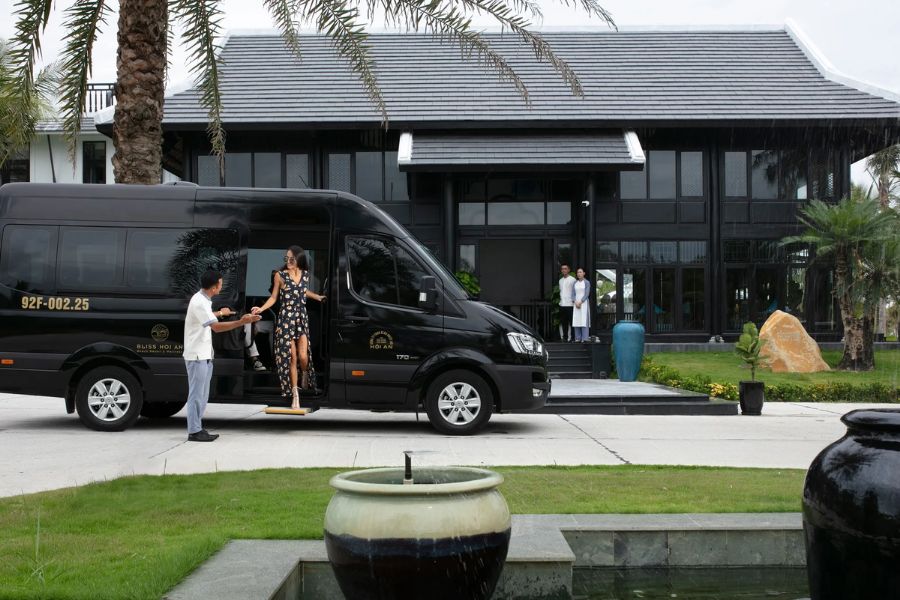
Tourist minivan (9 – 15 reclining seats) ~250,000 – 350,000 3.5 – 4.5 hours Tourist minivans are faster, more comfortable, and often include hotel pickup and drop-off. This is the most popular choice for travelers who value convenience and better air conditioning.
Sleeper bus (reclining berths, sometimes over 30 seats) ~220,000 – 300,000 4 – 5 hours Sleeper buses are less common on this short route, but still available. These are better suited for overnight travel from other cities. If you’re prone to motion sickness, a sitting seat might be a better choice.
VIP or limousine minivan (fewer seats, leather interiors) ~350,000 – 450,000 3 – 4 hours The minivans exude additional leg room, butter-smooth rides, and fewer passengers. Going to pick up at custom times or schedules may be permitted at some companies. Reservations should be made ahead of time, and this is most preferable on weekends and holidays.

By Private Car

If you don’t mind spending a bit more, traveling from Hue to Hoi An by car is one of the most comfortable and flexible ways to go. It’s a good option for travelers who want to avoid busy buses, ride on their schedule, or make scenic stops along the way, like Lang Co Bay or Hai Van Pass.

This option works especially well for families, groups with children or elderly travelers, or anyone who values comfort over price. Most private cars offer hotel pickup and drop-off. You can ask the driver to stop for lunch in Da Nang or take photos at the top of the pass before continuing on to Hoi An.

a picture of Hoi An

Car Type Estimated Price (VND) Travel Time Best For
4-seater sedan Around 1,300,000 – 1,600,000 VND 3 to 4 hours with stops A practical choice for solo travelers or couples looking for a smooth and quiet ride. The car is small but comfortable enough for two people with light luggage.
7-seater SUV or MPV Around 1,600,000 – 2,000,000 VND 3 to 4 hours with stops A flexible option for families or small groups who want more space and better quality rides, especially if traveling with kids or elderly parents.
16-seater van Around 2,200,000 – 2,800,000 VND 3.5 to 4.5 hours with stops Best for larger groups wanting to travel together. There’s more luggage space, and the cost per person becomes affordable when shared among multiple travelers.

By Train

Taking the Hue to Hoi An train is a good choice for travelers who prefer a calmer journey and want to enjoy the view along the way. Although the train doesn’t go directly to Hoi An, you can travel from Hue to Da Nang Station, then take a car or shuttle for the last stretch. Most travelers book a soft seat or a 4-berth sleeper cabin, especially if they want extra space. It’s worth choosing a daytime train so you can enjoy the views through the window instead of sleeping through it.

Travel From Hue To Hoi An by train

Aspect Details
Travel Time The train from Hue to Da Nang takes 2.5 to 3.5 hours, depending on the train type and number of stops.
Cabin Types or Options
  • Soft seat: Air-conditioned seats with modest comfort.
  • Hard seat: Basic seats with no A/C, not ideal for long rides.
  • Soft sleeper (4-berth cabin): Comfortable beds in shared cabins with A/C.
  • VIP 2-berth cabin: Private, quieter, and more spacious (available only on selected trains).
Estimated Price Tickets range from 100,000 to 250,000 VND, depending on seat type and booking time.
Best For A good choice for travelers who want a safe, scenic ride and don’t mind continuing by car from Da Nang. It’s also ideal for those sensitive to motion sickness.
Notes You can book tickets at the station, through hotels, or online. From Da Nang Station, it takes about 45 minutes by taxi to reach Hoi An. Taxis and shuttle vans are readily available outside the station.

Tips For Traveling From Hue To Hoi An

This short journey can become more pleasant and less hasty with a couple of minor things. These helpful tips are what other experienced travelers have discovered on their own.

  • The roads over the pass are subject to fog or slippery roads after rain, thus you should check the forecast the previous night and, if necessary, change plans.
  • The left side of the train seats will provide better views of the coast, particularly when on a day trip down the coast from Hue to Da Nang.
  • Some minivans and tourist buses drop passengers off outside Hoi An’s old town, so it’s helpful to confirm your exact drop-off location before booking.
  • Transport services can get fully booked on weekends or holidays, and many travelers choose to reserve tickets a day or two in advance to avoid last-minute stress.
  • Long sleeves, sunglasses, and sunscreen are helpful for those planning to ride through the pass or stop frequently along the way.

Traveling From Hue To Hoi An

  • Some ride-hailing apps may not work well outside major cities, so it’s better to confirm transport details in advance instead of relying on last-minute booking.
  • Basic phrases in Vietnamese, or a printed address in Vietnamese script, can make it easier to communicate with local drivers or when asking for directions.
  • Gas stations are not available along the Hai Van Pass, so motorbikes should refuel in Hue or near Lang Co town before beginning the climb.
  • Google Maps sometimes suggests the Hai Van Tunnel for the fastest route, but motorbikes are not allowed inside. Riders need to manually re-route over the pass.
  • On certain train services, luggage space is limited and often fills up quickly. Passengers with large bags should arrive early to find a spot before the cabin fills.
  • Tourist minivans may arrive 15 to 30 minutes later than scheduled, especially when picking up from multiple hotels. Keeping some flexibility helps avoid unnecessary stress.

Final Thoughts

Hue and Hoi An are both highlights of central Vietnam, and the journey between them offers more than just a transfer. With a bit of planning, the way you travel can become one of the most memorable parts of your time here. For route advice, transport booking, or a custom itinerary between Hue and Hoi An, feel free to check out Seni World. Our local team is happy to help you make the most of every stretch of the road.

All About Thung Nham Bird Park Natural Landscapes and Local Stories

Tucked away in the lush landscapes of Ninh Binh, Thung Nham Bird Park offers a rare glimpse into Vietnam’s untouched natural beauty. Home to thousands of birds, this peaceful sanctuary invites travelers to slow down and connect with nature.

Introduction To Thung Nham Bird Park

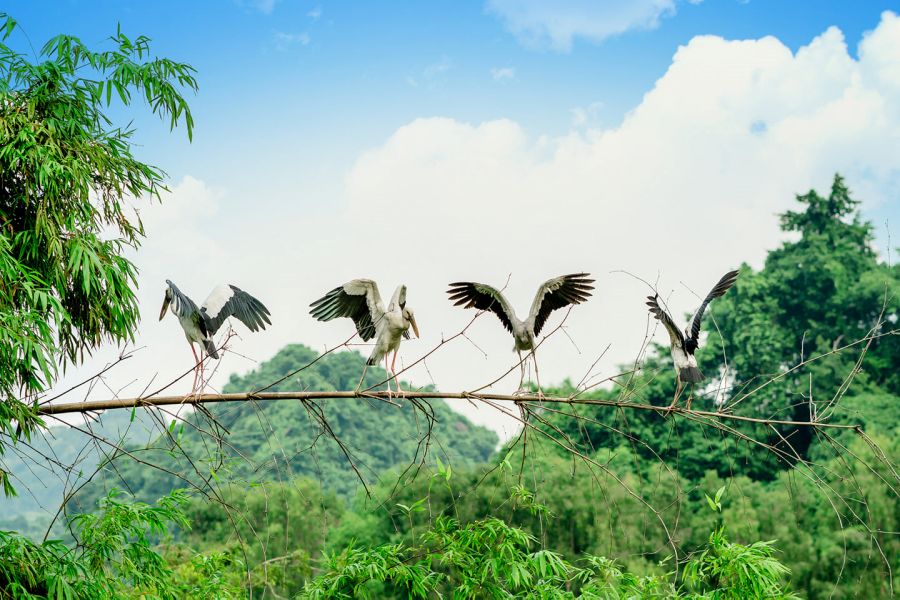
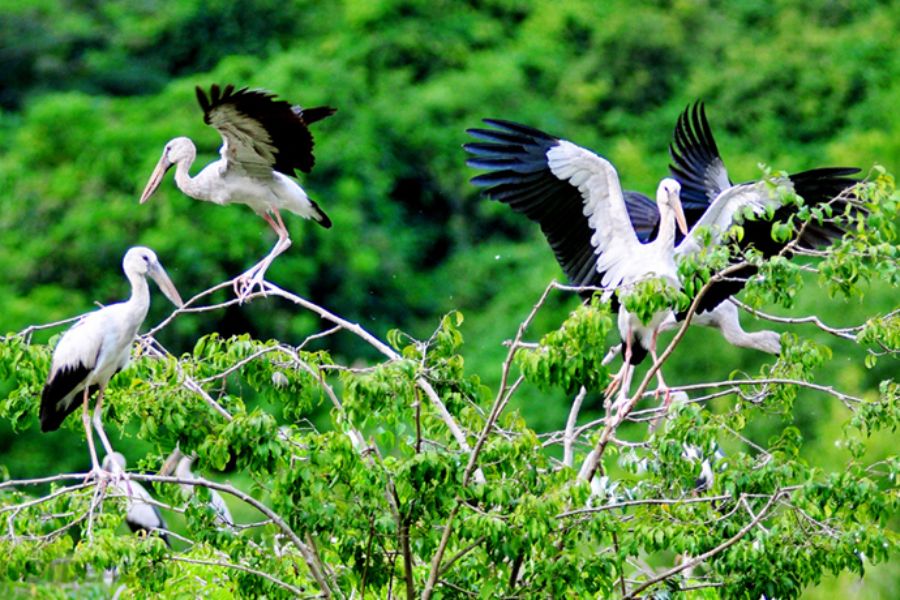
The bird park at Thung Nham is one of the most attractive locations for eco-tourism in Ninh Binh, which is about 100 kilometers south of Hanoi. The park is famous due to its enormous bird sanctuary and natural scenery, and offers a serene traveler facing nature firsthand. There are over 40 species of birds here that stay all year round, and flocks of white egrets come back every afternoon, and this is a rare spectacle.

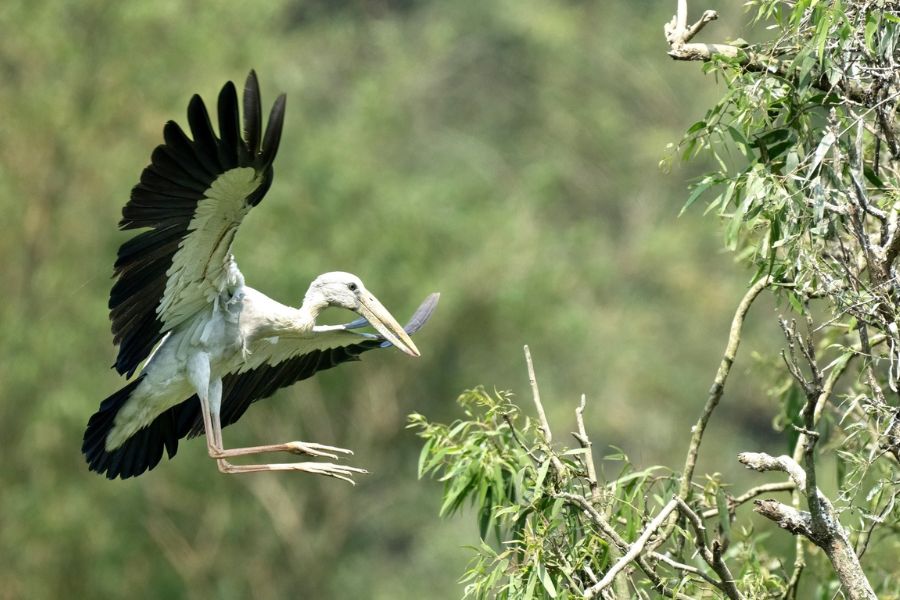
birds in thung nham park

Thung Nham is a place that visitors visit to see birds, but also to visit flooded forests, caves made of limestone, and peaceful streams on a boat. The location is included in the Trang An Scenic Landscape Complex World Heritage site, and is frequently visited along with Tam Coc and Bich Dong. It has everything: wildlife, landscape, and cultural attractions, so it is an all-round centred destination for domestic and foreign visitors.

History Of Thung Nham Bird Park

Thung Nham is in the district of Hoa Lu, which is in the core area of the Trang An Scenic Landscape Complex in Ninh Binh. This region was previously an untamed forest and swamp where the farmers of the region could fish and harvest rice. The flocks of birds have inhabited this place for generations, but their population has decreased over the late 20th century, because of hunting and loss of habitats. Around the early 2000s, the land started to be preserved by local authorities, with the territory becoming a controlled nature preservation.

visit thung nham ninh binh

As the nearby Tam Coc and Trang An started to ramp up tourism, Thung Nham was gradually opened to visitors. There was infrastructure development that introduced small walking tracks, boat routes, and even provisions to accommodate eco-tourism. The conservation activities have allowed bird populations to revive. And today, Thung Nham is known not only as a wildlife sanctuary but also as a local working center, where residents participate as river guides, boat rowers, and farmers.

Top 5 Iconic Attractions In Thung Nham Bird Park

Thung Nham is more than a bird-watching destination. The park includes flooded forests, caves inside limestone hills, and fruit orchards tended by local farmers. With its flooded forests, limestone caves, and quiet orchards, the park offers a serene escape from the busier things to do in Ninh Binh.

Bird Valley (Vuon Chim)

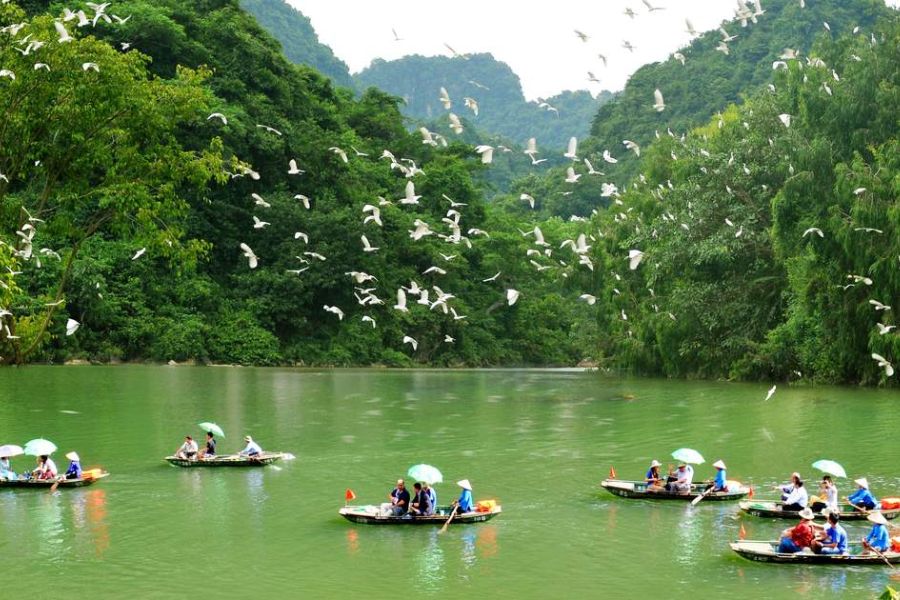
This is the largest bird sanctuary in Ninh Binh and covers wetlands where thousands of birds enter nests in rising trees above the water. To progress through the flooded section, you can take a small boat with a local person rowing. To get the most out of the ride, the best time to go is in the late afternoon. You can see hundreds of white egrets returning in numbers from their feeding at and hoots of roaring in the afternoon across the valley.

Explore Thung Nham Bird Garden in ninh binh

Buddha Cave (Dong Tien Ca)

Buddha Cave lies inside a limestone mountain and is only accessible by boat. The cave is narrow and dim, with natural stone walls shaped by water over time. Some formations are believed to resemble Buddha figures, and the space feels calm and cool compared to the open wetlands outside. Boat rides into the cave take about 10–15 minutes, allowing visitors to pass through slowly and take in the details of the rock. This cave is often included in guided tours and offers a quiet moment during the trip.

Buddha Cave (Dong Tien Ca) in Thung Nham bird park

Orchard Garden (Vuon Hong)

Near the park entrance, there is a large fruit garden where local farmers grow guava, mango, and longan. Visitors can walk along shaded paths, see the fruit trees up close, and buy fresh fruit directly from the growers. This garden is not crowded, and many visitors stop here to rest before or after exploring the bird area. It’s also a good spot to take photos and enjoy a quiet break under the trees.

Mermaid Cave (Hang Ca)

Mermaid Cave is a dry cave that visitors can explore on foot. The entrance is small, and the stone path inside is slightly uneven but safe for most visitors. The cave is known for its strange rock shapes, which locals say resemble fish tails and other sea creatures. Light enters through small openings in the rock, creating patterns along the walls. The walk through the cave takes about 15 minutes, and it provides a cool, sheltered space on hot days.

Mermaid Cave (Hang Ca) in Thung Nham bird park

Banana Island (Dao Coc)

Banana Island is a small island located inside the wetland area. Visitors can reach it by boat, and many tours stop here briefly for walking or photography. The island is covered in wild banana trees, and from its edge, you can see the surrounding wetlands and bird nesting areas. There are no buildings or services on the island, so the visit is short and simple. For many, it is a quiet stop that adds variety to the boat journey.

3 Cultural Experiences You Shouldn’t Miss

In addition to birdwatching and cave exploration, Thung Nham offers small but memorable cultural experiences tied to the daily life of local people. These activities help visitors connect with the land and its traditions in a quiet, hands-on way.

Explore The Bird Watching Platform At Sunset

One of the most memorable experiences is standing on the wooden platform overlooking Bird Valley as the sun sets. Around 5:00 PM, flocks of white egrets, storks, and herons begin to return, flying in waves across the wetland. Locals and travelers gather quietly, watching as the trees fill with birds. This scene is peaceful yet full of life, and many visitors plan their trip around it.

Explore The Bird Watching in Thung Nham

Walk Through the Flooded Forest Trails

In addition to boat rides, Thung Nham offers walking paths through the flooded forest, especially accessible in the dry season. These trails pass through shaded trees, small bridges, and quiet viewpoints where visitors can stop to watch birds or simply enjoy the stillness. Along the way, you may see small shrines, local fishermen, or fruit trees growing near the water’s edge.

Join A Traditional Boat Rowing Experience

At certain times of year, local boatmen demonstrate traditional rowing techniques using foot-rowing or standing positions, which are rare in modern Vietnam. Visitors can try rowing under guidance or simply watch and learn about the skills passed down through generations. This practice is linked to the way communities adapt to life in flooded landscapes.

Entrance Fee

Thung Nham Bird Park entrance fee includes a general ticket and optional services like boat rides or electric carts. Most visitors will need to buy the basic ticket, then choose extras depending on their plans.

Service Price (VND) Notes
Entrance ticket 100,000 / person Required for all visitors
Boat ride to Bird Valley 150,000 / boat Small boat, max 4 people; ideal for birdwatching at sunset
Buddha Cave boat ride 30,000 / person Short optional boat trip into the limestone cave
Electric cart (optional) 30,000 / person From the entrance to the main areas, recommended for families
Children under 1 meter tall Free No ticket required
Group discounts Contact park Available for tour groups; prior booking recommended

Payment tips: Tickets are sold at the main entrance gate. Cash is preferred, though some vendors near the gate may accept mobile payments (e.g., MoMo or ZaloPay). Boat rides are optional but highly recommended to visit Bird Valley during peak birdwatching hours.

Opening Hours

Thung Nham Bird Park opening hours follow a fixed daily schedule, and the park does not require advance booking. Tickets can be purchased at the main entrance throughout the day, and all key attractions inside the park, including Bird Valley, Buddha Cave, and the orchard area, follow the same opening schedule. Visitors are free to explore the park at their own pace within these hours.

The best time to visit depends on your interests, and it often matches the best time to visit Ninh Binh for good weather and active birds. Late afternoon, especially between 4:30 PM and 6:00 PM, is ideal for birdwatching as flocks return to the trees in Bird Valley. The park sees more visitors from May to October, while the cooler months from November to April offer a calmer experience.

birds in Thung nham bird park

Period Hours / Dates Details
Daily Opening Hours 07:00 AM – 06:00 PM Entry allowed all day; the last tickets sold at 05:00 PM
Best Time for Birdwatching 04:30 PM – 06:00 PM Birds return in large numbers; ideal for viewing and photos
High Season May – October Warm weather, more birds, and tourists
Low Season November – April Cooler, fewer visitors; better for quiet walks and cave visits

How To Get To Thung Nham Bird Park

Thung Nham Bird Park is located about 5 km southwest of Tam Coc in Ninh Binh Province and 100 km south of Hanoi. Travelers usually reach Ninh Binh first by train, bus, or car from Hanoi, and then continue to Thung Nham by local transport. The park is set inside a protected landscape area, so the final stretch includes small roads and village paths.

From Tam Coc or Ninh Binh City, visitors can choose between taxi, motorbike, or bicycle to reach the park. The road is paved and accessible year-round, but the last 2 km includes narrow sections through rural areas. Travel times may vary slightly depending on traffic and weather conditions.

Transport Method Travel Time (one way) Cost (VND) Notes
Taxi from Tam Coc 15 – 20 minutes 100,000 – 150,000 Fastest and most comfortable; available at any time
Motorbike rental 15 – 25 minutes 100,000 – 150,000/day Flexible and scenic route; helmets required by law
Bicycle rental 30 – 40 minutes 50,000 – 80,000/day Suitable for active travelers; some uphill sections
Private car from Hanoi 2 – 2.5 hours 1,200,000 – 1,800,000 Ideal for groups or families; parking available on site

Things To Know Before Traveling To Thung Nham Bird Park

Visitors are welcome year-round, but a few practical tips will help ensure a more comfortable and enjoyable experience.

  • The park does not have ATMs, so it’s best to bring cash in small bills for tickets, boat rides, and local snacks.
  • Comfortable walking shoes are recommended, especially during the rainy season, as forest paths can be muddy and slippery.
  • Boat rides may involve waiting during weekends and holidays, so arriving early helps avoid long queues at peak times.
  • While photography is allowed, flying drones requires permission from park staff and should not disturb birds in nesting areas.

overview of thung nham bird park

  • Food options inside the park are limited to basic stalls near the entrance, so plan accordingly if you need a full meal. The road to the park includes narrow village paths; cautious driving is advised, especially when using motorbikes or bicycles. During national holidays or festivals, the park can get crowded, so visiting on weekdays ensures a quieter experience.
  • Tickets and boats are paid in cash at the entrance; mobile payment is accepted at some stalls, but not guaranteed.
  • Mobile signal can be weak in parts of the park, especially near caves and inside Bird Valley, so it’s a good idea to download maps or contact details in advance.
  • The final stretch of road to the park includes some unmarked turns; using Google Maps or asking locals near Tam Coc can help avoid confusion.
  • Sunset boat rides are popular and limited; for the best chance, arrive before 4:00 PM and check availability at the ticket counter upon arrival.

Final Thoughts: Is Thung Nham Bird Park Worth Visiting?

Thung Nham is a quiet place that fits well into a trip through Ninh Binh. It offers a mix of birdwatching, boat rides, and easy walks through forest and farmland. For visitors who enjoy nature and want to see more than temples or pagodas, this is a good stop. The trip is simple to plan and pairs easily with nearby places like Tam Coc or Bich Dong. If you need help arranging transport or timing your visit, Seni World can assist with local travel support.

Phat Diem Cathedral Travel Guide With History And Local Insights

Phat Diem Cathedral in Ninh Binh is a rare fusion of Gothic stonework and Vietnamese temple style, carved entirely from wood and stone. Many travelers come here to explore its unique architecture, peaceful setting, and rich cultural significance.

Introduction To Phat Diem Cathedral

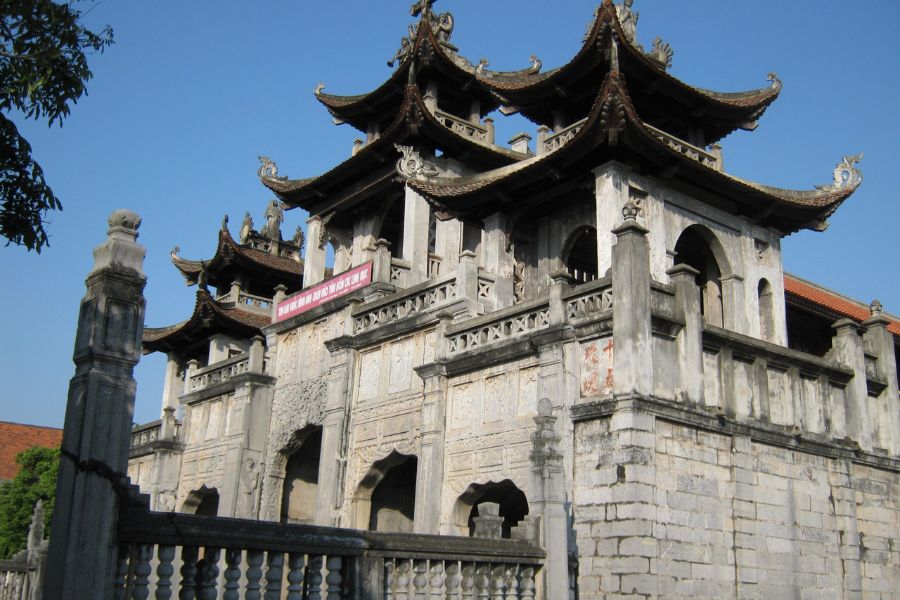
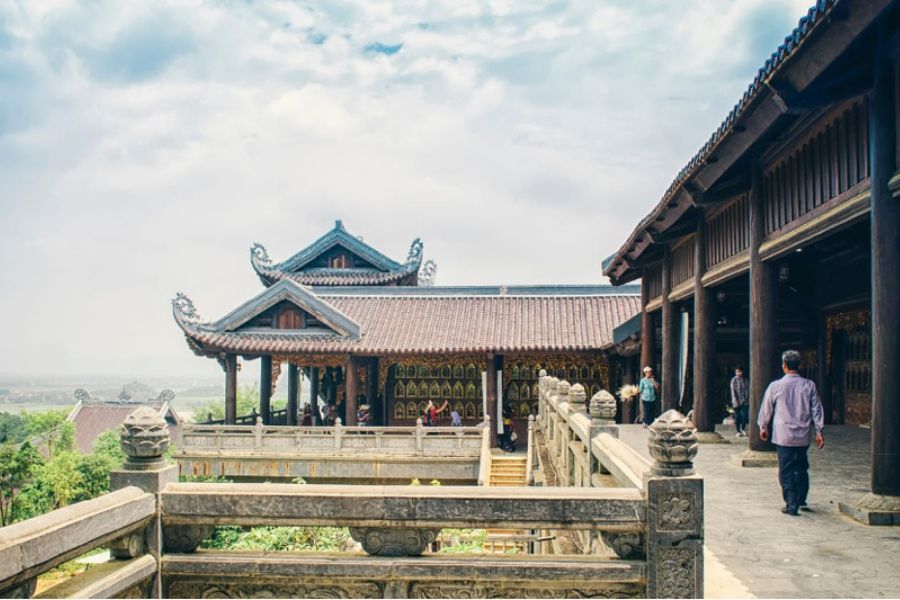
Phat Diem Cathedral is located in Kim Son District, Ninh Binh, about 120 km south of Hanoi. Surrounded by peaceful villages and rice paddies, the cathedral is known for its rare blend of traditional Vietnamese temple design and European Gothic architecture. Built from stone and wood over a hundred years ago, the church complex spans several chapels, a bell tower, and a lake, offering visitors a calm and unique place to explore.
Phat Diem Cathedral_ A Masterpiece of Stone and Faith

Many travelers visit to see how local design and European influences come together in one place. The atmosphere is calm, and there are no ticket lines or large tour groups. Visitors can walk freely around the grounds, take photos, or spend time inside the main hall. It’s a short trip from Ninh Binh city, often included in day tours to nearby attractions, and considered one of the peaceful things to do in Ninh Binh.

History Of Phat Diem Cathedral

Phat Diem Cathedral was built in 1875, with the finishing work being done in 1899. The Catholic priest, Father Tran Luc, was the leader of the project and had collaborated with craftsmen in the area in the design and construction of the complex. It used materials like ironwood and stone that were transported to the site from the nearby mountains. The effect was a church that looked like a Buddhist temple and was Catholic at work.

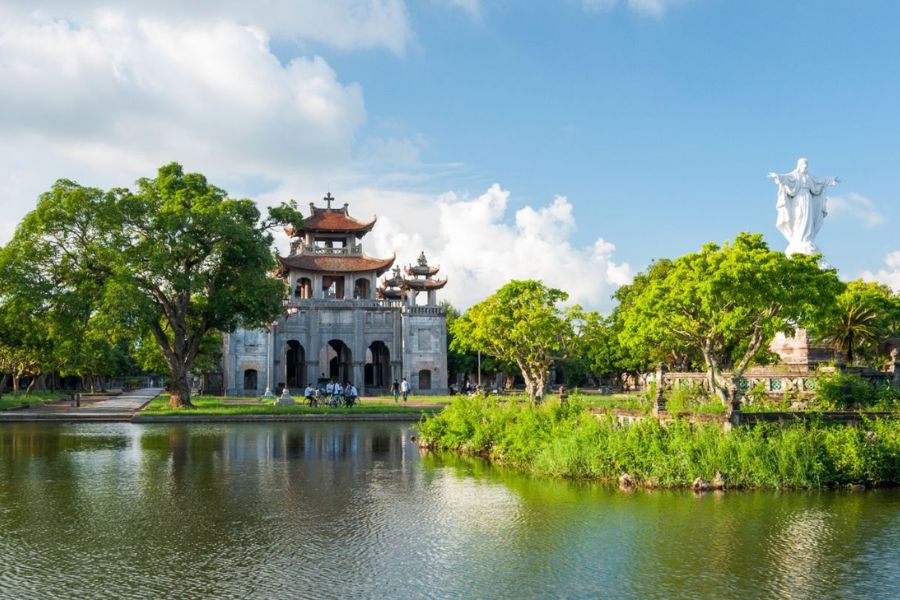
Phat Diem Cathedral was built in 1875

The cathedral became the point of worshipping the religion to Catholics in Kim Son District, since the area had hosted Catholics for generations. Local villagers still come to attend services here, and the usual festivals are also still celebrated. Although ravaged during wars in the 20th century, the place has been preserved and is still in use today.

Unique Architecture Of Phat Diem Cathedral

Phat Diem Cathedral is one of the few churches in Vietnam that is not based on Western Gothic traditions. Rather, it was meant by the temple touches of Vietnam, which made this particular space feel both familiar and unusual. All the buildings in the complex were constructed with the use of local materials in traditional craftsmanship, paying the appropriate detail to each detail.

Wooden Pagoda-Style Roofs

The roofs of the chapels and cathedral resemble the roofs of the traditional Vietnamese temples in their gentle upward edges. The roofs are thick stone columns that rest on tiled roofs that are made of large ironwood beams. These wooden frames are not just a feature of the buildings, but also add a natural stream of air inside these buildings. Visitors will be able to appreciate the worn grain of the wood and the joinery of local carpenters when walking below them.

Stone Bell Tower

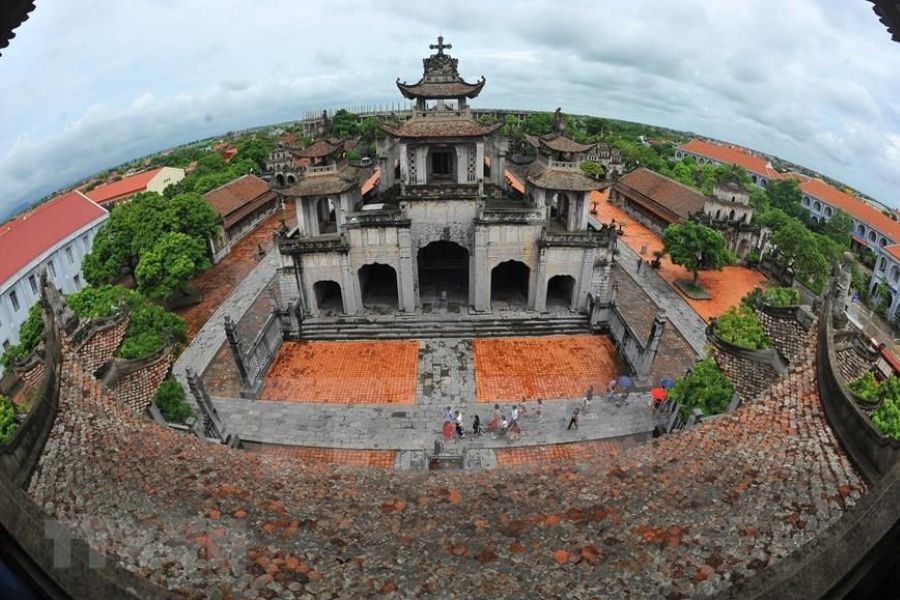
At the center of the complex stands a stone bell tower, three stories tall, overlooking a square lake. The tower has arched doorways, small carved windows, and a tiled roof supported by stone brackets. Inside, a large bronze bell hangs from wooden beams, still used during religious ceremonies. Visitors can climb the tower for a clear view of the entire site, including the lake and surrounding countryside.

Granite Stone Chapel

To the side of the main cathedral is the Stone Chapel, known locally as Nha Tho Da. It was carved entirely from grey granite, including the floors, walls, pillars, and ceiling. Decorative patterns of lotus flowers, angels, and religious symbols are etched into the stone, blending Catholic and Vietnamese elements. Many travelers stop here for photos and admire the precision of the stonework, which has lasted over a century.

Open Courtyards And Lake

The layout of Phat Diem Cathedral includes open courtyards, stone pathways, and a square lake in front of the bell tower. These spaces allow visitors to move easily between buildings and enjoy the calm setting. The lake reflects the nearby structures, adding to the peaceful atmosphere. It’s a place where many people sit, rest, or take in the quiet view before exploring the rest of the complex.
5 Cultural Experiences You Shouldn’t Miss

Phat Diem Cathedral refers not only to a historical site but also to an operational religious hub where one is able to observe significant local customs. It is possible to experience the depth of local faith and craftsmanship through the cathedral’s daily life.
Attend A Morning Mass

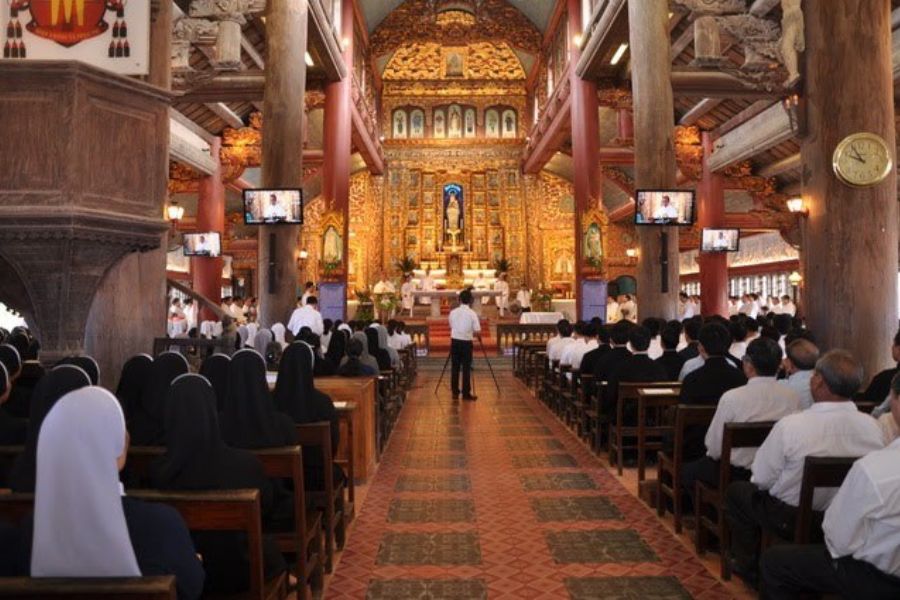
Daily masses are held early in the morning, often starting around 5:00 AM. Residents, many of whom are practicing Catholics, gather quietly in the main cathedral for prayer and hymns. Visitors are welcome to sit at the back and observe the ceremony, though it’s important to dress modestly and remain respectful. The atmosphere is peaceful, with natural light coming through the windows and soft singing filling the space. Attending mass is a way to experience the cathedral as a living place of worship, not just a historic site.
Morning Mass in Phat Diem Cathedral

Observe A Religious Procession

Phat Diem has solemn processions on days of significance for the Catholic religion, including Christmas and Easter. Locals dress in ceremonial garb, carry crosses, and sing as they walk around the courtyards and lake of the church. Any bystanders can quietly and respectfully observe, and photo-taking from a distance is typically permitted. Specific dates for the designated days of observance vary with years and can be determined by guidance from local tour guides.

Visit A Stone-Carving Workshop

The Kim Son District is renowned for traditional stone-carving villages, where the artists create religious statues and decorations. A stroll across the road or a ride on a motorbike takes one to tiny ateliers where the granite is being carved into saints or angels or into fanciful panels. Lots of those techniques that were used to construct the cathedral are still being applied nowadays. Custom orders or the sale of small items as souvenirs are also agreed to in some workshops.

Explore The Catholic Village Culture

The community surrounding Phat Diem is largely Catholic, and one is likely to find shrines and crosses lining small streets and gardens. Visitors walking the streets of Phat Diem will note houses with religious symbols, locals preparing for mass, and residents planning for or attending religious events. The combination of daily life and religious tradition, as well as ongoing community building, is just one reason Phat Diem may be distinctive.

Try Local Food At Village Eateries

The cathedral can be found close to a couple of simple restaurants with such dishes as pho, banh cuon, and grilled meat skewers. A majority of them run family businesses, and they offer outdoor tables or low tables under shade. Food is cooked daily on the spot, and it is cheap, and its products are frequently based on local farms. Certain stores cater to seasonal fruits or local sweets, particularly at the time of festivals.

grilled meat skewers in Ninh Binh

Entrance Fee

The entrance to the Phat Diem Cathedral is free, and one does not have to get any kind of ticket or make any prior arrangements to visit the site. Solo tourists and tour groups are not charged. Yet, those throwing coins are welcome and can do it in boxes that are placed in the main hall or by the chapels. If you come on a motorbike or bicycle, there might be parking costs at the sites nearby. They are usually covered by residents or households and are low-cost.

Item Price (VND) Notes
Entry to Cathedral Complex Free Open access for all visitors
Parking (Motorbike/Bicycle) 5,000 – 10,000 VND Pay on arrival, near the main entrance
Camera/Photography Fee Free No fee for photos; drones are not permitted
Donation (Optional) 10,000 VND or more Voluntary, used for maintenance and services

Opening Hours

Phat Diem Cathedral is open daily with no admission fee. People can tour the grounds and enter the chapels, and take pictures without paying an admission fee. Often used to maintain and provide local services, donations are made in special boxes, usually in small amounts.

It should be visited early in the morning at 6:00 and 8:00 AM in the morning when the air is cool and the environment is quiet. Large Catholic holidays such as Christmas and Easter attract more visitors. However, they also provide an opportunity to observe local rites and festive decorations, often regarded as the best time to visit Ninh Binh.

Day Hours Notes
Monday-Sunday 6:00 AM – 6:00 PM The grounds are open all day; early morning is the quietest.
Mass Times 5:00 AM & 5:00 PM Visitors can attend or wait until service ends.
Peak Season December, March Christmas and religious festivals may draw crowds, so if you’re visiting Ninh Binh in March, expect livelier scenes and more local events.

How To Get To Phat Diem Cathedral

Phat Diem Cathedral is located in Kim Son District, about 30 km southeast of Ninh Binh city and 120 km south of Hanoi. The most common way to reach it is by motorbike, car, or private tour from Ninh Binh, often combined with a visit to other attractions like Tam Coc or Trang An. Travel time from Ninh Binh city to the cathedral is around 45 minutes by road, making it easy to include in any Ninh Binh itinerary.

Unique Architecture Of Phat Diem Cathedral

Public transport options are limited, so most travelers choose to rent a motorbike or hire a private car for the day. Roads are flat and paved, but signage may be limited in some rural areas. It’s advisable to use GPS or a local map. Parking is available near the cathedral entrance, and the walking distance from the parking to the cathedral is minimal.

Transport Method Travel Time Cost (One Way) Notes
Motorbike Rental 40 – 50 minutes 100,000 – 150,000 VND/day Flexible; helmets required; good for short trips
Private Car 40 – 50 minutes 500,000 – 800,000 VND/day Comfortable for groups; can combine attractions
Taxi/Grab 40 – 50 minutes 300,000 – 400,000 VND Easy from Ninh Binh city; less flexible
Bus (Local) 1.5 – 2 hours 50,000 – 80,000 VND Not direct; may require transfers; limited schedules

Things To Know Before Traveling To Phat Diem Cathedral

Many visitors appreciate walking on the grounds at a more leisurely pace. Before your visit, here are a few practical notes that may assist in making your visit more enjoyable, especially if you hope to make a stop at other nearby locations such as Tam Coc.

Boat Tour In Tam Coc

  • Morning mass generally begins around 5:30 – 6:00 AM, and if you arrive at this time, you may need to sit outside or keep quiet.
  • When locals attend a church service, they are very conservative in their dress, so wearing shorts or sleeveless tops is unlikely to seem appropriate.
  • There are almost no convenience stores in the area, and even drink stalls may be closed in the early morning.
  • Parking spots are available close to the gate, and you’ll need to pay in cash since digital payments are rarely accepted.
  • Mobile signals can drop completely in certain corners of the ground, and using offline maps or screenshots will help you avoid getting turned around.
  • The stone paths can get slippery after rain, and shoes with grip are better than sandals or heels.
  • Toilets are basic and may lack toilet paper, and carrying tissues or wet wipes is recommended.
  • The stone paths can get quite slippery after rain, and shoes with proper grip tend to work better than sandals or heels.
  • Small shrines behind the main church are sometimes overlooked, but often have interesting stone carvings and quieter spaces.

Final Thoughts: Is Phat Diem Cathedral Worth Visiting?

Phat Diem Cathedral is not a large or crowded site, but many travelers find it worth the short trip for its quiet setting and distinct mix of local and European design. If you enjoy slow travel and places with a local rhythm, it’s a good stop to add to your Ninh Binh plan. For help organizing a visit or combining it with nearby attractions, Seni World is here to assist. Let this peaceful corner of Ninh Binh surprise you with its quiet charm and cultural depth.

Tam Coc-Bich Dong: Ha Long Bay On Land Awaits You To Uncover

Tam Coc – Bich Dong is a well-known scenic spot in Ninh Binh, with magnificent limestone mountains, serene rivers, and ancient pagodas. Known as “Ha Long Bay on land,” it represents an idyllic combination of nature and history.

Introduction To Tam Coc-Bich Dong

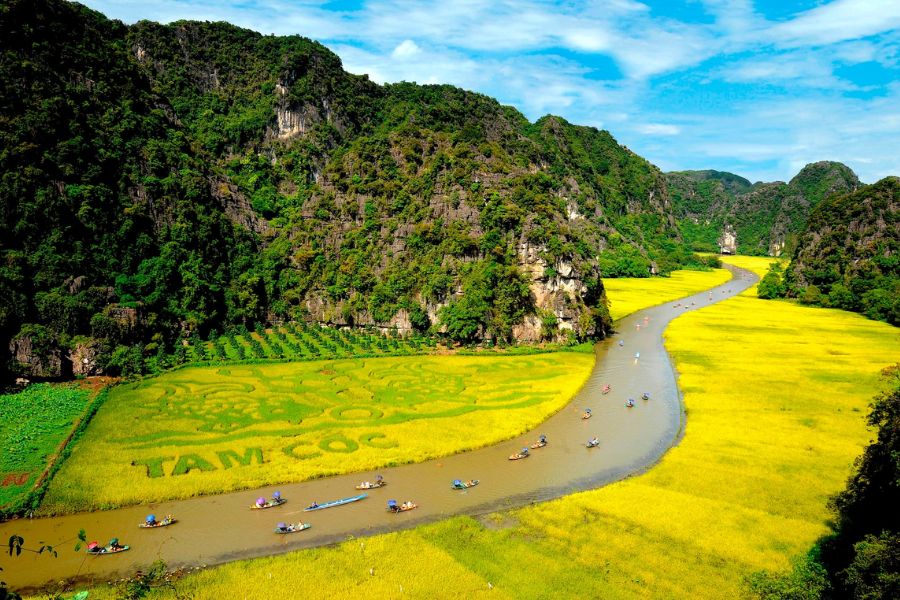
Often referred to as “Ha Long Bay on land,” Tam Coc – Bich Dong is one of the most captivating places in Ninh Binh. The limestone karsts jutting up from the golden rice fields and the rivers lined with rice paddies and mysterious caves, this is the tranquil retreat that showcases the natural beauty of Vietnam.

overview of Tam Coc Bich Dong

Many visitors to Tam Coc come to enjoy the famous boat ride, including its 3 famous caves, Hang Ca, Hang Hai, and Hang Ba, but they also come to enjoy the peaceful countryside atmosphere, rice paddies, and visit some historical places such as Bich Dong Pagoda on the mountainside.

History Of Tam Coc-Bich Dong

Tam Coc-Bich Dong has been famous for centuries. It dates back to the time of the Dinh and Le dynasties. It was a part of the ancient capital of Vietnam and a place of national history in the early feudal period of Vietnam. It is a beautiful land, a landscape full of witnesses to the country’s glorious history.

In 2012, Tam Coc -Bich Dong was also inscribed as a Special National Heritage site along with Trang An Landscape Complex and Hoa Lu ancient capital. This shows that it now has cultural, historical, and environmental importance within the national heritage of Vietnam.

Top 6 Iconic Attractions In Tam Coc-Bich Dong

Tam Coc-Bich Dong is a rich area of natural wonder and cultural sites, providing the opportunity to connect with Vietnam’s incredible beauty and spirituality. Here are some site highlights to be sure that you don’t miss:

Hang Ca

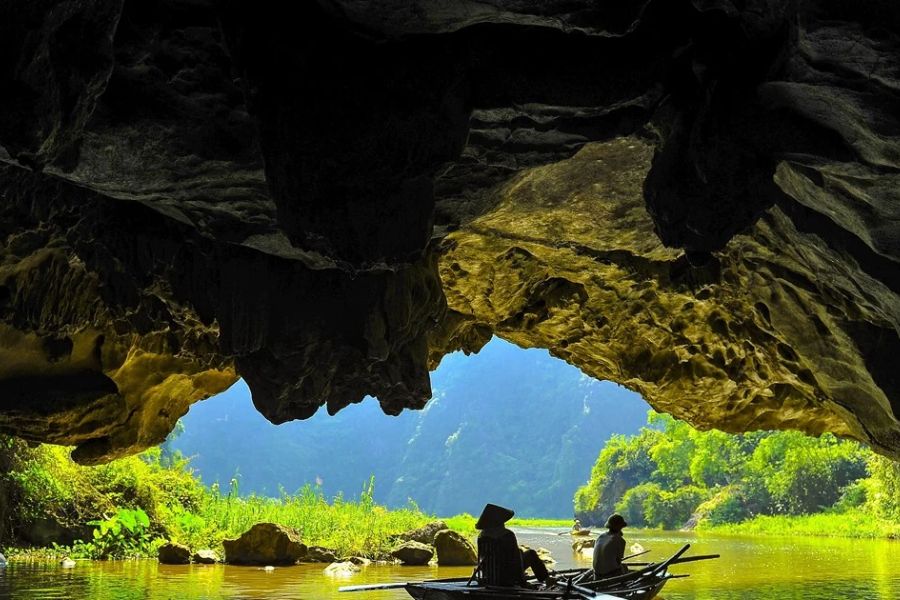
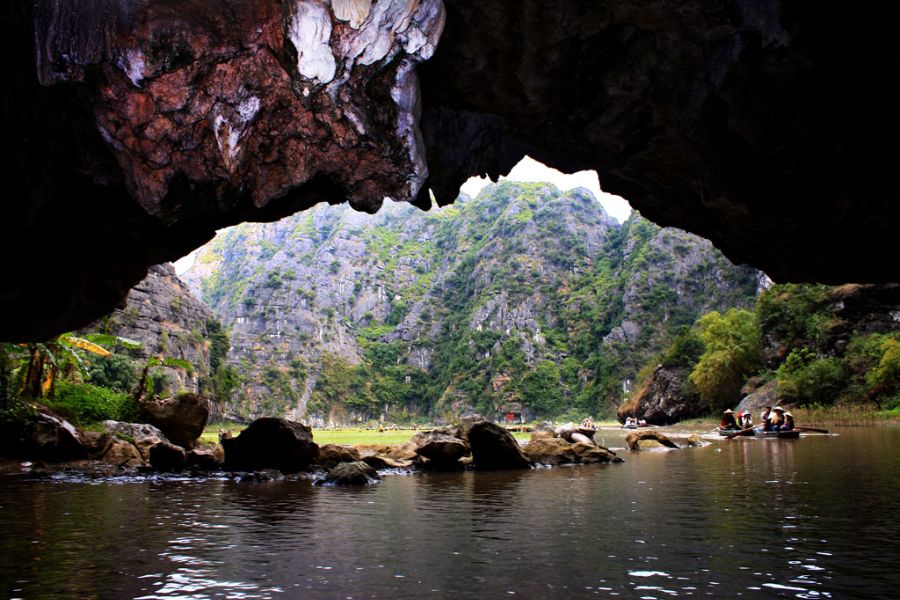
Hang Ca is the first and largest cave in the Tam Coc system. The entrance is a spectacular 127-meter tunnel that cuts deep into a limestone mountain. As your boat makes the transition from the river to the cave, a welcome coolness in the air temperature accompanies the transition from bright daylight to the dim light of the cave.

Hang Ca in Tam Coc system

Once inside the cave, natural light is scarce, and quietness permeates the air, aside from the splashes of paddles and drops of water echoing from the ceiling. The interior contains vaulted ceilings, very cathedral-like, filled with brilliant stalactites and stalagmites, which shimmer faintly in the dim light. Some stalactites and stalagmites look like animals or mythic creatures, fuelling the imagination.

Hang Hai

After about a kilometer downstream from Hang Ca, you will find Hang Hai, the second cave in the Tam Coc sequence. At roughly 60 meters, it is shorter and has a different charm that is quieter, intimate, and contemplative. The curve of the ceiling and walls seems to wrap the boat in a hug as you move through the cave. Water softly cascades from the stalactites, and the smell of humus adds to the experience.

The formations in this cave are more ornate, and may resemble the shape of lotus petals or folded fans. As your boat emerges from Hang Hai, you will feel like you have passed through a meditative space where you now feel calmer, more aligned with nature.

Hang Ba

Hang Ba is the third and final cave, and it’s the smallest at just under 50 meters long, but it has a serene elegance to it. With it being small, the low ceiling means you bow your head, at times, as if respectfully acknowledging the immense value of nature. The silence of the water gliding beneath the paddle, the hazy lights doing some dancing on the top of the cave, and the closeness to the rock as you row make you feel not just close to nature, but close to yourself.

Hang Ba is the third and final cave in Bich Dong System

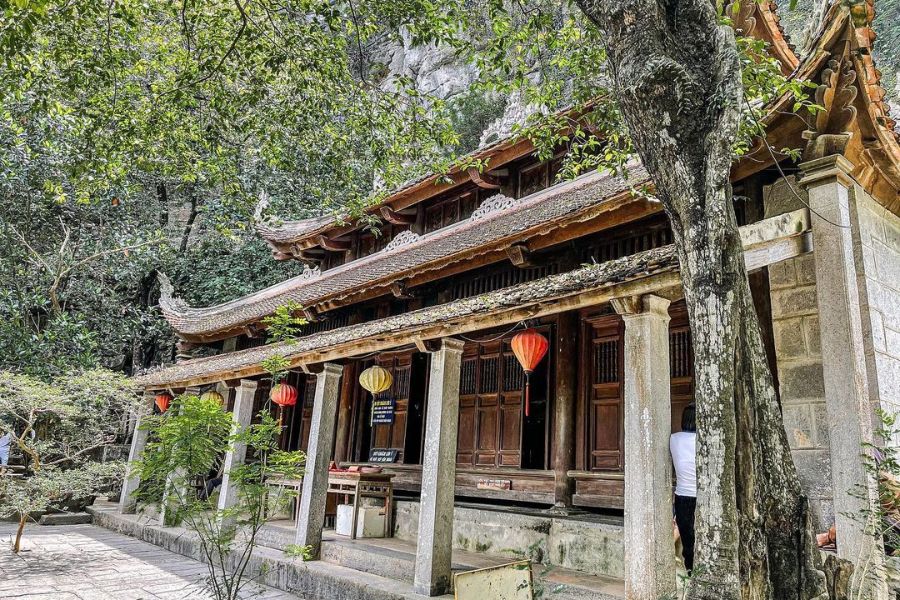
Thai Vi Temple

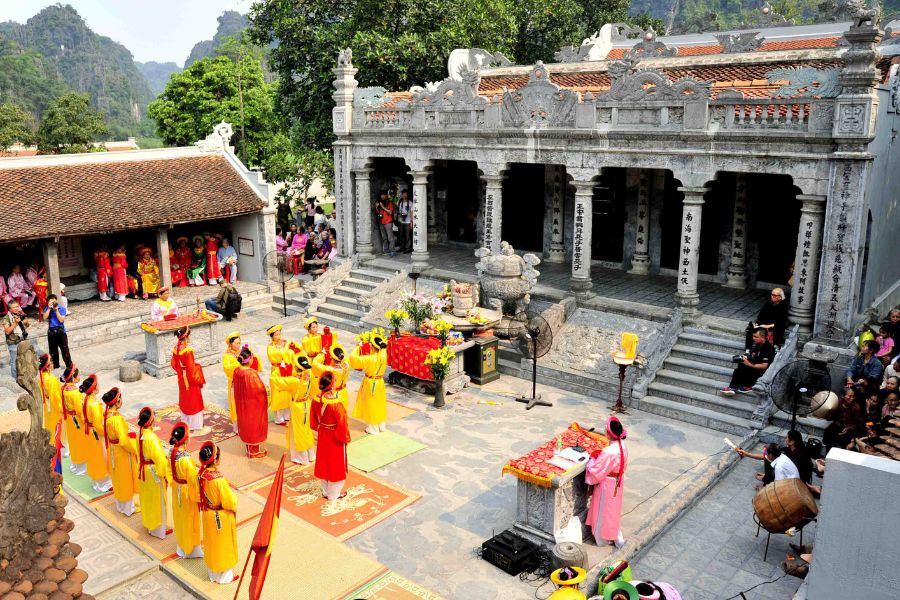
Located in the tranquil O Lam forest, Thai Vi Temple was built to honor the Tran Dynasty and particularly, to honor the brave kings who fought valiantly to protect Viet Nam against the Mongol invasion in the 13th century. Thai Vi Temple is located at a peaceful curve of the Ngo Dong River, and behind it, the sacred Coi Linh Mountain clearly stands. The fresh green stone of the temple was quarried from nearby mountains.

a festival in Thai Vi Temple

Visitors often remark on the stone pillars with thin and delicate dragons engraved on the sides, the weathered incense burners, and the relaxed feeling of those sacred spaces. Thai Vi Temple is not only a tourist destination, but it is a place to feel the pride of a country that survived adversity.

Bich Dong Pagoda

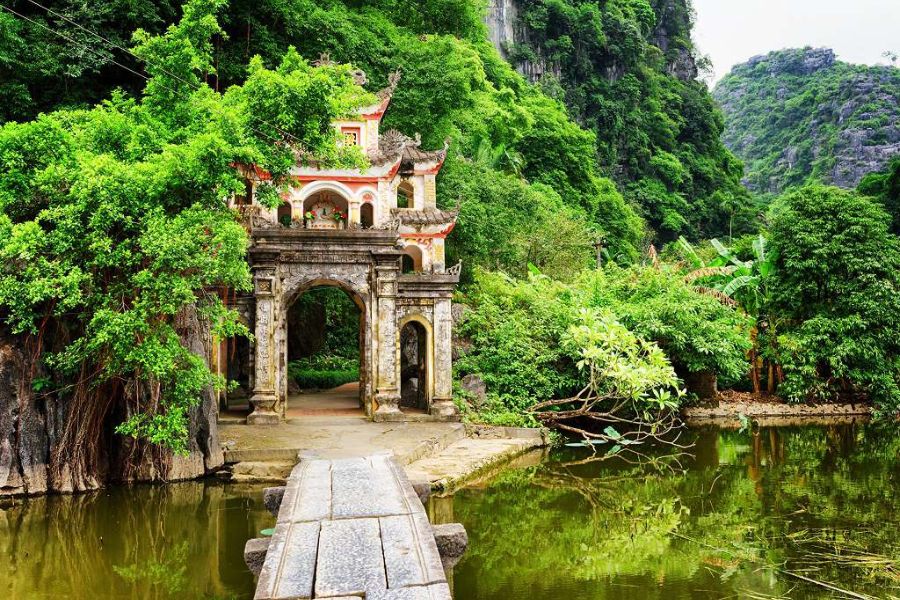
Bich Dong Pagoda is one of the most amazing cave temples in Vietnam, and it clings to the side of a steep limestone mountain. Built in 1428 and added on to in the era of King Canh Hung, there are three different levels to the pagoda: Ha, Trung, and Thuong, with each level being constructed in natural caves. The movement upward is not only a movement physically upwards, but also deeply spiritual.

overview of Bich Dong Pagoda

The Thuong (Upper) Pagoda is the highest up in a cave, and it is there that you find the purest atmosphere of meditation. Monks would use the place to meditate, only the wind and the mountain stone, and the sky. Though it is a religious site, Bich Dong is also an ecosystem in which human devotion exists harmoniously within nature.

Thien Huong Cave

Located approximately 60 meters in the air on Dong Vo Mountain, Thien Huong Cave is a spiritual treasure that most casual travelers miss. Although it is only 40 meters deep and 12 meters wide, it is surprising for the dome-shaped ceiling, like a large stone bell hanging in silence. It also has a shrine for Queen Consort Tran Thi Dung, wife of King Ly Hue Tong and mother of the Tran Dynasty, who is commemorated for her contributions to Buddhism and to the early development of Vietnam’s identity.

4 Cultural Experiences You Shouldn’t Miss

In addition to its rich biodiversity, Tam Coc-Bich Dong and the surrounding region also provide cultural activities that allow you to connect deeply to Vietnam’s cultural and natural heritage:

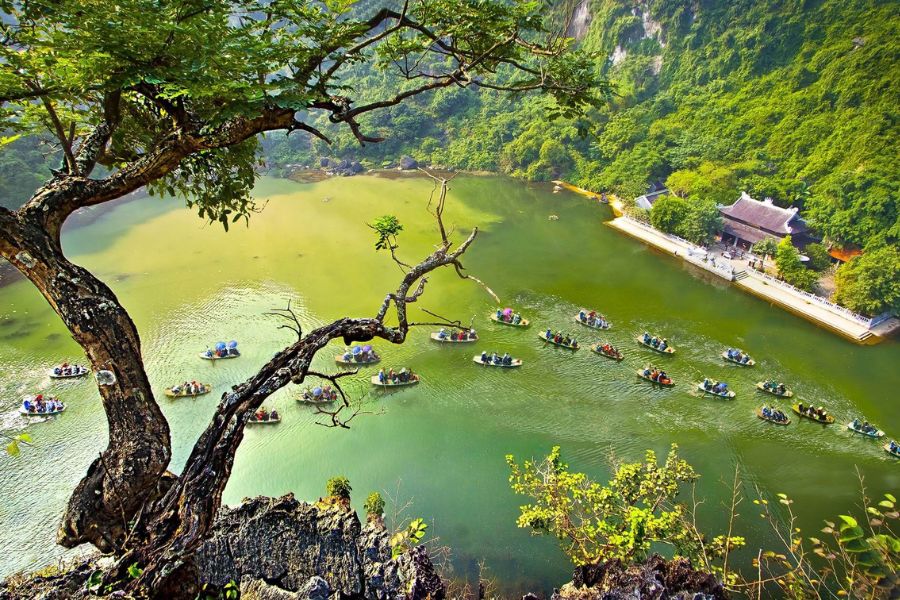
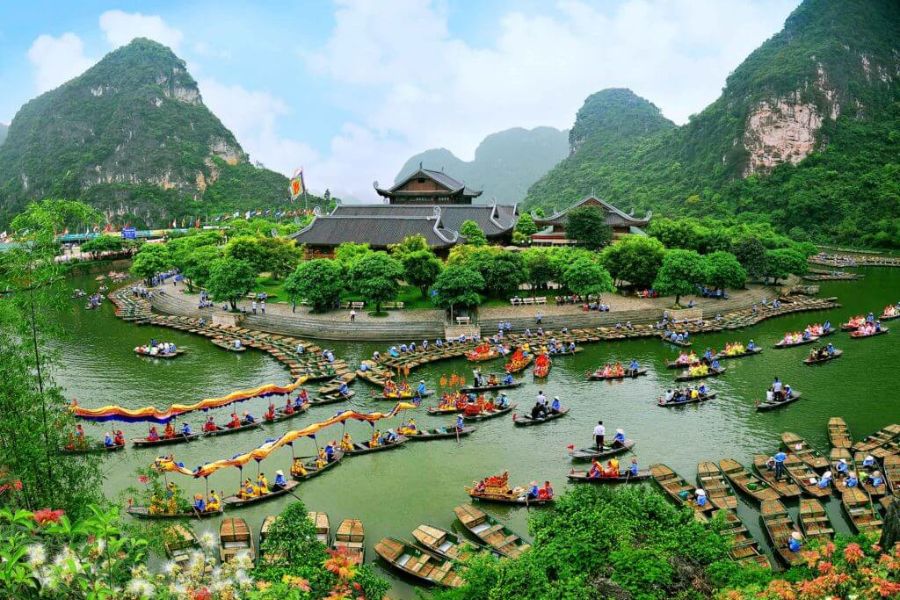
Boat Tour In Tam Coc

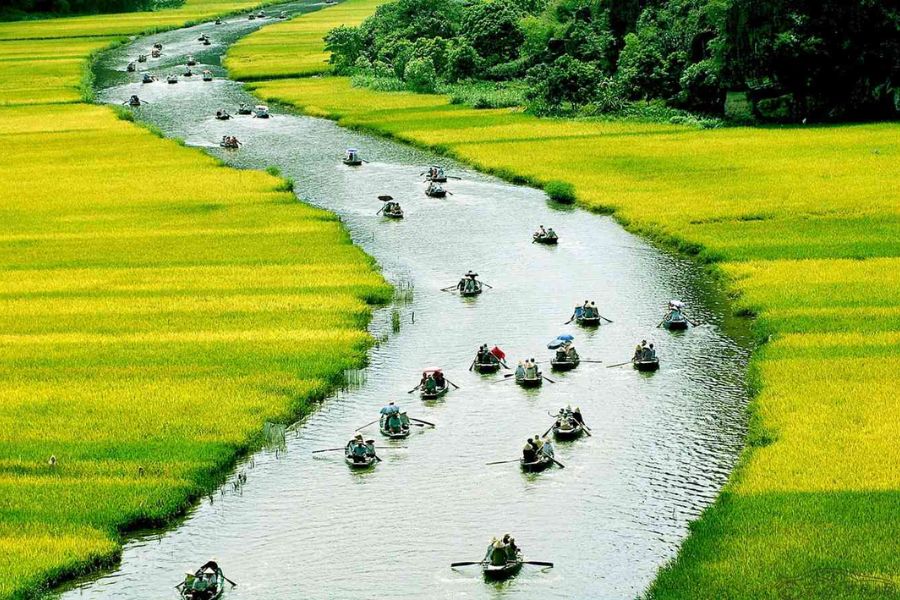
Your visit to Tam Coc would not be complete without a quiet, leisurely boat ride down the meandering Ngo Dong River from the comfort of a long sampan boat. With your local rower, frequently an older lady, skillfully paddling with her feet, you will gently drift past golden rice paddies and stunning limestone cliffs that rise sharply from the water.

Boat Tour In Tam Coc

The boat passes underneath three caves, Hang Ca, Hang Hai, and Hang Ba, where the temperature drops and light filters through the stone, providing a spirited feel of a cave-like tunnel, unparalleled to what you experience seated on the boat. The sound of silence, punctuated only by birds and the flowing river, creates one of the most serene and poetic ways to see the karst topography of Vietnam.

Pray At Bich Dong Pagoda

Known as “The Second Most Beautiful Cave in Vietnam,” Bich Dong Pagoda is an ancient religious complex set against one of Vietnam’s many limestone karst mountains. You’ll climb three temples here: Ha Pagoda (Lower), Trung Pagoda (Middle), and Thuong Pagoda (Upper) – intertwined within the natural beauty and tranquility of the site.

Bich Dong Pagoda from outside

The higher you go, the better the view gets, revealing an expansive view of valleys and limestone mountains shrouded in mist. The architecture, silent courtyards, and ancient statues also contribute to a sense of divine stillness that resonates with visitors long after they leave.

Visit Traditional Craft Villages

Just a short drive from Tam Coc are villages that continue the traditions of Vietnamese craft for many generations. In Van Lam embroidery village, you can watch artisans sewing patterns by hand skilfully, usually informed by nature and folklore. In Ninh Van stone carving village, you can see not only stone carving at its detailed best but also Buddha statues and ornate temple ornaments carved from local limestone using multi-generation-old methods. The villages are an opportunity to embrace the cultural soul of Ninh Binh, whose heritage is still alive.

Savor The Local Cuisine

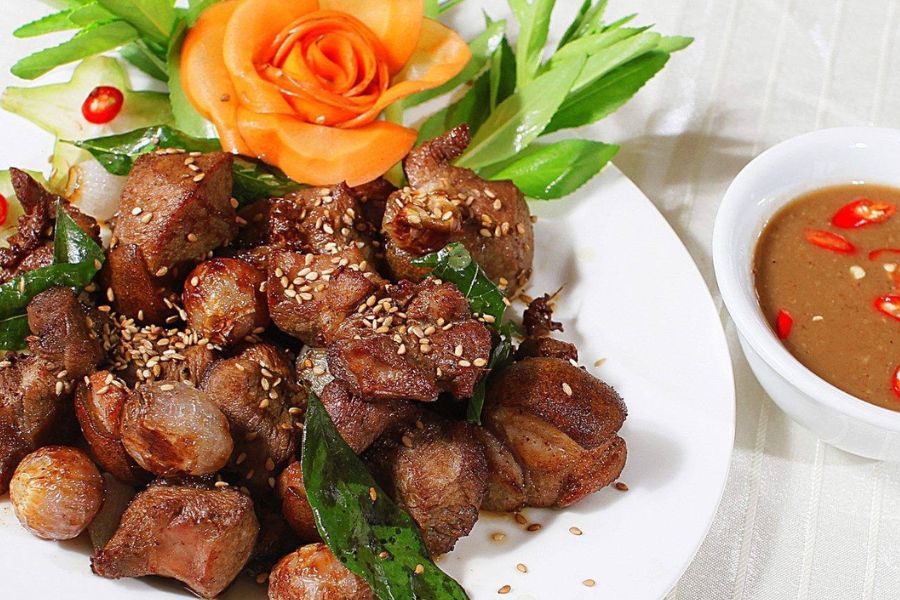
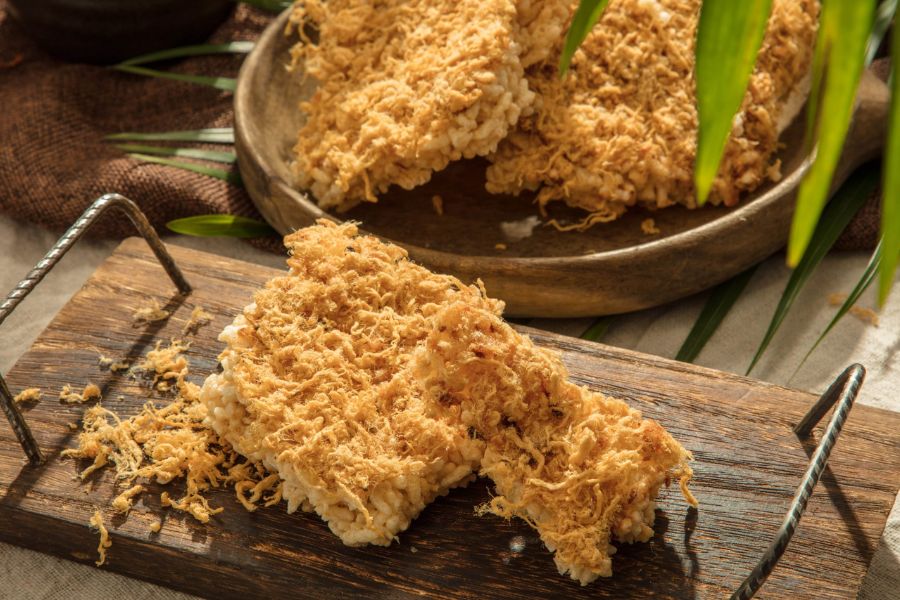
No cultural experience is complete without food, and the Ninh Bình region is full of unique food products to satisfy your appetite. A must-try is Com Chay, crispy rice crust paired with a thick goat meat sauce or fried vegetables. Thit De Nui (mountain goat) is a local specialty, which is lean and a flavorful meat product because they roam freely in the rocky hills.

Thit De Nui (mountain goat) is a local specialty in Ninh Binh

Depending on the season, you might also get to try Xoi Trung Kien (sticky rice with ant eggs), a fresh delicacy that can only be harvested in the spring, or Oc Nui (mountain snails), a chewy, flavorful food product that is often served steamed with ginger or stir-fried with lemongrass. These types of products are strongly fragrant, earthy on the palate, and earthy relates to the surrounding environment.

Entrance Fee

The entrance fee for visiting Tam Coc – Bich Dong is at a reasonable price, used to protect the natural and cultural heritage of the area..

Ticket Type Price
Adults 250,000 VND/person
Seniors 120,000 VND/person
Children (under 1.4m) 120,000 VND/person
Children (under 1.0m) Free of charge

Opening Hours

Tam Coc – Bich Dong opens from 08:30 AM to 06:30 PM every day of the week, weekends, or holidays. The opening hours include boat tours and sightseeing services throughout the complex.

Tam Coc’s best visitors are during the spring (from January to March) and early summer (from May to June). At that time, the weather in Ninh Binh is much cooler and pleasant during spring; the flowers are blooming among the trees growing higher throughout the green space.

In May and June, rice is harvested, and fields of bright yellow paddy can be seen stretched out under the limestone mountains. It’s an exciting natural scenery.

How To Get To Tam Coc-Bich Dong

Tam Coc – Bich Dong is about 100 km from Hanoi and can be reached in various ways. Depending on the transportation you choose, the journey can take approximately 2 hours. Here are some ways to travel:

Mode of Transport From Estimated Time Estimated Fare
Bus Hanoi ~2 hours ~100,000 VND
Private Motorbike/Car Hanoi ~2 hours Varies
Train Hanoi ~2.5 hours ~150,000 VND
Airplane + Bus Ho Chi Minh → Hanoi → Ninh Binh ~3.5 hours flight and 2 hours transfer From ~1,200,000 VND
Sleeper Train/Bus Ho Chi Minh ~30 hours Varies (~1,000,000 VND)

Things To Know Before Traveling To Tam Coc-Bich Dong

If you’re thinking of visiting Tam Coc-Bich Dong, you’ll want to plan as well as prepare to face the local conditions. Here are some useful hints and tips to help make your visit successful:

  • Consider public transport or rent motorbikes: If you’re coming from Hanoi, buses or trains will likely provide the cheapest option for travel. Once you’re in Tam Coc, using a bicycle (or motorbike) can also be a perfect option to get to points of interest at your own pace.
  • Pack personal items: As most activities are outdoors, you should bring personal items such as a hat, sunglasses, sunscreen, and drinks. All these little things might just make your trip a little more comfortable in the sun.

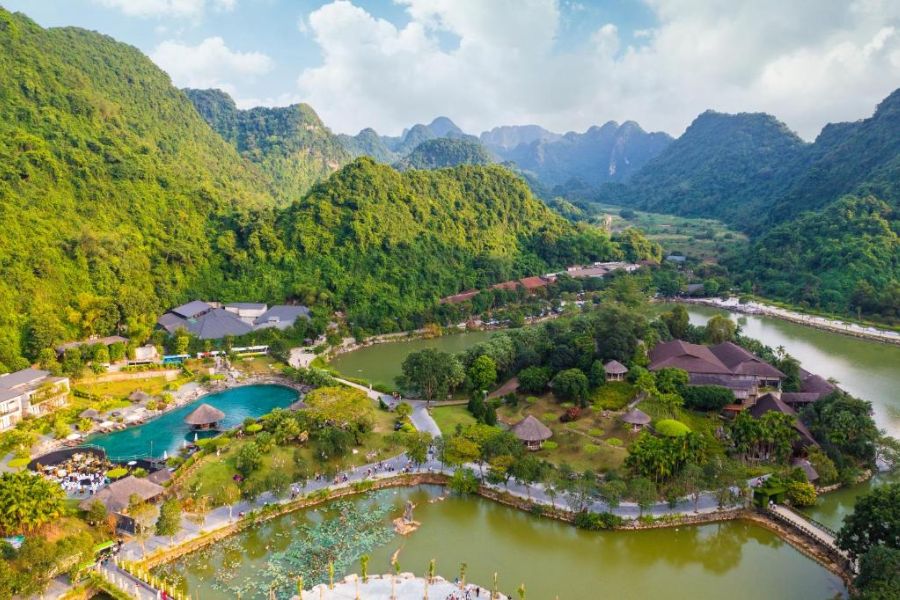
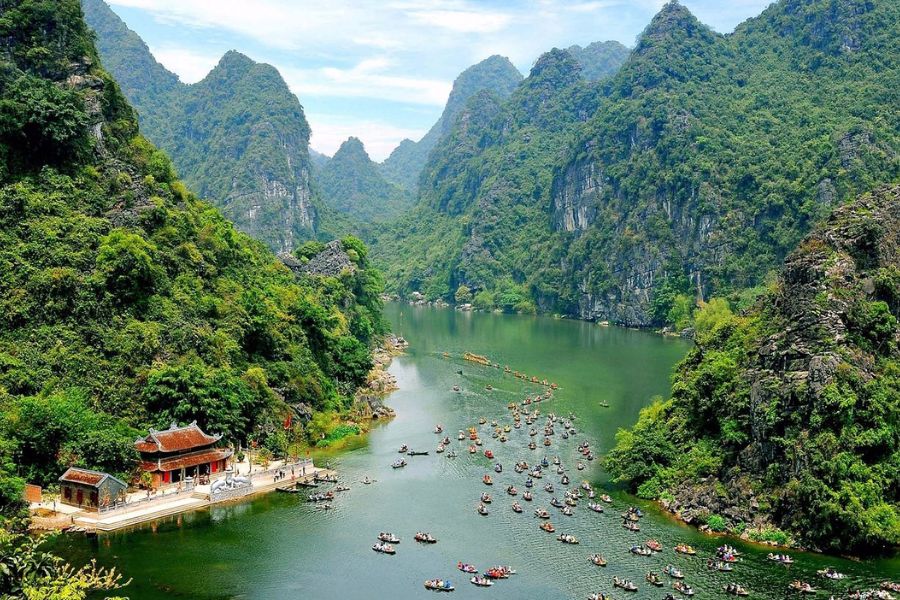
view of Tam Coc Bich Dong from above

  • Check the weather forecast: You should always check the weather forecast before your trip so you can dress properly and adjust your plan to any changes in the weather.
  • Stay safe on the boat ride: If you are joining a boat tour in Tam Coc, you should always wear a life jacket and follow the directions of the boat operator. You should always sit when taking photos and not lean out too far, or you may fall into the water.
  • Bring cash: Some of the services in Tam Coc – Bich Dong can be cash only, so it is a good idea to bring cash (Vietnamese Dong) with you anyway, in case you need to buy tickets, food, or little extras.

Final Thoughts: Is Tam Coc-Bich Dong Worth Visiting?

Visiting Tam Coc – Bich Dong is a must-do activity if you travel to Ninh Binh. The pristine rivers, striking limestone caves, and century-old pagodas offer a great escape from the hustle and bustle of city life. If you aren’t taking a rowboat through tunnels and caves or exploring ancient temples, you will feel that every instant spent soaking in the beauty is magical. Let Seni World guide you to the perfect Tam Coc-Bich Dong adventure today!

Cuc Phuong National Park: Vietnam’s Oldest Rainforest Gem

Cuc Phuong National Park is Vietnam’s oldest national park, recognized for its biodiversity, rainforest, and famous historical landmarks. Just a few hours from Hanoi, it is an ideal getaway for anyone seeking nature, hiking, and wildlife experiences.

Introduction To Cuc Phuong National Park

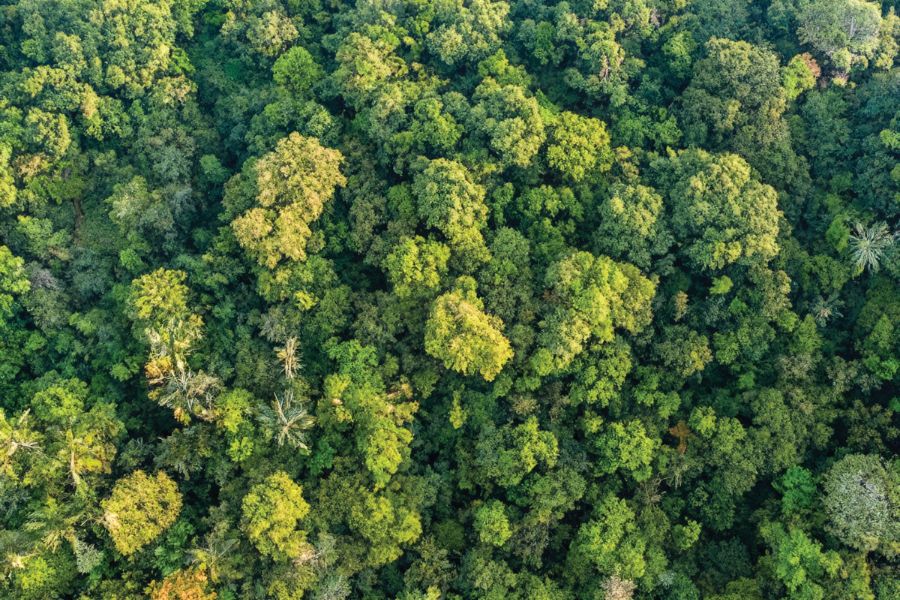
Cuc Phuong National Park, located between the provinces of Ninh Binh, Hoa Binh, and Thanh Hoa, is Vietnam’s first national park and one of the most important national parks anywhere. Full of biodiversity, ancient tropical rainforests also mean that there is a lot of rare wildlife. This protected area is a biodiversity hotspot, rich in flora and fauna.

biodiversity, ancient tropical rainforests of Cuc Phuong National Park

Every year, thousands of visitors come to Cuc Phuong not only to see and walk among the majestic trees and tranquil scenery, but also to take eco-tours, go trekking, camp overnight, or take in the cultural history of the forest. For the last five years, Cuc Phuong has been voted Asia’s Leading National Park (2019-2023). For sure, you can get in touch with nature in Cuc Phuong, but you can also have fun exploring and experiencing the wild in Vietnam.

History Of Cuc Phuong National Park

Cuc Phuong National Park occupies an important place in Vietnam’s conservation history. Its designation as a forest reserve occurred in 1960. Just 2 years later, on 7th July 1962, it was designated as a protected area by the government under Decision 72/TTg, becoming the first protected area in Vietnam and covering an area of 20,000 hectares.

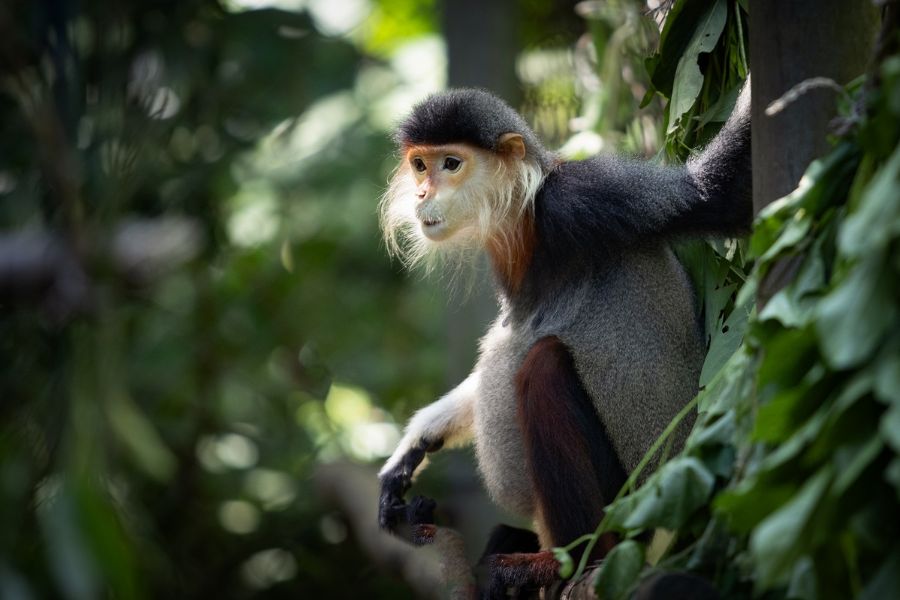
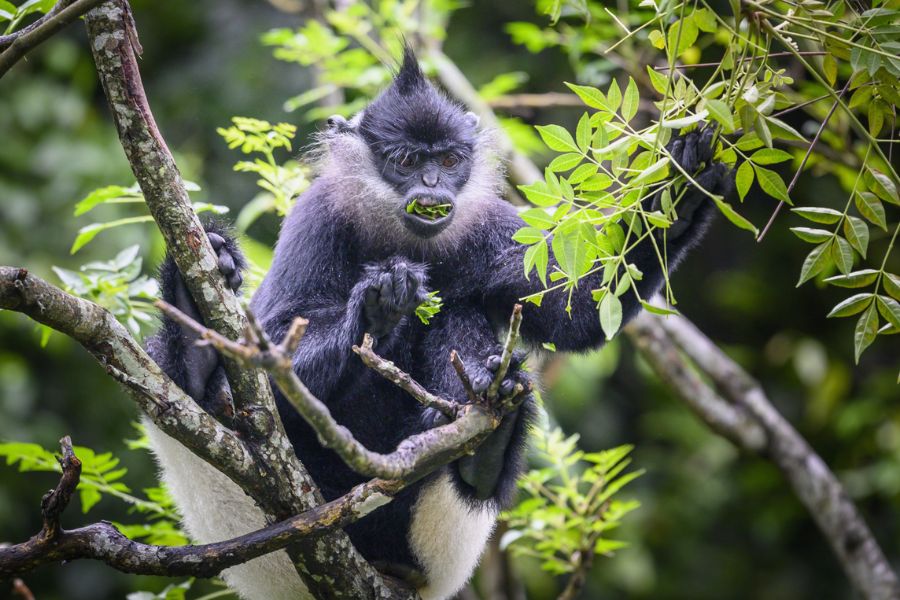
This animal is protected by Cuc Phuong National Park

Cuc Phuong was elevated to the status of national park in 1966 under Decision 18/QD-LN on 21st December, from a forest station. This was an important step in Vietnam’s environmental protection system and paved the way for the establishment of future nature reserves in Vietnam.

Top 4 Iconic Attractions in Cuc Phuong National Park

Cuc Phuong National Park is not only the first national park in Vietnam, but also a gem of natural and environmental discovery. Whether you are searching for ancient forests, rare wildlife, or just need a break in nature, the park provides a variety of recreational opportunities.

Visitor Center

This is usually the first stop for visitors. The visitor center can provide useful information, accommodation opportunities, guided tours, and cultural experiences.

Wildlife Conservation Areas

Cuc Phuong includes sites of active wildlife rescue and conservation, including Grassroots Wildlife Conservation, Endangered Primate Rescue Center, Turtle Conservation Center, and Small Carnivore Conservation Program. The wildlife conservation areas attempt to educate the public about Vietnam’s rare and endangered wildlife and promote conservation.

This animal is protected by Cuc Phuong National Park

Natural and Cultural Landmarks

The park also has a number of iconic sites; for example, Dong Nguoi Xua (Ancient Cave), where evidence of prehistoric man was found, a legendary thousand-year-old Cho Xanh tree, and Thac Bac (Silver Cloud Waterfall). These natural features can be appreciated along with cultural and historical significance.

Biodiversity Research Areas

Protected areas in the park contribute to ongoing dedicated scientific research and biodiversity projects. These areas highlight the unique ecological value of Cuc Phuong and frequently draw students, conservationists, and researchers from across the globe to learn from Cuc Phuong’s biodiversity.

6 Cultural Experiences You Shouldn’t Miss

A trip to Cuc Phuong National Park is not only a gateway to nature, but it is also a portal to history, culture, and biodiversity in one amazing location. Here are six advanced cultural experiences you won’t want to miss on your visit.

Explore The Cuc Phuong Museum

The Cuc Phuong Museum is a wealth of information for nature lovers and academics alike. The museum contains more than 50 archaeological objects, including fossils, such as the spiny, blade-toothed reptile fossil from 230-250 million years ago.

Also, the facility offers more than 12,000 plant specimens, more than 2,900 insect samples, and over 200 specimens of animals, all serve as an engaging introduction to Vietnam’s natural history.

The museum is a special place for students, researchers, and travelers who wish to enhance their understanding of the biodiversity within the magnificent Cuc Phuong Park.

Discover The Botanical Garden

As one of the first botanical gardens in Vietnam, and recognized around the world, the Cuc Phuong Botanical Garden is important for plant conservation and research. So, the purpose of this area is to gather and propagate rare and endangered plant species indigenous to Vietnam and abroad.

Cuc Phuong National Park at night

The 3km trail introduces you to a host of unique and interesting medicinal plants. A great opportunity to absorb nature, science, and pure relaxation.

Climb May Bac Peak

May Bac Peak is the highest summit in Cuc Phuong National Park at 648 meters above sea level. The adventure starts with a 3km journey from the centre of the park and a moderately challenging trek through grassy, leafy terrain.

At the top, you are rewarded with incredible views of the entire park and ancient Hoa Lu and Bai Dinh Pagoda in the distance. Bring your best hiking boots and consider engaging a local guide; the trail is rocky and steep in places.

Explore The Ancient Man Cave

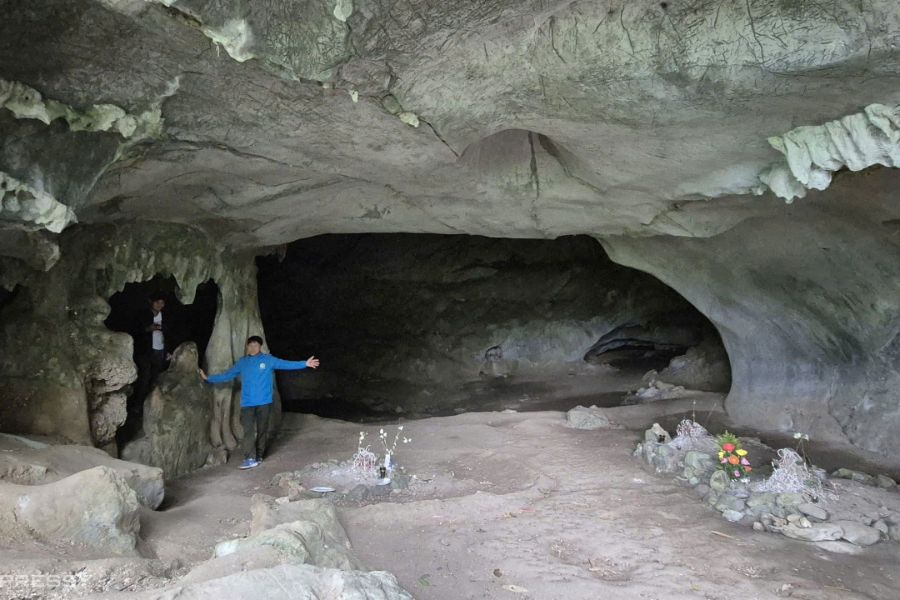
Called “Dong Nguoi Xua,” this mysterious cave is situated about 4 kilometers from the entrance of the park. It was once the home of prehistoric humans. Archaeological discoveries have included burial and tool sites, revealing a glimpse into the lives of early Southeast Asians.

Explore The Ancient Man Cave

In addition to its cultural significance, the cave’s stalactites also whistle like gongs when tapped softly. It is only a minute’s hike away from the main trail, but be sure to go during the day!

See Yen Quang Lake And Pho Ma Cave

Yen Quang Lake is a serene lake nestled between karst cliffs. Take a kayak or paddle yourself and the family on the lake. When the water is calm, the reflections of the forest and cliffs are stunning, so bring your camera.

Pho Ma Cave is nearby and is also worth visiting for the limestone formations. You’ll see what appears to be the shape of a royal figure carved out of stone as well. This area is great if you want to paddle, bird watch, or just enjoy the quiet! There is so much to “see” as a hidden area of the park!

Trek To The Ancient Trees

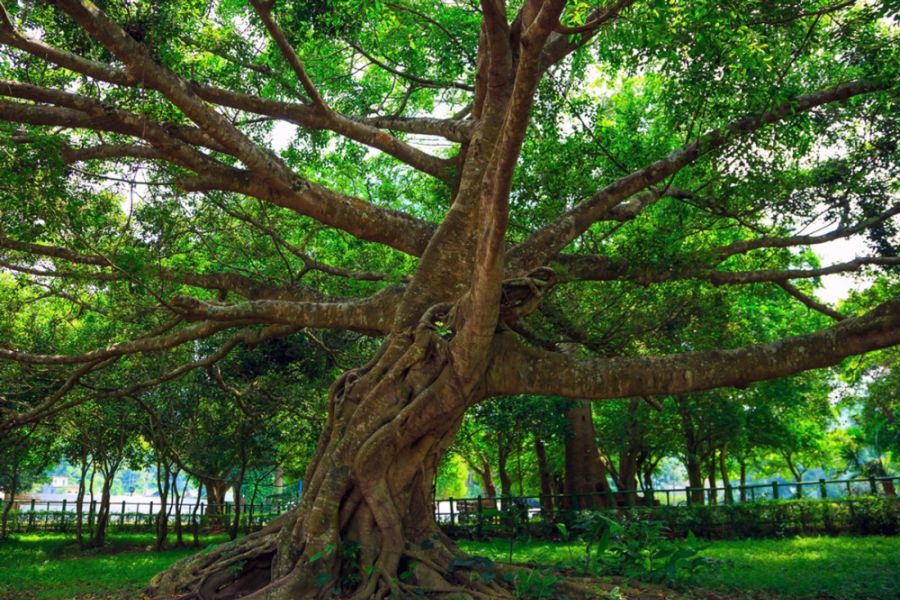
Cuc Phuong is well known for its legendary trees, including the Thousand-Year-Old Cho Xanh Tree, the ancient Dang Tree, and the grand Sau Tree. These forest giants grow to heights of 45-70 meters, while their roots pipe outwards beyond understanding, and the stories these trees unfold span centuries.

Trek To The Ancient Trees

The hike to these trees takes you on a journey into old-growth forest, so you may encounter rare vines, orchids, and, if you are lucky, some endangered birds or langurs. It is more likely a spiritual as well as humbling journey that reemphasizes the will of nature and its unending endurance.

Entrance Fee

Visitors to Cuc Phuong National Park must purchase an entrance ticket. Ticket prices are based on age and category of ticket purchasers:

Visitor Type Ticket Price (VND/person)
Children under 5 years Free
Children (5 – under 16) 10,000
Students 20,000
Adults 60,000

Note: The ticket prices above are for entry into the park only; they do not include any other services, including transportation, boat rentals, food, or tour guiding. Students wanting to get a discount must bring a valid student ID.

Best Time To Visit Cuc Phuong National Park

Cuc Phuong National Park has a different kind of beauty in every season, so the best time to visit depends on your preferences you’re looking for. Here are some practical recommendations about the weather in Ninh Binh, and a good time for your trip to the park:

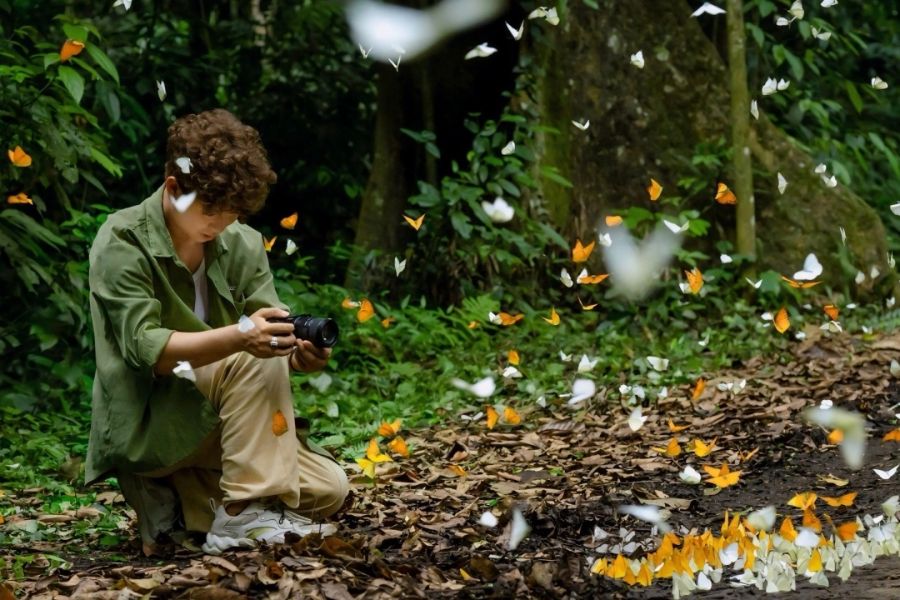
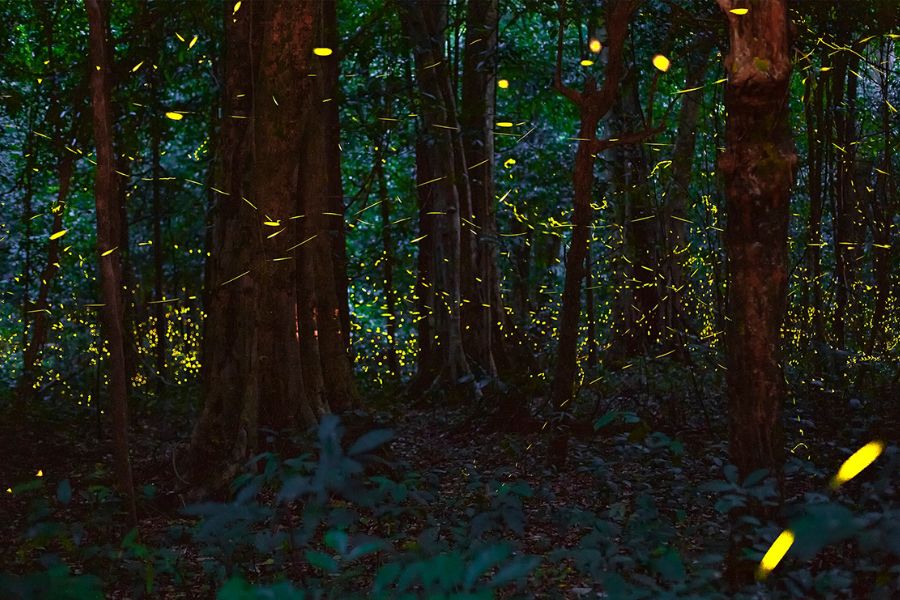
  • From late April to early May, the park is full of butterflies, with thousands of colorful butterflies fluttering throughout the forest. This is regarded as one of the most beautiful and active times to explore the park since the weather is cool, dry, and ideal for trekking.

From late April to early May, Cuc Phuong national park is full of butterflies

  • Spring (February-April) is another great time to visit since the forest is vibrant and green, temperatures are moderate, and you’ll likely encounter wildlife, such as squirrels and pheasants, while you hike. Summer (June to August) will be hot. However, Cuc Phuong will provide a cool location with trails under mature trees, along with the natural, cooler forest air if you’re trying to avoid the hot city temps.
  • Autumn (August-October) is a calmer time for weather by reducing crowds, which is ideal for camping and nature photography. You can capture some beautiful pictures of endangered plants and animals here!

Note: Winter months (November to January) are better avoided, as the forest is damp and chilly, plus parts of the park may be soft or unsafe during the winter months.

How To Get To Cuc Phuong National Park

Cuc Phuong National Park is approximately 130 km from Hanoi, and usually takes between 2.5 and 3 hours to reach. You can choose to go by private car, motorbike, or public transport.

By motorbike

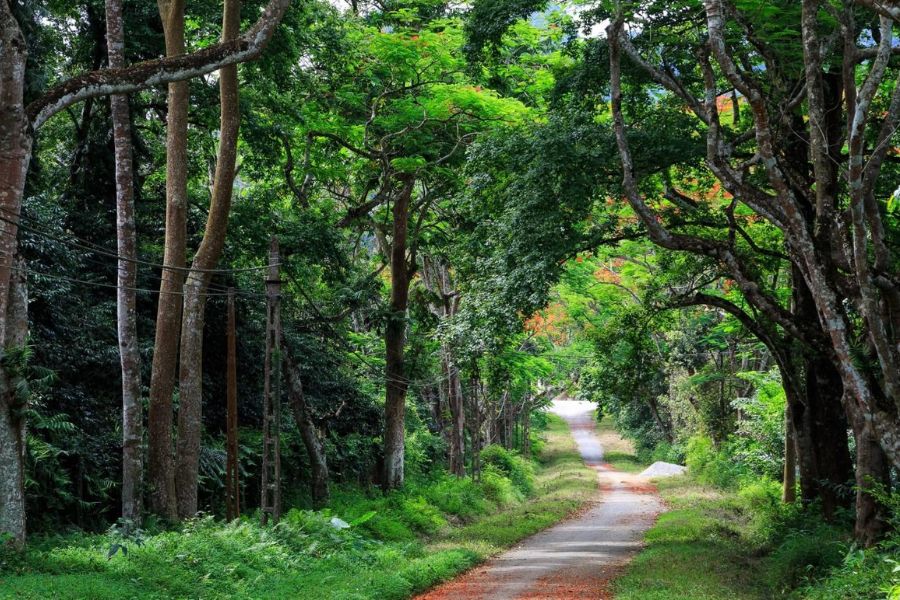
If you are driving or riding a motorbike, one of the easiest ways is to take the CT01 highway, take National road 1A from Phu Ly to Provincial road DT477, which goes south to Cuc Phuong National Park. Another scenic alternative route is via the Ho Chi Minh Highway.

From Ninh Binh city, to get to Cuc Phuong, you will go by Trang An and Bai Dinh Pagoda, which are about 15 km before Cuc Phuong. After passing Bai Dinh Pagoda, you take the road behind Bai Dinh’s parking area and drive for around 25 km to the park entrance. This road is nice, wide, and not heavily trafficked, which has made for pleasant and easy driving.

the green road in Cuc Phuong National Park

By public transport

For travel via public transport, there is a 35-seat bus operated by the park, which leaves daily from Giap Bat Bus Station in Hanoi to Cuc Phuong National Park at 3:00 PM, and returns from Cuc Phuong to Hanoi at 9:00 AM.

Other buses regularly take passengers to Nho Quan District from My Dinh bus station and Giap Bat bus station, where you can take a taxi or motorbike taxi, or a local bus to the park.

Things to Know Before Traveling to Cuc Phuong National Park

Before heading off on your expedition to Cuc Phuong National Park, it is always good to be as prepared as possible for the natural environment. Here are just a few helpful tips to make sure your journey will be safe, as well as satisfying:

  • Wear light-weight breathable clothes, long-sleeved shirts, and long pants will help prevent leech and insect bites.
  • Wear solid footwear with a flat sole that is good and solid for trekking around in a forest.
  • Bring insect repellent spray and a basic first-aid kit.
  • If you stay overnight or you will be exploring for several days, pack a basic flashlight, a whistle, a pair of binoculars (for birdwatching), and any personal gear you may require.
  • The park attracts many people during the butterfly season in April, so make sure to book accommodation first if you are not camping.
  • When you check in, ask for the emergency contact number in case of any unexpected issues.

Final Thoughts: Is Cuc Phuong National Park Worth Visiting?

If you love nature and adventure, Cuc Phuong National Park is certainly a place to visit for you! Consisting of ancient forests, unique wildlife, and a lot of historic sightseeing, it’s a great option if you want to experience life beyond the city to escape to hustle and bustle. Are you ready to take a trip with Seni World and enjoy Vietnam to the fullest now?

Hoa Lu Ancient Capital: Impressive Vietnam’s First Royal City

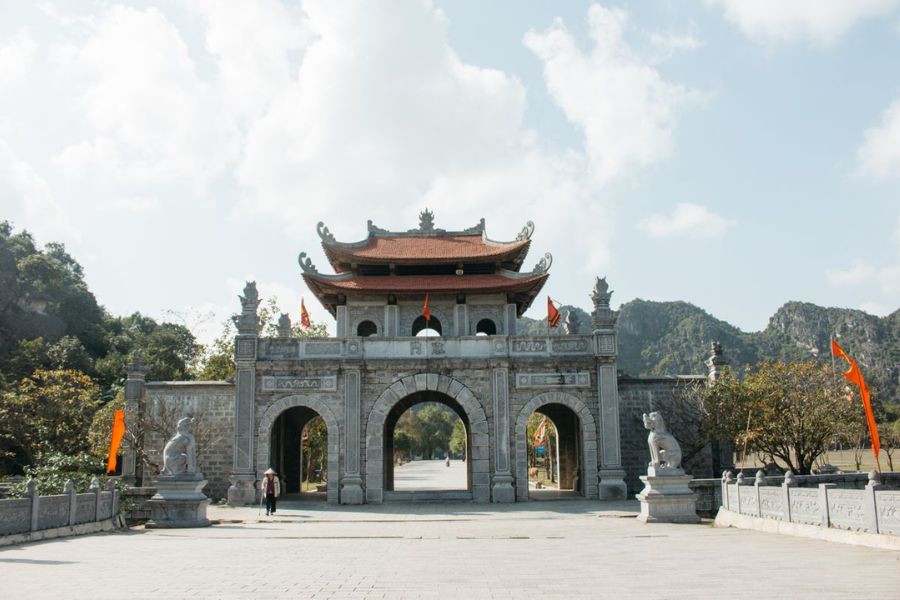
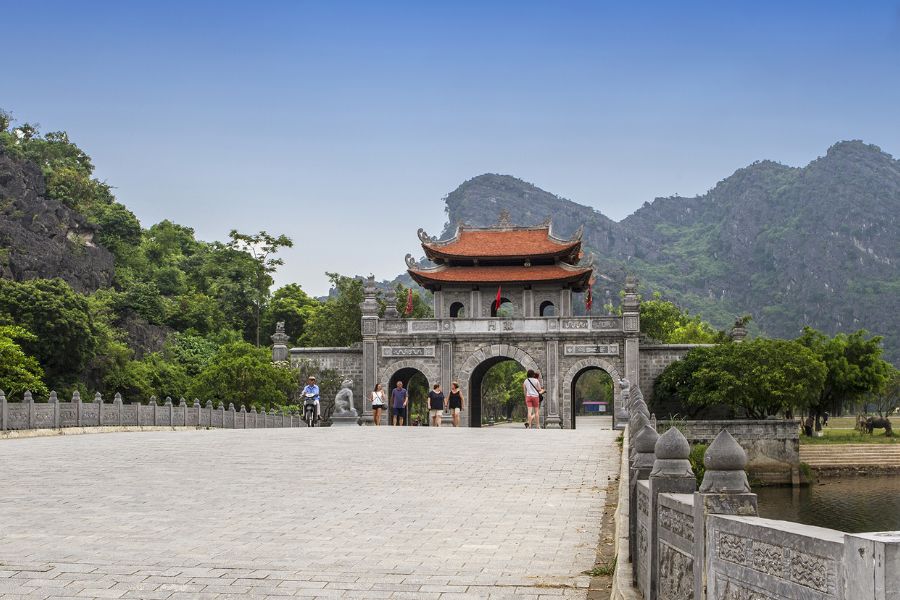
Located in Ninh Binh province, Hoa Lu Ancient Capital was the first capital of Vietnam in the 10th century. The surrounding mountains and rivers played an important role in shaping Vietnam’s beginning history and royal heritage.

Introduction To Hoa Lu Ancient Capital

Located in Ninh Binh Province, Hoa Lu Ancient Capital is a perfect destination for anyone interested in history or culture. Hoa Lu was once the political and cultural center of Vietnam in the 10th and 11th centuries. It was the first capital of the Dai Co Viet kingdom, led by King Dinh Tien Hoang and King Le Dai Hanh. Today, it is a national heritage, loved by Vietnamese citizens, that shows some of Vietnam’s heroism through its temples, stone architecture, and rural landscape.

Go To Hoa Lu Ancient Capital in ninh binh

Visitors come to Hoa Lu to see not only the ancient temples and antiquities, but to feel the sense of national pride that resonates throughout the complex. The complex is surrounded by many limestone mountains that formed a natural protection for Hoa Lu from Ancient Vietnam’s enemies. People visiting Hoa Lu feel the past in many ways, traveling through century-old pagodas or serene steps close to ancient villages. When visitors go to Hoa Lu Ancient Capital, they feel the connection to an era of dynasties, legends, and nationally aligned citizens.

History Of Hoa Lu Ancient Capital

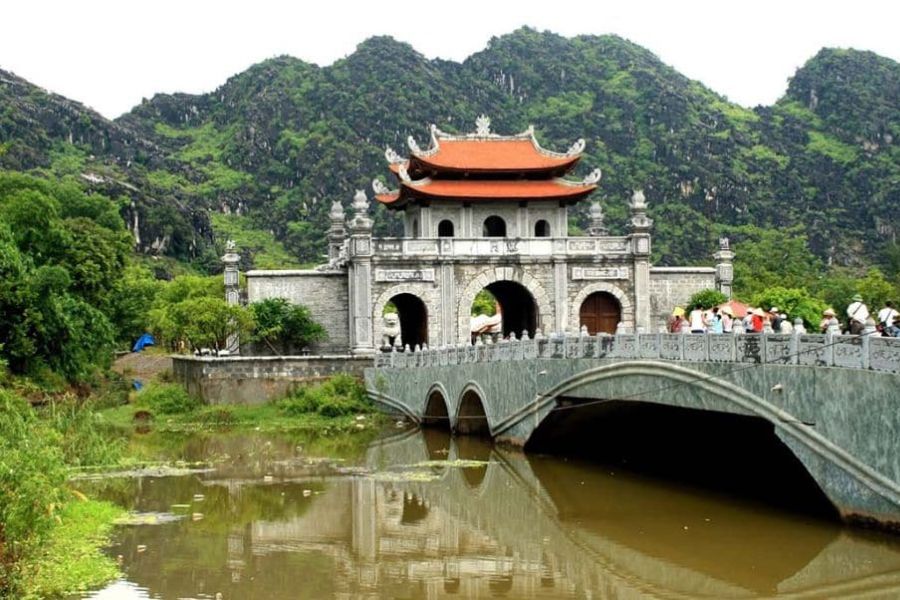
Hoa Lu Ancient Capital occupies a pivotal place in the history of Vietnam as the first independent and unified capital of Vietnam. For 42 years (968-1010), Hoa Lu served as the political and military centre of the nation. This land saw the rise of King Dinh Bo Linh, the King who vanquished the Twelve Warlords, unified the pathway for the country, and founded the Dai Co Viet kingdom. Under Dinh (968-980) and Early Le (980-1009) (941-1026), Hoa Lu was the royal capital. Hoa Lu, protected by towering limestone mountain ranges or ranges and by the Hoang Long River, was an ideal place for protection, control, and power.

Hoa Lu Ancient Capital

In 1010, King Ly Thai To made the monumental decision to clear the capital and move to Thang Long (present-day Hanoi). King Ly found that Hoa Lu was spatially constrained and pessimistic about the prospects for any expansion. Although Hoa Lu was no longer a political area of significance, there were still significant structures in Thang Long Citadel, built on that would utilize building traditions established during the Hoa Lu period.

Top 5 Iconic Attractions in Hoa Lu Ancient Capital

Hoa Lu Ancient Capital is over 300 hectares of historic architecture, sacred temples, tranquil caves, and century-old relics of royalty. There are three spectrum zones to the site: the special protection zone, the buffer zone, and the tangential monuments, which all illustrate Vietnam’s imperial past.

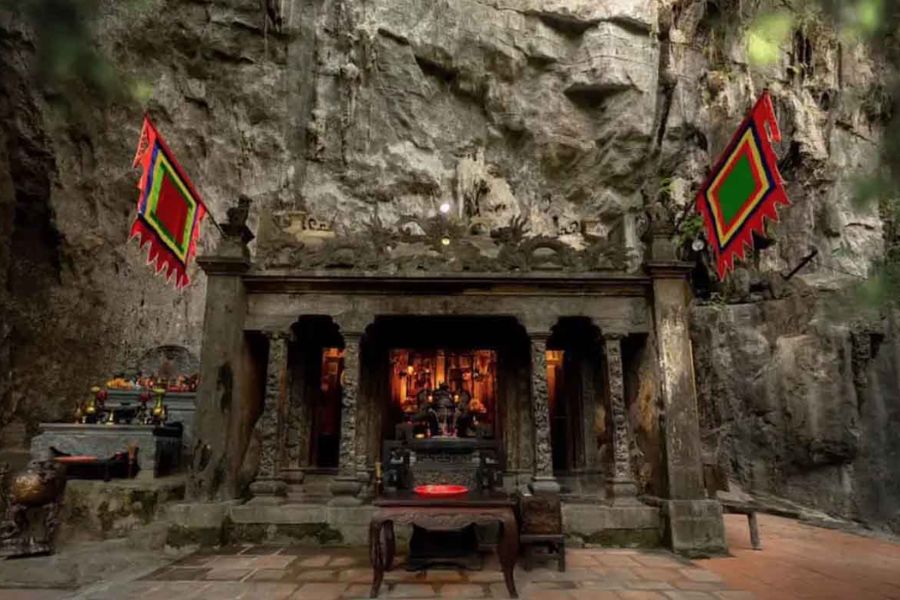
The special protection zone preserves the remnants of the old capital, including the temples of King Dinh Tien Hoang and King Le Dai Hanh, Phat Kim Shrine, Nhat Tru Pagoda, Kim Ngan Pagoda, and the underground palace foundation. Outside of the special protection zone is the buffer zone that features magnificent leafy landscapes to gateway the Sao Khe River and the Trang An Scenic Landscape Complex, with Am Tien Cave, the longitudinal grottos, and several shrines such as Ba Ngo Temple, and Tran Temple.

Additional historically significant sites associated with the Dinh Dynasty legacy, such as the ancient Bai Dinh Pagoda, Hoa Lu Cave, and the worship Halls for King Dinh Bo Linh, add to the landmark in delineating the intricacy and deliberate magnificence of Vietnam’s illustrious dynastic epoch.

Hoa Lu Ancient Capital has a rich history and has been built over a long period with many cultural and religious remains below:

Temple of King Dinh Tien Hoang

overview of Temple of King Dinh Tien Hoang Hoa Lu

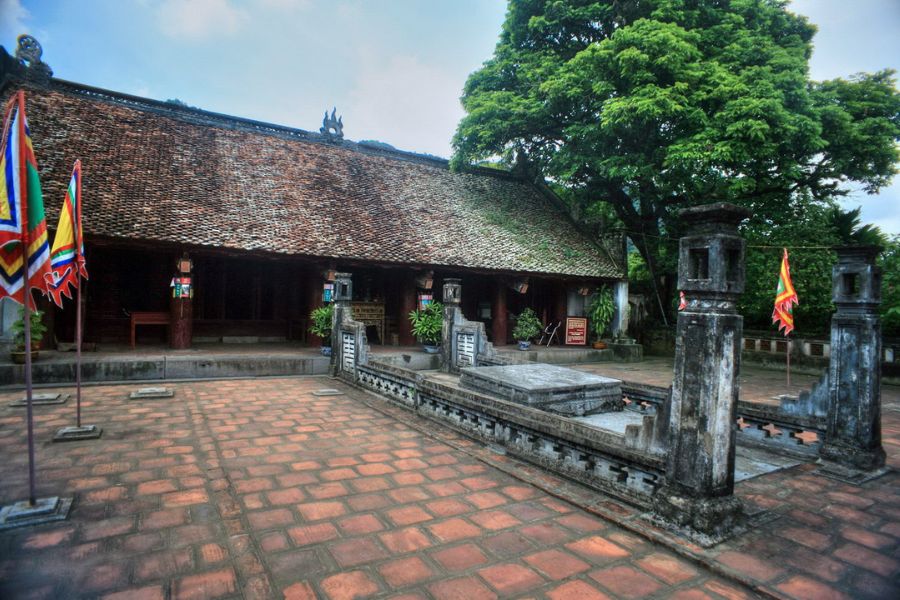
The Temple of King Dinh Tien Hoang is located in Truong Yen Commune and was built to commemorate King Dinh Tien Hoang, who created the Dinh Dynasty. The temple is located at the foot of Ma Yen Mountain. The Temple of King Dinh Tien Hoang reflects Vietnamese architecture with ancient royal palace-style features. Tourists will see intricately carved wooden and stone columns, mythical creatures, and authentic artifacts such as stone thrones and elephant statues.

There are a number of impressive building features and sites located on the property, including the outer gate, lotus pond, gardens, ceremonial halls, and main sanctuary, which displays statues of the king and his sons. The temple is a sacred site for a religious purpose, but it is also a collection and a preserve of 17th-century Vietnamese fine arts.

Temple Of King Le Dai Hanh

Temple Of King Le Dai Hanh Hoa Lu

About 500 meters from King Dinh’s temple is the Temple of King Le Dai Hanh. Although modest in scope, it is rich in culture and history. The complex consists of three main dependencies, with the main altar enshrining King Le Dai Hanh. The side altars enshrine King Le Dai Hanh’s son Le Ngoa Trieu and Queen Duong Van Nga.

Behind the Temple, you can still see remnants of the ancient royal moat and old palace grounds. There is a small museum beside the Temple with preserved ceramics and artifacts about this time that match its lifestyle with the art of the time.

Temple of Princess Phat Kim

The Le Dai Hanh Temple and the Nhat Tru pagoda are the humble but respected Temple of Princess Phat Kim, daughter of King Dinh Tien Hoang. The Temple attempts to honour her virtues of dedication and fortitude during the chaotic period of the 10th century, to symbolize the devotion and strength of Vietnamese women in history as daughters and mothers.

The area is a culturally and spiritually sacred site for those seeking it for peacefulness and respect to a princess, whose good name persevered through significant historical pains that call for recognition in the building of the early Vietnamese state.

Hoa Lu Four Guardian Temples (Hoa Lu Tu Tran)

Hoa Lu Four Guardian Temples (Hoa Lu Tu Tran)

The Hoa Lu Four Guardian Temples were built to protect the ancient capital from all sides. Each temple worshiped a guardian deity, which is a reflection of the syncretism of folk beliefs and the deep spiritual traditions of Vietnamese culture. The temples feature unique architecture with stone columns featuring many carvings and yards that are themselves shrouded in legends.

For the purposes of worship, the temples also symbolize Vietnam’s pride in its enduring culture. They also illustrate an unfading faith in concepts of spiritual protection as well as co-existence, and co-dependence on the natural world in spirit.

Nhat Tru Pagoda

As one of the oldest pagodas in Vietnam, Nhat Tru pagoda is known throughout the country for the unique one-stone pillar of Buddhist scriptures. The pagoda dates back to, built during the Dinh Dynasty period. Nhat Tru is the spiritual center of Hoa Lu.

The tranquil atmosphere, traditional wooden structure, and ancient trees make it an ideal place for spiritual reflection. Most visitors come here not just to take photos, but they also hope to soak in some of the calm energy, which has washed over the sacred site for over a millennium!

4 Cultural Experiences You Shouldn’t Miss

While visiting Hoa Lu Ancient Capital, you are not only visiting a historical site but the chance to immerse yourself in the culture of Vietnam. From colorful festivals to regional cuisine, these are the cultural experiences to immerse yourself in.

Participate In Hoa Lu’s Traditional Festivals

Experience the festive nuances of Hoa Lu by attending some of its festivals! The largest is the Truong Yen Festival, or Hoa Lu Festival, which takes place annually in the third lunar month to commemorate King Dinh Tiên Hoàng and King Le Dai Hanh with great processions, offerings of incense, and display of art forms such as cheo and hat van. These festivals not only provide a glimpse of Hoa Lu’s history but also the community’s pride in their heritage.

Taste Hoa Lu’s Local Foods

some kind of Hoa Lu food

A trip to Hoa Lu would not be complete without tasting its food! Signature dishes, such as the Ninh Binh mountain goat, which can be eaten grilled or steamed, with crispy rice, exemplify the region’s culinary excellence. Don’t forget other local favorites, which include fermented shrimp paste from Gia Vien or Kim Son’s pork ball noodle soup. Each dish had a story to tell, as each was cultivated locally and delicately crafted by master hands; each meal became an experience of culture.

Visit the Ancient Pagodas and Temples

Throughout Hoa Lu, the ancient temples and pagodas, such as Dinh and Le Temples, summarise the spiritual heritage of Hoa Lu. Set in the limestone karst landscapes of Hoa Lu, these sacred sites highlight the serene surroundings and tranquil space where visitors can respect the ancient, imperial history of Vietnam through ancient architecture. These peaceful places are perfect for sightseeing and reflection.

Biking in the Countryside Roads

If you want to experience the beautiful charm of Hoa Lu, rent a bike to cycle through the countryside. You’ll explore the rice fields, limestone hills, small villages, and truly experience the normal way of life in Northern Vietnam’s rural countryside. The great scenery and experience of the atmosphere will create an unforgettable experience for people looking for hidden gems on their travels.

Entrance Fee

It’s worth knowing the ticket prices and any special conditions before visiting Hoa Lu Ancient Capital. Here is the current ticket information for 2025:

Service Adult Ticket Price Notes
Entrance to Hoa Lu Ancient Capital 20,000 VND Free for children under 1.2 meters tall
Local Tour Guide (per group) 300,000 VND/group (≤ 20 people) Covers the entire site

Notes:

  • The entrance fee is for King Dinh Temple and King Le Temple.
  • The prices may change during festivals, so look ahead if possible.

Opening Hours

Hoa Lu Ancient Capital in the night

Hoa Lu Ancient Capital is open for visitors all year round, but the opening hours are slightly different according to the season:

Season Opening Hours
Summer 06:00 AM – 06:30 PM
Winter 06:30 AM – 06:00 PM

You can visit Hoa Lu at any time of the year, but spring (February-April) is the best time to visit. This time of year is when several traditional festivals, such as La Temple Festival and Thai Vi Temple Festival, take place, which is a great way to see the ancient capital come alive with culture and ceremony.

Another great time to visit is in May, when we are in the dry season, and the weather is still lovely, and the rice fields start to crop and turn golden. Perfect for a day of sightseeing or photography. You can also enhance your trip by visiting other nearby sites, such as Tam Coc-Bich Dong or Bai Dinh Pagoda.

How To Get To Hoa Lu Ancient Capital

It is easy to reach Hoa Lu using a variety of transportation methods. Travel time typically ranges from 1.5 to 2.5 hours, depending on what you prefer.

travel to hoa lu ancient capital by motorbike

Transport Method Duration Cost Notes
Local Bus 2 – 2.5 hours 70,000 – 90,000 VND Stops at Ninh Binh Bus Station; take a taxi to the site afterward.
Private Car/Taxi 1.5 – 2 hours Toll: 90,000 – 120,000 VND + fuel/taxi fare Via Phap Van – Cau Gie – Ninh Binh Expressway. Convenient and direct.
Motorbike Around 2.5 hours 120,000 – 200,000 VND/day (rental) Suitable for experienced riders; foreigners need an IDP.
Train About 2 hours From 100,000 VND From Hanoi Railway Station to Ninh Binh Station, then take a taxi (≈50,000 VND).

Things to Know Before Traveling to Hoa Lu Ancient Capital

Before you go to Hoa Lu Ancient Capital, here are a few things to take into consideration to help make your visit more comfortable and respectful of the cultural significance of the site of Vietnam’s heritage. The following rules will help you have a pleasant and meaningful time.

  • Dress in modest, comfortable clothing that is appropriate for a historical and sacred site
  • Wear sports shoes or walking shoes, since there will be stone steps and uneven roads
  • Bring drinking water, sunscreen, and an umbrella for unexpected sun or rain
  • Do not litter and help to keep the area clean and natural
  • Check out some of the basic historical information beforehand, so you will understand every aspect you want to visit
  • It is best to go early in the morning to avoid the crowds of people and enjoy the serene environment

Final Thoughts: Is Hoa Lu Ancient Capital Worth Visiting?

Hoa Lu Ancient Capital offers a tranquil and historic area with ancient temples, mountain landscapes, and the memories of Vietnam’s first kings. This is a perfect stop for travelers seeking culture and quaintness. Let Seni World take you there!

Van Long Nature Reserve – Vietnam’s Wetland Wonderland

Van Long Nature Reserve is a tranquil wetland in Ninh Binh, featuring serene waters, breathtaking limestone cliffs, and endangered animals. For nature lovers seeking a peaceful retreat or an escape from crowded tourist areas, Van Long Nature Reserve is ideal.

Introduction To Van Long Nature Reserve

Going for a boat ride in Van Long Nature Reserve

The Van Long Nature Reserve, found in Ninh Binh, is a quiet place to enjoy nature with its cool water and huge limestone cliffs. Compared to other higher-profile tourist destinations, Van Long is a much quieter and more natural experience, and no matter what you’d like to do in the park, there is enough peace to please everyone.

As we drifted along in our boat across the still water of the wetland, it felt like we were floating through a watercolor painting. We spotted some ancient langurs, birds, and intriguing rock formations. If you want a peaceful escape from tourists, visiting Van Long is one of the best things to do in Ninh Binh to discover in northern Vietnam.

History Of Van Long Nature Reserve

Sunset in the Van Long Nature Reserve

The Van Long Nature Reserve was formed after a large flood control project was undertaken by local people in Gia Vien District, Ninh Binh Province. By constructing a dyke more than 30 kilometers along the left bank of the Day River to protect their homes and farmland from annual floods, the dyke accumulated rainwater and river overflow, and the dry terrain became a gigantic shimmering wetland. Nature took its course, and the area evolved into a diverse ecosystem boasting rare species and exquisite scenery.

Now Van Long is not only the largest wetland nature reserve in northern Vietnam, but it is also a peaceful haven of natural beauty. The surface of the water has a mirror effect; limestone mountains tower above, and ornithological caverns are hidden away, making Van Long a popular destination for naturalists, ornithologists, and eco-tourists.

Unique Architecture Of Van Long Nature Reserve

Van Long Wetland Reserve has an extremely fresh natural landscape, which is shaped by an abundance of wetland ecosystem habitats and also by the limestone mountains bordering the wetland.

  • Rich diversity of wetland ecosystems: Van Long has a notable diversity of wetland ecosystems and is home to a plentiful abundance of plant and animal species, especially waterbirds.
  • Rich diversity of flora and fauna: Van Long contains birds, including the white stork, large and medium herons, pond herons, snipes, snails, and other wildlife.
  • Diverse terrain: The wetland is surrounded by limestone mountains, encapsulating the wild and majestic charm, creating the raw poetic tones felt by visitors.
  • “A lake without a wave” landscape: On account of the specific terrain surrounding the wetland, the water surface of Van Long often remains calm and mirror-like, thus calling it “the wave-less bay.”
  • Attractions inside the reserve: There are many natural attractions to view, including caves and limestone rock, and also freshwater wetlands that are great for eco-tourism or a love of nature.

6 Cultural Experiences You Shouldn’t Miss

Van Long Nature Reserve is so much more than beautiful scenery, a place of distinction, culture, and memories you will not forget, surrounds you. Below are some must-see cultural aspects during your trip.

Go For A Boat Ride In The “Bay Without Waves”

Go For A Boat Ride In The “Bay Without Waves”

Sometimes Van Long Nature Reserve is referred to as the “bay without waves.” The derivation of this name is apparent the moment you sit in a boat and glide across the incredibly still surface of the water. The pollution-free water is so lucid and calm that it reflects the sky and surrounding limestone hills like a giant, natural mirror. You could see underwater plants and algae that looked like coral reefs right through the water, directly from your seat in the boat.

Going for a boat ride is a wonderful way to slow down and connect with nature. The boat ride takes you to picturesque spots like Meo Cao Mountain, Mam Xoi Mountain, and Da Ban Mountain, each with its own name, character, and story.

Explore the Spiritual Site Surrounding The Reserve

The nature reserve is also a place to immerse yourself in the vibrant local culture of the area. Discover spiritual sites to explore in the vicinity of the reserve. Take the time to explore places like Thanh Son Pagoda, Dich Long Temple, and the Temple of the Holy Mother. They provide a calm and peaceful respite from the sightseeing, it’s a great opportunity to take in a little history, whilst exploring traditional Vietnamese architecture, showing centuries of passion and personal devotion.

Whether you are spiritual or just a naturally curious person, these sacred sites are worth a visit. Many people arrive at these sacred sites to make offerings, pray for calm, or simply to listen to local stories passed down through generations. Visiting these spiritual sacred sites is a calm and quiet experience, added to your journey in Ninh Binh.

Explore Enchanting Caves Around Van Long

Explore Enchanting Caves Around Van Long

Van Long boasts a remarkable treasure of over 1,000 caves, most of which you can access from the boat trip. Inside, you will find beautiful stalactites, stalagmites, and natural sculptures formed by both time and moisture. The cool air, stillness, and soft light made for an ethereal space.

Famous caves of Van Long include Ca Cave, Rua Cave, Chanh Cave, and Bong Cave. Each will offer a little something different. If you’re an explorer or simply want to experience something beautiful and unexpected, you will leave with lasting memories of this experience and a feeling of delight.

Enjoy Some Local Rural Life

Spending time in the rural areas surrounding Van Long is a great opportunity to engage with the reality of life for Ninh Binh’s people. Many local people are still engaged in traditional forms of farming and fishing, along with local handicrafts. You can walk or bike around local villages, look out over rice paddies that go on to the horizon, and watch farmers working with buffalo or hand-harvesting crops.

If you are fortunate, you may be invited into a local family home to enjoy a meal with them, or even get involved with simple daily tasks. Moments such as this, whether it be helping in the garden, talking to local elders, or watching kids swim in the river, also create moments of simple joy. It is a good reminder to slow down, and a moment to feel situated, more specifically within the Vietnamese countryside, and practice the art of living in this way.

Spotting Delacour’s Langurs In Van Long Wetland

Spotting Delacour's Langurs In Van Long Wetland

One of the most memorable things to do in Van Long Nature Reserve is to see the rare Delacour’s langurs, also called the “white-short langurs” because of their markings. This is the only place in Vietnam for the most well-known population, with about 200 individuals. The best time to see them is in the early morning or late afternoon when the langurs are active. With a little patience, most visitors will see them swinging around in groups off the limestone cliffs and gliding along rocky ledges in search of food.

The unique karst landscape, with the lush limestone mountains isolated and surrounded by water, is perfectly suited for not only the langurs but also for countless other plant and animal species. Even rare insects such as the giant water bug are still found here, nearly extinct in Vietnam. During certain seasons, flocks of white storks migrating in the thousands take their rest in the reed beds, and it is a sublime experience to watch them collectively take flight at sunset, in such perfect synchrony in the golden hours of light.

Exploring Meo Cao Mountain In Van Long

Exploring Meo Cao Mountain In Van Long

One of Van Long’s most iconic natural sites is Meo Cao Mountain. A limestone prominence with a unique shape, the sheer walls of the mountain illustrated by long blemishes, some resembling claw marks, origin of its name “Meo Cao” (or “Cat Scratch”). The mountain is on its island, standing 150-200 meters straight up from isolation, and is completely different from its surroundings, something that intrigued both local people and visitors for generations.

Meo Cao has ancient rock paintings made with “ochre,” a natural iron oxide pigment with tree resin. When cascaded with water, the red-tinged images are revealed, where you can see the fearsome outline of a man, as well as a series of pictographic characters. The unknown images are suggested to be an executioner from the past who wore a mask so that the spirits of the dead would not be able to come back and trouble him.

Entrance Fee

When you arrive at Van Long Nature Reserve, you must purchase an entrance ticket and a boat ticket. Below is the detailed price list with discounts for children and the elderly for easy reference:

Ticket Type Adults Children (under 1m) Seniors (60+)
Entrance Fee 20,000 VND/person 20,000 VND/person 10,000 VND/person
Boat Ticket (per trip) 50,000 VND/trip 25,000 VND/trip 25,000 VND/trip

Best Time To Visit Van Long Nature Reserve

lotus and bamboo bridge in Van Long

Van Long Nature Reserve is open to visitors at all times of the year, and every season has a distinctive appeal. In the summer months of May and June, if you wish to see the lotus flowers, it is beautiful, as the wetland is transformed into a land of pink paradise with blooming lotus flowers on the water at a time for all photography enthusiasts.

If you are interested in birds, the dry months from November to April are ideal since the north as these migratory birds arrive to nest. The wetland will come to life as a form of motion to what begins as a very tranquil scene.

If you want to enjoy the quietness of the wetland, the best time is early morning. The fresh air and serenity of dawn make for a memorable experience. If you are pursuing sunsets in late afternoon, the golden glows on the water will seal in what appears to be a wonderful beauty.

How to Get to Van Long Nature Reserve

From Ho Chi Minh City or Hanoi to Ninh Binh

There are multiple ways to get to Ninh Binh, based on your departure point. If you are coming from Hanoi, you can travel by bus, motorbike, or train. The train ride from Hanoi to Ninh Binh is about 2 to 3 hours in duration and quite inexpensive. If you are departing from Ho Chi Minh City, the easiest way is to fly into Hanoi and then travel by land from there.

Buses are the most common form of transport for travelers heading to Ninh Binh. Well-known companies like Thanh Hung and Hoang Long offer direct routes with incredible reliability and acceptable prices.

From Ninh Binh City to Van Long Nature Reserve

When you arrive at Ninh Binh, you can rent a motorbike or car to travel to the Van Long Nature Reserve. The distance from Ninh Binh’s city center to the nature reserve is around 10-15 km, and the roads are generally smooth and easily traversable.

Things to Know Before Traveling to Van Long Nature Reserve

lotus and bamboo bridge in Van Long

Before setting out to discover the peaceful waters and wild nature of Van Long, some preparation enhances your trip. Here are some tips to help your trip be safe, smooth, and fun:

  • Pack an extra light jacket, sun protective clothing, a wide-brimmed hat, and/or an umbrella to help stay cool in the strong embrace of sunlight.
  • Bring sunscreen because you do not want a deep tan when your experience is through!
  • Insect repellent is necessary, especially if you plan to be in nature for a certain amount of time.
  • If you plan to explore caves, bring a flashlight or stay until dark.
  • When you take a boat trip through the reserve, you should wear a life jacket as a precaution and follow safety instructions.
  • Bring a bottle of water and a few light snacks to eat while you are exploring, especially if you are traveling with family or friends!

Final Thoughts: Is Van Long Nature Reserve Worth Visiting?

Van Long Nature Reserve is a must-visit if you’re after a tranquil and picturesque escape in Ninh Binh. With its tranquil wetlands, spectacular limestone hills, and rare wildlife like the Delacour’s langur, you’re assured to have a quieter experience away from the crowds. Get in touch with Seni World today to start planning your Vietnam tour!

Mua Cave: Beautiful Viewpoint From The Mysterious Summit

Mua Cave, or “dancing cave,” is a brilliant destination for travelers to see natural beauty from a wide viewpoint and uncover wonderful spiritual points. The Seni World travel guide will show you its history, attractions, and essential travel tips.

Introduction To The Mua Cave

overview of Mua Mountain

Mua Cave is located at the foot of Mua Mountain in Ninh Binh Province, and is one of the most scenic and cultural destinations in the Northern Vietnam itinerary. This place is regularly called the “mini Great Wall of Vietnam” because of its iconic stone stairway with nearly 500 Mua Cave steps. Visiting here, you can see the breathtaking panoramic views of the Tam Coc rice fields, huge limestone karsts, and winding, beautiful rivers from the summit. The Mua Cave combines natural splendor, cultural background, and peaceful atmosphere.

History Of The Mua Cave

The history of Mua Cave is deeply tied to the legends of the Tran Dynasty of Vietnam in the 13th century. At this time, King Tran Nhan Tong is thought to have arrived in the vicinity to relax and watch court dancers dance, which is called “mua” in Vietnamese. Over time, Mua Cave is still a quiet, sacred area until modern tourist activities highlighted its nature and impressive ancient attractions. Therefore, it has changed into one of Ninh Binh’s most iconic and visited points of interest nowadays.

Top 5 Iconic Attractions In The Mua Cave

Mua Cave, or “dancing cave,” is a brilliant destination for travelers to see natural beauty from a wide viewpoint and uncover wonderful spiritual points. Here are 5 iconic attractions of the world-famous Mua Cave in Ninh Binh for travelers:

Mua Cave Itself

Despite being regularly overshadowed by the Mua Mountain climb, Mua Cave is worth exploring. Mua Cave has the meaning “dancing cave”, a name that originates from royal dance performances since the Tran Dynasty of Vietnam. The Mua Cave is exceedingly small but has unique stalactites, pleasant cool air, and wonderful historical meaning. Therefore, it is one of the intriguing stops as well as things to do in Ninh Binh before or after the interesting hike.

The Stairway To The Dragon Peak

Stairway To The Dragon Peak of Mua Cave Ninh Binh

The most symbolic point of Mua Cave is the stone stairway that winds up to the pinnacle of Ngoa Long Mountain. Consisting of almost 500 steps, the road is flanked by carved stone dragons and phoenixes, drawing an ancient and mysterious vibe. When reaching the top, travelers can see panoramic views of the Tam Coc rice fields, huge limestone karsts, and poetic, winding rivers. They are all captivating scenes in Ninh Binh.

The Stone Dragon Sculpture

Climbing to the top of the Ngoa Long Mountain of Mua Cave, you will witness the famous stone dragon sculpture, which is considered an impressive guardian who watches over the landscape of this place. Carved in the conventional style of Vietnamese imperial dragons, this sculpture is not only an image of protection, but it is also a photogenic centerpiece. Many vacationers reach this point to take memorable photos with the dragon, in particular during sunrise or sunset, while the lighting becomes magical.

The Lying Lady Buddha Statue

In the middle of hiking or close to the base of the Mua Cave region, you can have an opportunity to see the serene statue of a lying Lady Buddha (Phat Ba Quan Am). This religious monument presents a peaceful presence amid the thrilling and challenging climb and is a spot where visitors frequently pause to reflect or respectfully make offerings. It highlights the Buddhist effect and peaceful vibe of the Mua Cave Complex.

Viewpoint Overlooking Tam Coc Valley

Viewpoint Overlooking Tam Coc Valley from Mua Cave

At the peak, travelers can have a chance to see one of the best perspectives in Vietnam from the Mua Cave viewpoint, including the whole view of Tam Coc’s rice paddies, beautiful rivers, and huge karst formations. This viewpoint is especially popular during the rice harvest season in Ninh Binh (from May to June), when the fields change into golden yellow. The comparison between natural splendor and cultural history makes the Mua Cave viewpoint a true highlight of any journey to Mua Cave.

5 Cultural Experiences You Shouldn’t Miss In The Mua Cave

Not only can you explore mysterious Mua Cave, but you can also learn more and revel in cultural activities in this well-known destination. Here are 5 cultural experiences you should not miss when visiting the beautiful area around Mua Cave:

Traditional Music Performances At The Foot Of The Cave

At some particular seasons or at the peak of traveller seasons, or when there are some local events, local artists will perform traditional Vietnamese tunes at the foot of Mua Cave. Some unique Instruments like the Dan Bau (monochord) or Dan Tranh (zither) create a soothing vibe. So travelers, especially global travelers, can enjoy Vietnam’s rich musical heritage as they relax before or after the hike.

Wearing Traditional Vietnamese Costumes For Photoshoots

Taking Photoshoots in Mua Cave

As an exciting cultural experience, many tourists rent Ao Dai, the traditional clothing of Vietnam, or different conventional costumes such as Ao Tu Than or ethnic apparel to take various cultural photos around the lotus ponds and scenic spots of Mua Cave. This immersive level allows travelers to no longer appreciate the Vietnamese lifestyle and culture but to embody it, creating memorable and meaningful moments.

Exploring The Lotus Pond And Bamboo Bridge

Lotus Pond And Bamboo Bridge in Mua Cave

Close to the entrance to Mua Cave is an attractive lotus pond with a beautiful curved bamboo bridge crossing over it. Vacationers can stroll across this bridge even as they admire blooming lotus vegetation — a powerful image in the Vietnamese lifestyle. This image represents purity, resilience, as well as enlightenment, and a tranquil enjoyment that connects breathtaking nature with proudly traditional Vietnamese aesthetics.

Trying Local Ninh Binh Specialties

Local Ninh Binh Specialties

The region surrounding Mua Cave has many different delicious dishes consisting of Com Chay (Crispy Rice), De Nui (Mountain Goat), and Canh Chua (Sour Soup). Don’t forget to enjoy these local specialties after a long climb. This is not only about local foods, but additionally a way to understand more deeply about the culinary culture of Ninh Binh and find out about local farming, as well as meal traditions.

Visiting Nearby Temples And Altars For Offerings

Scattered around the Mua Cave area are small spiritual shrines and altars where local people and vacationers usually burn incense and leave offerings. Taking part in or gazing at these simple rituals gives a great insight into Vietnamese religious practices, consisting of ancestor worship and the honoring of deities related to nature, being an image of protection, and prosperity.

Entrance Fee Of The Mua Cave

Here is a table that Seni World has collected the Mua Cave entrance fee. These fees can slightly vary according to the real-time travel season:

Ticket or Service Price Notes
Adult ticket 100,000 VND Apply for both local and global travelers.
Child ticket under 1m in tall Free
Parking – Motorbike 10,000 to 15,000 VND Remember to pay only at the official parking inside the gate. You need to avoid roadside scams.
Parking – Bike 5,000 VND
Parking – Car 30,000 VND

Opening Hours Of The Mua Cave

Mua Cave Ninh Binh viewpoint

Seni World has also summarized all Mua Cave opening hours for travelers. Thanks to them, you can arrange a comfortable and suitable trip to this iconic destination in Ninh Binh:

  • Daily: 06:00 AM to 07:00 PM.
  • Earlier access: from 05:00 AM. You need to ask the guards to let you in early for sunrise views.

The peak seasons (from October to April), during Spring and early Summer (from March to June), are the best times to visit Ninh Binh and Mua Cave. This is the reason why the open hours of this place can be different, so you need to ask the manager of this attraction before booking the ticket to visit.

How To Get To Mua Cave

In this Ninh Binh itinerary to the Mua Cave, you should select the right way to get to this attraction to be comfortable and have a low price. Here are hints from Seni World about how to get to the well-known Mua Cave in Ninh Binh:

Mode Of Transport Typical Travel Time (From Hanoi Or Nearby Areas) Estimated Cost (VND) Notes
Limousine bus (from Hanoi to Mua Cave) 2 to 2.5 hours to the direct drop-off About 250,000 to 300,000 VND per person It is convenient and comfortable, and drops you near the entrance gate.
Train (from Hanoi to Ninh Binh) and then taxi About 2 hours by train, and then about 15 minutes by taxi About 112,000 to 140,000 VND for a train, and about 150,000 to 200,000 VND for a taxi You can choose the soft-seat AC trains to Ninh Binh Station. Then, book a taxi to Mua Cave.
Bus (a local service from Hanoi) 2 to 3 hours to Ninh Binh, and then a taxi About 70,000 to 80,000 VND for a bus, and about 100,000 to 150,000 VND for a taxi This is a budget option. You will take a bus to the city, then a local taxi onward.
Motorbike (local areas, Tam Coc or Ninh Binh) About 10 minutes from Tam Coc, and 20 to 30 minutes from Ninh Binh About 100,000 to 150,000 VND, and 10,000 VND for parking You can have a chance at scenic and flexible riding through rice fields.
Bicycle (from Tam Coc) 20 to 30 minutes for a 5 km ride About 50,000 to 100,000 VND per day Let’s unwind on a ride through the countryside, eco-friendly.
Taxi or private car (Ninh Binh or Tam Coc area) 5 to 30 minutes, depending on the start About 150,000 to 200,000 from the city, and about 15,000 VND per km if metered This transportation is comfortable and good for non‑riders.

Things To Know Before Traveling To The Mua Cave

Mua Cave

To have an interesting, happy, convenient, and safe journey in Mua Cave, you should remember the following important travel tips. These tips will help you explore this destination comfortably, but still respect the culture and protect yourself best:

  • Arriving in the early morning: This time will help you to keep away from crowds, heat, and long, tired strains. At Mua Cave, the stone stairs can be exhausting under the strong sun at midday. Don’t worry when traveling early, because Mua Cave opens from 06:00 am.
  • Protect your skin: Remember to prepare sunscreen, a hat, to protect your skin, and a bottle of water to ensure your body has enough water in the sun.
  • Carry cash: There is no ATM nearby Mua Cave, so let’s bring cash (VND or Vietnam Dong) to pay for tickets, food and drink, and services.
  • Respect all the local customs: You must avoid climbing statues, and remember to wear modest and polite clothing around shrines, as well as not littering.
  • Wear suitable walking shoes: You need to climb more when exploring Mua Cave, so let’s wear secure and comfortable shoes to ensure a safe and pleasant hike.

Final Thoughts: Is The Mua Cave Worth Visiting?

Mua Cave has beautiful nature and is one of the most wonderful attractions for travelers when exploring Ninh Binh. If you want to take a mysterious Mua Cave adventure, as well as consult interesting things to do in Ninh Binh, and receive support for the visa process, let’s contact Seni World, a reputable tour operator from Vietnam. We are here to help you from A to Z on your Mua Cave discovery trip.

Trang An: Halong Bay On Land With Various Wonderful Nature

Trang An, with the name “Halong Bay on land,” is a UNESCO-recognized World Heritage Site, which has wonderful cultural and natural scenery. The Seni World travel guide will show you its history, attractions, and essential travel tips.

Introduction To Trang An

Trang An

Trang An, positioned in Ninh Binh province, is a UNESCO-recognized World Heritage Site and one of the best destinations in the Northern Vietnam itinerary. It is world-famous for its breathtaking natural scenery and rich cultural history, with the name “Halong Bay on land.”

Trang An has a captivating limestone karst network, winding, poetic rivers, mysterious, hidden caves, and lush greenery. For nature lovers, adventurers, and cultural tourists, you can discover this region by boat, gliding through tranquil waterways to see historical temples, hidden grottoes, as well as traditional villages.

History Of Trang An

panoramic view of Trang An, the UNESCO-recognized World Heritage Site

The history of Trang An stretches back thousands of years. There is some archaeological evidence that shows prehistoric people lived in Trang An over 30,000 years in the past. Throughout Vietnam’s feudal generation, particularly the Dinh and early Le Dynasties of Vietnam, Trang An was a strategic area due to its rugged terrain and hidden waterways, whilst Hoa Lu (close to Trang An) was the capital. Nowadays, Trang An is a UNESCO-recognized World Heritage Site for its wonderful cultural and natural values.

Top 5 Iconic Attractions In Trang An

Trang An, a UNESCO-recognized World Heritage Site, is a wonderful destination for travelers to experience natural beauty, enjoy a boat tour, and uncover various spiritual temples. Here are 5 iconic attractions of the world-famous Trang An in Ninh Binh:

Boat Ride Through Limestone Caves

Boat Ride in Trang An

One of the most iconic things to do in Ninh Binh in general and in Trang An in particular is a Trang An boat tour through a network of mysterious caves and waterways. They are surrounded by beautiful, towering limestone karsts as well as plush greenery.

Local rowers in Trang An will take you on a tranquil 2 to 3-hour adventure, slightly flowing through dark, narrow caves, consisting of Hang Sang (Light Cave), Hang Toi (Dark Cave), and Hang Seo (Seo Cave). This is an enthralling mixture of natural beauty, captivating adventure, and great peace.

Investigate Trinh Temple

Trinh Temple is a historical temple, positioned at the doorway to Trang An, and is dedicated to 4 crucial mandarins of the Dinh Dynasty. Surrounded by serene mountains and poetic water, this is an area where travelers often stop to burn incense and pray for luck and success before beginning to delve deeper into the scenery. The Trinh Temple’s historical value and peaceful setting make it a must-visit for international visitors.

Go To Dia Linh Cave and Nau Ruou Cave

Nau Ruou Cave in Trang An

Some of the caves at the Trang An boat tour routes, like Nau Ruou Cave (Wine-Brewing Cave), are very famous for their legend: the local people brewed wine in this place by using water from an underground spring. Nearby, Dia Linh Cave impresses travelers with both dramatic stalactites and unique echoing chambers. Those caves bring a hanging contrast between geology, mythology, and silent beauty.

Discover Tran Temple

Positioned deep in the scenic location, Tran Temple is devoted to King Tran Nhan Tong of the Tran Dynasty, who led Vietnam to victory over Mongol invaders and, after that, became a Buddhist monk. This temple is hidden among limestone cliffs, and visitors can only reach it by boat. The Tran Temple gives a quiet and spiritual vibe to everyone, making it a meaningful and memorable stop on the Trang An adventure as well as the Ninh Binh itinerary.

Visit Kong Island Village

Visit Kong Island Village in Trang An

A unique point of Trang An is the replica tribal village, named Kong Island Village, used in the famous Hollywood film “Kong: Skull Island” (2017). This destination is still maintained as a tourist attraction, with simple thatched huts, cool mock guns, and memorable photo chances with tribal costumes. It gives a fun and cinematic ruin between the spiritual and natural factors of the location.

5 Cultural Experiences You Shouldn’t Miss In Trang An

Not only can you discover Trang An, but you can also learn more and unwind in cultural activities in this well-known destination. Here are 5 cultural experiences you should not miss when visiting the brilliant area around Trang An UNESCO-recognized World Heritage Site:

Climb To Bai Dinh Pagoda From Trang An

Climb To Bai Dinh Pagoda From Trang An

Only a quick ride from Trang An, Bai Dinh Pagoda is Southeast Asia’s biggest Buddhist temple complex. This pagoda will give you a strong cultural immersion. You can choose to arrive at the Bai Dinh Pagoda from Trang An by electric car or boat transfer. After that, let’s climb the stone steps, light incense, and admire many Arhat statues. This time, you can feel tranquil and have a deeply meaningful, complete-day cultural experience.

Visit A Traditional Boat Rower’s Village

There are many local boat rowers in Trang An who have worked for generations. Travelling through their nearby rural villages, you can see conventional Northern Vietnamese life, including home-cooked meals, fresh vegetable gardens, and handmade, special bamboo items. Don’t miss out on the chance to enjoy local tea and communication with the local people here to expand your cultural perspective.

Try Local Specialties In Trang An

Local Specialties In Trang An

Trang An is in Ninh Binh province, and this place is home to the well-known dishes like Com Chay (Crispy Rice) and Thit De Nui (Mountain Goat Meat). When enjoying at a local family-run restaurant, you can not only eat a delicious meal, but you can also taste authentic flavors tied to the land, as well as the farming traditions of this location. Many dishes are served with traditional medicinal herbs or fermented rice wine from Ninh Binh.

Participate In Various Local Festivals

In case you arrive in Trang An in Spring, particularly the Lunar New Year, you will have an opportunity to see or be part of colourful festivals, like the Dinh Tien Hoang Temple Festival. In these festivals, there are numerous exciting activities, consisting of traditional tunes, dragon dances, ancestor worship rituals, and boat processions. They are a mixture of Buddhism, Confucianism, and folk beliefs.

Explore Handicraft Workshops Near Trang An

Close to Trang An, many different craft villages specialize in traditional techniques, including embroidery, stone carving, and wood sculpture. Touring these workshops, you can understand how artisans work, find out how they keep age-old techniques, or even try carving or sewing yourself. Then, don’t forget to buy a handmade souvenir here to help local craftsmanship and keep cultural history alive.

Entrance Fee Of Trang An

Here is a table that Seni World has collected the Trang An entrance fee in general and the Trang An boat tour price in particular. These fees can slightly vary according to the real-time travel season:

Ticket or Service Price Notes
Adult ticket (more than 1.3m tall) 250,000 VND Consists of a standard boat tour (group rowed boat).
Child ticket (from 1.0 to 1.3m tall) 120,000 VND
Children under 1.0m Free
Private boat rental 1,250,000 VND This fee is charged per boat for about 4 to 5 people.
Kayak rental for a single and 2 hours 250,000 VND This is the self-row kayak along the river. There is no access to caves.
Kayak rental for a single and 3 hours 300,000 VND
Kayak rental for a double and 2 hours 350,000 VND
Kayak rental for a double and 3 hours 400,000 VND
Parking fee About 10,000 to 25,000 VND

Opening Hours Of Trang An

festival in Trang An

Seni World has also summarized all Trang An opening hours for you. Thanks to them, you can arrange a comfortable and suitable adventure to this iconic attraction in Ninh Binh:

  • Standard all‑year visitor hours: 07:00 AM to 04:00 PM
  • The ticket booth sales hours: 06:30 AM to 05:00 PM (weekdays) and 06:00 AM to 05:00 PM (weekends).

On Tet Holiday (Lunar New Year), Summer (from May to August), and Winter (from December to February) are the best times to visit Ninh Binh and Trang An Scenic Landscape Complex. This is the reason why the open hours of this place can be different, including:

  • Tet Holiday (Lunar New Year): 06:00 AM to 04:45 PM
  • Summer (from May to August): 06:00 AM to 04:45 PM
  • Winter (from December to February): 07:00 AM to 04:30 PM

How To Get To Trang An

In this Trang An in Ninh Binh itinerary, you should select the right way to get to this destination to be comfortable, as well as have a low price. Here are hints from Seni World about how to get to the Trang An Scenic Landscape Complex in Ninh Binh:

Mode Of Transport Typical Travel Time (From Hanoi Or Nearby Areas) Estimated Cost (VND) Notes
Private Car 1.5 to 2.5 hours About 1,200,000 to 1,800,000 VND This is very convenient and great for communities or families. You can go directly to Trang An.
Public Bus (to Ninh Binh City) 2 to 3 hours About 100,000 to 150,000 VND Buses from Giap Bat or My Dinh bus station will stop at the Trang An Scenic Landscape Complex in Ninh Binh.
Taxi (from Ninh Binh City to Bai Dinh) 15 to 20 minutes About 150,000 to 250,000 VND You can use the taxi after the public bus or train to arrive in Trang An. It is quick.
Train (to Ninh Binh Station) 2 to 2.5 hours About 100,000 to 200,000 VND It departs from Hanoi Station for a scenic route. After that, you will call a taxi transfer to Trang An.
Motorbike (from Hanoi or Ninh Binh City) 2.5 to 3 hours from Hanoi and 10 to 20 minutes from Ninh Binh City About 120,000 to 200,000 VND per day (rental) It is an adventure-friendly selection, scenic but still weather-dependent.
Bike (from Tam Coc or Trang An areas) 30 to 60 minutes About 50,000 VND per day (rental) A great option for local people or nearby travelers with the hilly roads and moderate difficulty.

Things To Know Before Traveling To Trang An

an Iconic Attraction In Trang An

To have an interesting, convenient, happy, and safe journey in the Trang An Scenic Landscape Complex in Ninh Binh, you should remember the following essential travel tips. These tips will help you explore this place comfortably, but still respect the culture and protect yourself best:

  • Prepare suitable walking footwear: In Trang An, especially on a boat tour, it may be wet grounds, so let’s wear secure and comfortable shoes.
  • Protect your skin: Don’t forget to bring sunscreen, a hat, and a bottle of water to protect your skin and ensure your body has enough water in the sun.
  • Traveling in the early morning: This time will help you to keep away from crowds, heat, and long strains. Don’t worry, because the ticket booth of Trang An opens from 06:30 am.
  • The offline Trang An boat tour map: You need to download an offline map of Trang An to know how it runs exactly, so you can prepare to take photos timely.
  • Carry a dry bag: It will help to protect your valuables don’t to getting splashed, especially whilst different boats bypass or if it rains.

Final Thoughts: Is Trang An Worth Visiting?

Trang An in particular, and Ninh Binh in general, is “Halong Bay on land”, which has a beautiful nature, as well as a proudly UNESCO-recognized World Heritage Site. If you want to take a Trang An adventure, as well as consult interesting things to do in Ninh Binh, and receive support for the visa process, let’s contact Seni World, a reputable tour operator from Vietnam. We are here to help you from A to Z on your Trang An discovery trip.

Bai Dinh Pagoda: Spiritual Beauty And Vietnamese Pride

The Bai Dinh Pagoda is a symbolic attraction in Ninh Binh, which has a long history and proudly showcases the religious devotion and culture of Vietnam. Seni World’s travel guide will show you its history, attractions, and travel tips.

Introduction To The Bai Dinh Pagoda

Bai Dinh Pagoda

Bai Dinh Pagoda, located in Ninh Binh province, is one of the wonderful attractions in the Northern Vietnam itinerary. This is a religious and primary pilgrimage site that attracts tens of millions of both local people and travelers every year.

Bai Dinh Pagoda is hidden among lush mountains and scenic landscapes, and is very well-known for its superb scale, peaceful atmosphere, and terrific mixture of historic and modern architecture. Not only does it have a spiritual meaning, but the Bai Dinh Pagoda is also a symbol of the Vietnamese cultural and historical past, as well as the national pride.

History Of The Bai Dinh Pagoda

Bai Dinh Pagoda

Talking about the Bai Dinh Pagoda history, it has a rich record that combines old spiritual roots with great, modern grandeur. The original, old Bai Dinh Pagoda dates back over one thousand years to the Dinh and early Le Dynasties of Vietnam, famous for its connection to Buddhist legends and Vietnamese heroes.

In the early 2000s, a huge new complex was built close by, making it the most important and largest Buddhist pagoda in Southeast Asia. The present Bai Dinh Pagoda was completed in 2003 and features majestic architecture, massive bronze Buddha statues, and wonderful long corridors lined with stone Arhat statues. It symbolizes both religious devotion and Vietnamese pride.

Top 5 Iconic Attractions In The Bai Dinh Pagoda

The Bai Dinh Pagoda is not only a spiritual attraction, but it also has a wonderful long history, as well as showing the proud tradition of Vietnamese religion. Here are 5 iconic attractions of the well-known Bai Dinh Pagoda in Ninh Binh:

See The Giant Bronze Buddha Statue

The Giant Bronze Buddha Statue in Bai Dinh Pagoda

With its 10 meters in height and weighing approximately 100 tons, this surprisingly fascinating bronze statue of the Phat A Di Da (Amitabha Buddha) is one of the largest in Southeast Asia. Housed inside the Phap Chu Hall of the Bai Dinh Pagoda, this statue exudes both spiritual and serenity strength, attracting heaps of visitors who arrive to pay their respects. The craftsmanship is superb, with beautiful carvings and a very peaceful expression, iconic of wisdom and enlightenment.

Investigate The Arhat Corridor

Arhat Corridor or Hanh Lang La Han is stretched over 3 kilometers and is lined with 500 complex and carefully sculpted Arhat statues crafted from monolithic stone. Each statue has a unique expression and posture, which is a unique and valuable story from Buddhist teachings. On foot through the Arhat Corridor is a meditative enjoyment, and travelers can reflect on the great lives and virtues of these enlightened beings.

Visit The Great Bell Tower

The Great Bell Tower or Thap Chuong has a big 36-ton bronze bell, one of the largest in Vietnam. Visiting this place, you can have a chance to hear the sound of the bell resonating throughout the mountains around the Bai Dinh Pagoda. From that, it grows a deep and calming echo that complements the spiritual atmosphere here. Hiking up the tower also brings travelers the whole perspectives of the Bai Dinh Pagoda complex as well as the surrounding huge limestone landscapes of Ninh Binh.

Explore The Stupa

Bai Dinh Pagoda

One of the next things to do in Ninh Binh is to visit the Stupa or Bao Thap in the Bai Dinh Pagoda. This 13-story tower is about 100 meters high and a brilliant landmark seen from afar. The Stupa enshrines relics of the Buddha appreciatively brought from India and Myanmar, so it is a sacred pilgrimage destination. You can take an elevator or try to climb the stairs to the pinnacle to witness the panoramic sides of the Bai Dinh Pagoda complex, as well as the Trang An scenic area.

Discover The Ancient Bai Dinh Pagoda

Positioned on a quiet mountainside close to the present-day complex, the original Bai Dinh Pagoda dates back over 1,000 years. The Ancient Bai Dinh Pagoda has historic temples, cave shrines, and stone statues hidden in a mysterious forested region. This historical site still keeps a magical impression and provides all visitors with a greater, intimate, and traditional Buddhist vibe in comparison to the grandeur of the new pagoda.

5 Cultural Experiences You Shouldn’t Miss In The Bai Dinh Pagoda

Not only can you navigate the Bai Dinh Pagoda, but you can also find out and revel in cultural experiences in this famous destination. Here are 5 cultural experiences you should not miss when discovering the captivating area around the Bai Dinh Pagoda:

Participate In The Bai Dinh Pagoda Festival

Bai Dinh Pagoda

Bai Dinh Pagoda Festival is held yearly from the 6th day of the Tet Holiday (Lunar New Year). This spring festival is one of the greatest vital Buddhist events in Vietnam. Coming to this festival, travelers can see traditional rituals, offerings to ancient deities, ceremonial processions, and folk performances. This is a colourful event that mixes spirituality with local tradition, impressing hundreds of local people and travelers.

Light Incense And Pray At The Giant Buddha Statues

Traveling to the Bai Dinh Pagoda, you can pay your respects by bowing and lighting incense sticks before the enormous bronze Buddhas. It is a deeply religious and cultural practice. Whether or not you are a Buddhist or not, by taking part in this ritual, you will hook up with the spiritual surroundings, reflect in silence, and recognize strongly the religious devotion of the Vietnamese people.

Listen To The Echo Of The Giant Bell

At the Great Bell Tower, you can ask permission to ring the large bronze bell or, honestly, pay attention when monks or temple staff do. The echoing sound of this bell is said to purify the soul and thrust back bad fortune. This simple yet profound moment is a stunning cultural and sacred experience that reflects and showcases the importance of sound in Buddhist practice.

Take Photos With Bodhi Tree Courtyard

bai dinh pagoda

The Bai Dinh Pagoda has a sacred Bodhi tree, originating from Sri Lanka, that stands in this courtyard. This tree symbolizes enlightenment, and travelers very cherish its leaves. The Bodhi Tree is the spiritual connection between the Bai Dinh Pagoda and the place where Buddha achieved enlightenment, beneath a Bodhi Tree in India. Travelers can take admirably memorable photos under this tree.

Try Traditional Vegetarian Cuisine At The Pagoda Complex

Don’t forget to experience a vegetarian meal made by temple chefs or local eateries near the Bai Dinh Pagoda. These foods are no longer scrumptious, but they are also a part of the Buddhist lifestyle, consisting of simple, mindful, and nourishing foods. You can have a chance to enjoy the peaceful setting of the Bai Dinh Pagoda enhances your cultural immersion.

Entrance Fee Of The Bai Dinh Pagoda

Here is a table that Seni World has summarized the Bai Dinh Pagoda entrance fee. These fees can slightly vary according to the real-time travel season:

Ticket or Service Price Notes
Main entrance to the Bai Dinh Pagoda Complex Free The entrance fee is free for both the ancient and new pagoda areas.
Electric shuttle (just one-way) 30,000 VND
Electric shuttle (round-trip) 60,000 VND
The Stupa entrance fee 50,000 to 60,000 VND This is the fee to access both the tower and the observation deck of the Stupa.
Parking fee for a motorbike 15,000 to 20,000 VND This is the fee for secure bike parking.
Parking fee for a car 40,000 to 50,000 VND This is the fee for car parking near the entrance.
Audio guide (optional) About 100,000 VND Multi-language audio guide in 2025.

Opening Hours Of The Bai Dinh Pagoda

bai dinh pagoda

Seni World has also collected all the Bai Dinh Pagoda opening hours for you. Thanks to them, you can arrange a comfortable and suitable journey to this iconic attraction in Ninh Binh:

  • The main complex (general grounds): from 06:00 AM to 10:00 PM
  • The Bai Dinh Pagoda complex (both old and new pagoda areas): from 07:00 AM to 06:00 PM
  • The pagoda complex: from 07:00 AM to 09:00 PM

Spring (from January to April) and early Summer (from May to June) are the best times to visit Ninh Binh and the Bai Dinh Pagoda. This is the reason why the open hours of this place can be different. So you need to confirm with the Bai Dinh Pagoda’s manager in advance.

How To Get To The Bai Dinh Pagoda

In this Bai Dinh Pagoda in Ninh Binh itinerary, you should select the right way to get to this destination to be comfortable, as well as have a low price. Here are hints from Seni World about how to get to the Bai Dinh Pagoda in Ninh Binh:

Mode Of Transport Typical Travel Time (From Hanoi Or Nearby Areas) Estimated Cost (VND) Notes
Private Car 1.5 to 2.5 hours About 1,200,000 to 1,800,000 VND This is very comfortable and best for communities or families. You can go directly to the pagoda gate.
Public Bus (to Ninh Binh City) 2 to 3 hours About 100,000 to 150,000 VND Buses from Giap Bat or My Dinh bus station will stop at the Ninh Binh bus station.
Taxi (from Ninh Binh City to Bai Dinh) About 30 minutes About 150,000 to 250,000 VND You can use the taxi after the public bus or train to reach the Bai Dinh Pagoda.
Train (to Ninh Binh Station) 2 to 2.5 hours About 100,000 to 200,000 VND It departs from Hanoi Station for a scenic route. Then you need a taxi transfer to the Bai Dinh Pagoda.
Motorbike (from Hanoi or Ninh Binh City) 2.5 to 3 hours from Hanoi and 30 to 40 minutes from Ninh Binh City About 120,000 to 200,000 VND per day (rental) This type of transportation is an adventure-friendly choice, scenic but weather-dependent.
Bike (from Tam Coc or Trang An areas) 45 to 60 minutes About 50,000 VND per day (rental) A great option for local people or nearby travelers with hilly roads and moderate difficulty.

Things To Know Before Traveling To The

Bai Dinh Pagoda

To have a happy, interesting, comfortable, and safe journey in the Bai Dinh Pagoda in Ninh Binh, you should remember the following essential travel tips. These tips will help you explore this place conveniently, but still respect the culture and protect yourself best:

  • Bai Dinh Pagoda dress code: Because this is a religious site, you need to wear respectful apparel, which covers your shoulders and knees, and say no to tight or flashy outfits.
  • Carry cash: There is no ATM nearby, so let’s bring cash (VND or Vietnam Dong) to pay for tickets, food, and services.
  • The offline Bai Dinh Pagoda map: You need to download an offline map of the Bai Dinh Pagoda complex to know how to walk easily, as this area is large and complicated.
  • Photograph rules: Taking photos is allowed, but remember, no flash in the pagoda.
  • Be quiet and respectful: Particularly in prayer halls, you must be quiet and respectful. Don’t interrupt all monks or rituals.

Final Thoughts: Is The Bai Dinh Pagoda Worth Visiting?

The Bai Dinh Pagoda is an iconic destination in Ninh Binh, which has a long history, and proudly showcases the religion and traditions of Vietnam. If you want to take a Bai Dinh Pagoda trip, as well as consult interesting things to do in Ninh Binh, and receive support for the visa process, let’s contact Seni World, a reputable tour operator from Vietnam. We are here to help you from A to Z on your Bai Dinh Pagoda discovery adventure.